La chapelle Sainte-Foy, located at 14, rue Jacques Cœur in Montpellier, is a church dedicated to Sainte Foy and commonly known by this name. Its construction dates from the 12th century and it is first mentioned in a legal document dated January 18, 1203. At that time, it bordered the road to Saint-Jacques de Compostelle and was intended to serve the suburb of Flocaria near a city entrance. The building may also have been founded in connection with the construction of a new city wall. In the first half of the 13th century, the church and the suburb were included in the new city enclosure. The original building was likely Romanesque and was repaired around 1380. The site later suffered damage during the Wars of Religion, when it was burned and destroyed by Huguenots in 1562 and 1568. Today, only a few early remains survive, including part of the facade and the base of the lateral walls. The visible elements include undecorated masonry on the facade and a covered passage crossing Jacques Cœur street, one of the last three remaining covered passages in Montpellier.
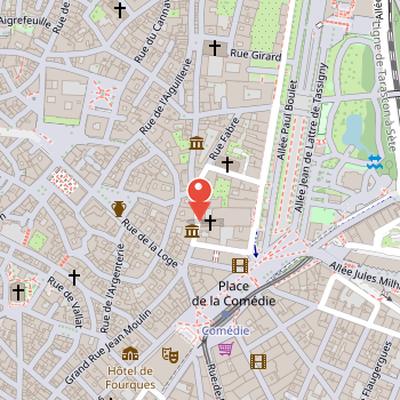
Nearby Objects
-
 Fontaine des Trois Grâces 120 m away
 -
 Comédie Square 120 m away
 -
 Opéra national de Montpellier 200 m away
 -
 Musée Fabre 250 m away
 -
 Esplanade Charles de Gaulle 250 m away
Chapel Sainte-Foy in Montpellier
Commonly called La chapelle Sainte-Foy, this church is located at 14, rue Jacques Coeur in Montpellier and is dedicated to Sainte Foy. Founded in the Middle Ages, it preserves interior features from later periods, including baroque decoration and a coffered painted ceiling dating from the 17th century. The church also has a functional bell dated 1401, which is among its notable surviving elements.
History and architectural features
The construction of the chapel Sainte-Foy dates from the 12th century and was first mentioned on 18 January 1203 in a legal document. At that time, it bordered the road to Saint-Jacques de Compostelle and was intended to serve the suburb of Flocaria near a city entrance. It may also have been founded in connection with the construction of a new city wall. In the first half of the 13th century, both the chapel and the Flocaria suburb were incorporated into the new city enclosure.
The building later acquired additional functions. From 1240, it housed solemn sessions of the Faculty of Arts. Its original structure was likely Romanesque and was repaired around 1380. One of its notable surviving features is an arch crossing Jacques Coeur street, identified as one of the last three remaining covered passages in Montpellier. This arch was built at the end of the 14th century and formed part of Jacques Coeur's mansion. It is sometimes confused with the Arc Pellissier, which was built in 1528.
During the 17th century, the chapel was occupied by the Confraternity of the White Penitents, adding another stage to its long history of religious and civic use.
Destruction, Ruins, and Rebuilding
The early archives of the chapel were destroyed during the Wars of Religion, and very little of the original structure survives today. Only part of the facade and the base of the lateral walls remain from the early building. The chapel was burned and destroyed by Huguenots in 1562 and again in 1568. Its ruins were regarded as strategic because of their proximity to the city wall. They were not restored and instead served as an open-air cemetery for more than fifty years. The present building was later rebuilt on medieval wall bases. Today, the visible parts consist of unornamented facade masonry and a covered passage.
Reconstruction after the 1621 Siege
In 1621, new troubles led to the siege of Montpellier by royal troops, after which the city surrendered. The eastern rampart was razed, and Sainte-Foy lost its military importance. In 1623, Monseigneur Pierre de Fenouillet returned the chapel ruins to the Confrerie des Penitents blancs. The confreres then visited the chapel in procession and planted a cross against its facade. Reconstruction began immediately, and the main structure was completed by Christmas night 1624. The chapel was enlarged towards the east on the site of the former rampart and ditch, and the Penitents were committed to enriching its decoration. The rebuilt chapel was later described in 1632, when Louis XIII and Anne d'Autriche heard mass there.
Interior Decoration and Heritage Status
The interior of the chapel is part of the chapel des Penitents blancs de Montpellier. It was decorated by the Penitents between 1647 and 1698. The interior is also classified as a historical monument by an official order, underlining its protected heritage status.
Public Visits and Access
Visits take place in the chapel owned by the Confrerie des Penitents blancs. Free or guided tours are offered on Saturdays from 15:00 to 19:00. During summer and from December to February, visits for the Creche are available from Monday to Friday, from 16:30 to 19:00. In 2016, these free or guided tours attracted more than an unspecified number of visitors.