Fontaine des Trois Grâces is an emblematic sculptural ensemble in Montpellier, Hérault. Created by Étienne Dantoine in 1777, it represents the Three Graces from Greek mythology, named Aglaé, Euphrosyne, and Thalie. The group depicts the three Charites, daughters of Zeus, associated with Seduction, Beauty, Nature, Human Creativity, and Fertility. Classified as a monument historique in 1963, it holds a notable place in the city’s urban heritage.
The fountain project was decided in 1765 for Place de la Canourgue, and Étienne Dantoine was selected after a three-year process. He traveled to Carrara, Italy, to choose marble blocks, and the Trois Grâces group was later completed in his workshop on rue des Étuves. The sculpture was moved to Place de la Comédie on 19 Floréal Year V and placed on a white marble pedestal from the Monument to Louis XIV at Promenade du Peyrou. After several displacements and modifications, the original marble group was removed in 1989 because of air pollution damage and replaced by a resin cast. The original sculpture is now displayed in the reception hall of Opéra Comédie.
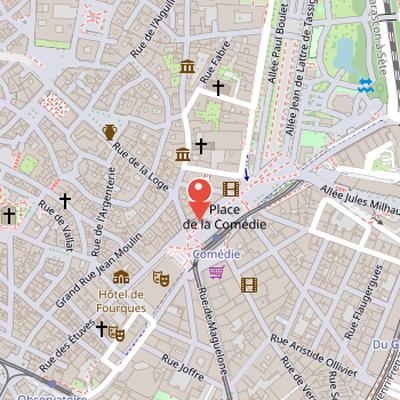
Nearby Objects
-
 Comédie Square 40 m away
 -
 Opéra national de Montpellier 90 m away
 -
 La chapelle Sainte-Foy 120 m away
 -
 Saint-Roch Church 300 m away
 -
 Rockstore 300 m away
The Fontaine des Trois Graces
The Fontaine des Trois Graces is a marble group sculpture created by Etienne Dantoine in 1777. Located on the place de la Comedie in Montpellier, Herault, it is presented here by a resin mold. The ensemble is considered emblematic and was classified as a monument historique in 1963. It represents the Three Graces from Greek mythology, named Aglae, Euphrosyne, and Thalie. As the three Charites, daughters of Zeus, they symbolize Seduction, Beauty, Nature, Human Creativity, and Fertility.
Planning and Creation of the Fountain
In 1765, officials in Montpellier decided to build a fountain at Place de la Canourgue. It took three years to select the sculptor, Etienne Dantoine, for the project. Dantoine traveled to Carrara, Italy, to choose the marble blocks used for the work. The Trois Graces group was then almost finished and received from Carrara marble workers. The fountain was completed in the sculptor's workshop on rue des Etuves, and it was finished without Etienne Dantoine's signature.
Relocations and later restorations
The Trois Graces group was moved from Place de la Canourgue to Place de la Comedie on 19 Florreal Year V. At that time, the sculpture was placed on a white marble pedestal taken from the Monument to Louis XIV at Promenade du Peyrou. The fountain then underwent several displacements and modifications as Place de la Comedie was repeatedly rearranged. In 1842, the basin was repaired by the marble worker Hortoles because of cracks. In 1893, during renovation of the theater stairs, sculptor Auguste Baussan moved the fountain several meters and designed a rocky, egg-shaped large pedestal for the Trois Graces. Another move followed in 1976 because of major roadworks.
The sculpture itself was removed in 1989 after deterioration caused by air pollution. It was replaced by a resin cast, while the original marble Trois Graces group was installed in the reception hall of the Opera Comedie. The fountain was fully renovated in 2013 with double basins, stone edges, metal ramps, water streams, and cross jets. It also has blue night lighting that highlights the edges, putti, and external gutter as a classified historic monument. The original basin from 1797 was placed at Domaine de Vissec near Abbaye de Valmagne, and Musee Fabre holds a plaster reduction titled Groupe d'enfants (1773) by Etienne Dantoine from a fountain element.