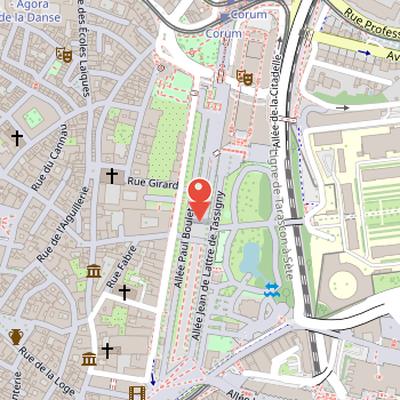
Esplanade Charles de Gaulle is a square in the city centre of Montpellier, in continuity with Place de la Comédie, of which it forms an extension. It is bordered by plane trees and includes many fountains, as well as a wooded park known as the Jardin du Champ-de-Mars. The esplanade also forms the forecourt of the lycée Joffre, installed there since 1947 in the former citadel of Montpellier. It is bounded by boulevard Sarrail, boulevard Bonne-Nouvelle, allée de la Citadelle, and avenue Frédéric-Mistral, and is near the palais des congrès du Corum. The area has three pedestrian access routes. Its layout is linked to the former city ramparts and to the history of the citadel area, later transformed into a promenade between the citadel and the city.
Nearby Objects
-
 Musée Fabre 90 m away
 -
 Notre-Dame des Tables 150 m away
 -
 La chapelle Sainte-Foy 250 m away
 -
 Comédie Square 300 m away
 -
 Fontaine des Trois Grâces 350 m away
Location and urban setting
Intro is a place located in the city center of Montpellier. It borders Place de la Comedie and forms its extension, linking it directly to one of the city's central public spaces. Its position in the urban core gives it a close connection to the surrounding central area.
Setting and Access
The esplanade Charles de Gaulle lies in continuity with the place de la Comedie and is bounded by boulevards Sarrail and Bonne-Nouvelle, allee de la Citadelle, and avenue Frederic-Mistral. It is near the palais des congres du Corum and forms the forecourt of the lycee Joffre, which has been installed since 1947 in the former citadel of Montpellier. The space is bordered by plane trees and includes many fountains, as well as a wooded park called the jardin du Champ-de-Mars. Access is provided by three pedestrian routes, reinforcing its role as a connected public space within this part of the city.
Ramparts and the Roquelaure Promenade
The history of the esplanade Charles de Gaulle is closely linked to the ramparts of the city. In 1622, Louis XIII ordered the Duke of Montmorency to bombard the Protestant rebellion city, and a first part of the commune enclosure, or ramparts, was destroyed to place the city under artillery fire from the citadel. The former defensive layout included a north bastion, the bastion du Roy, near the current Corum, which was connected by a wall to the Porte du Pila Saint Gely. To the south, the bastion de la Reyne stood near the monument aux morts de toutes les guerres and was connected by a wide and deep ditch to the Porte de Lattes. Later, the Duke of Roquelaure, king's lieutenant in Languedoc, cleared wild terrain and created a promenade between the citadel and the city. This promenade was named Roquelaure in honor of its creator.
Landscape Design and Public Use
Opened to the public in 1900, the esplanade Charles de Gaulle was designed by landscape architect Edouard Andre, who also designed Montsouris park and Buttes-Chaumont park in Paris. The garden was laid out according to classical principles and includes curvilinear paths, a central water feature, and a cascade. It serves mainly as a place for walking and for discovering park elements such as water and plant life. The city of Montpellier has invested significantly in its conservation. In 2008, a music-themed playground was added to the site.
Trees and Public Amenities
The esplanade Charles de Gaulle includes a range of notable trees and planted species, forming an important part of its landscaped character. Among those recorded are plaqueminier, marronnier rouge, podocarpus, palmier nain, arbre aux 40 ecus, palmier bleu, erable negundo, sterculia a feuilles de platane, sterculia a feuilles d'erable, chene a feuilles de chataignier, chene ecarlate, marronnier d'Inde, chene chevelu, magnolia grandiflora, grenadier, chene d'Espagne, noisetier de Byzance, cedre de l'Himalaya, cedre de l'Atlas, calocedrus, and platane. In addition to this planting, the esplanade has a public and commercial role. Four kiosks are occupied by brasseries, and the area also includes a merry-go-round and several florists. These elements indicate a space used both as a planted urban setting and as a place for everyday leisure and services.