Musée Fabre is the principal art museum of Montpellier. It originated with a proposal made in 1824 by François-Xavier Fabre, a painter and collector born in 1766 and died in 1837, who offered to donate his collections to the city on the condition that a museum be built to house them. Fabre, who won the grand painting prize of the Academy in 1787, had lived in Rome from 1788 to 1793 and later in Florence, where he gradually formed a rich collection of paintings and drawings. The donation was validated by an extraordinary municipal council meeting and required royal approval before being accepted by the mayor on behalf of the city. After three years of work financed by the municipality, the museum opened its doors. The museum was later enriched by many donations, bequests, and purchases, and expanded into adjacent buildings as its collections grew. In 1860, it was one of the most important museums in France, and in 2002 it received the label musée de France. The museum is installed in the hôtel de Massilian, an 18th-century hôtel particulier near the Esplanade on rue Montpelliéret in Montpellier.
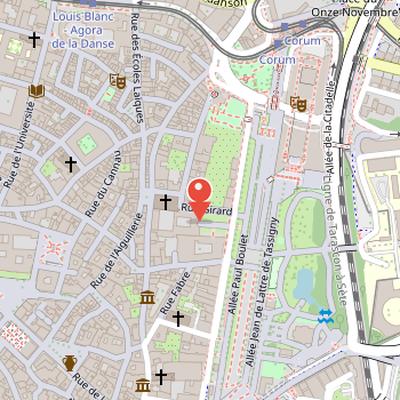
Nearby Objects
-
 Notre-Dame des Tables 60 m away
 -
 Esplanade Charles de Gaulle 90 m away
 -
 La chapelle Sainte-Foy 250 m away
 -
 Convent of the Ursulines of Montpellier 300 m away
 -
 Comédie Square 350 m away
Founding and Growth of the Museum
The principal art museum of the city was created after a proposal made in 1824 by François-Xavier Fabre to donate his collections to Montpellier, on the condition that a museum be built to house them. Fabre, a painter and collector born in 1766 and died in 1837, had won the grand painting prize of the Academy in 1787. He lived in Rome from 1788 to 1793 and then for a long time in Florence, where he gradually formed a rich collection of paintings and drawings. His friend Ange-Jean-Michel-Bonaventure de Dax, Marquis d'Axat, who was mayor and first president of the Societe des beaux-arts de Montpellier, supported the project. An extraordinary municipal council meeting approved the donation unanimously, and the king's approval was required before the mayor could accept it on behalf of the city. This approval also allowed the collections to enter the kingdom's territory. After three years of work financed by the municipality, the museum opened its doors. Over time, it was enriched by many donations, bequests, and purchases, and it expanded into adjacent buildings as its collections grew. By 1860, it was one of the most important museums in France, and it received the label musee de France under the law of July 4, 2002.
From Private Hotel to Expanded Museum
Musee Fabre is installed in the hotel de Massilian, an 18th-century hotel particulier east of the Ecusson in Montpellier, near the Esplanade on rue Montpelieret. The building was within the medieval city enclosure designed by the Guilhem and the kings of Aragon and is attested since 1767. The municipality purchased it for 140,000 francs, and it was remodeled into a museum through major works carried out from 1825 to 1828. These works were supervised by the mayor and Fabre and assigned to the Montpellier architects Fovis and Boue.
The museum later expanded around the original building, with 19th-century constructions facing the Esplanade and the absorption of the former Jesuit college from the late 17th century. In 2003, the museum closed for enlargement and space reorganization, including the relocation of the library. The renovation, designed by the Bordeaux firm Brochet-Lajus-Peyo with Emmanuel Nebout of Montpellier, led to the official inauguration on May 23, 2007, and the public opening on June 15, 2007. The works cost 13 million euros, financed by the State, the Languedoc-Roussillon region, and the Montpellier agglomeration community.
The renovated museum increased its exhibition space from 2,500 square meters to 4,000 square meters, including a 250 square meter temporary exhibition hall, and added a new wing dedicated to contemporary painting. Its visit circuit was entirely redesigned to highlight 19th-century decorations, including a grand staircase by Fabre, the Griffons room with a neo-Etruscan frieze, and Fabre's former apartment with painted ceilings and chandeliers. The entrance is now through the former Jesuit college set back from the hotel de Massilian, and the entrance hall under the college courtyard is decorated with a mosaic by Daniel Buren.
Collections and Formation
Musee Fabre includes several major groups of works, among them more than 300 sculptures in 2020 and a collection of several thousand art objects. Its collections also include nearly an unspecified number of exhibited objects. The holdings were constituted around revolutionary seizures and consular state shipments, giving the museum a foundation shaped by state transfers and historical confiscations.
The Fabre Collection and the Museum's Origins
The museum's collections are closely tied to the painter Fabre, a late 18th-century artist trained at the drawing school of the Societe des beaux-arts de Montpellier. Philippe-Laurent de Joubert helped him enter Jacques-Louis David's workshop. Fabre also became a major collector of Renaissance and Baroque Italian paintings and 18th-century French paintings. In 1825, he donated to the city an important set of 17th-century French and Italian paintings and drawings, giving the ensemble to his hometown on the condition that a public museum be created. He then became the first director of the museum and continued to pursue an acquisition policy. At his death in 1837, he bequeathed the rest of his personal collection, further shaping the museum's holdings.
The Collections and Their Historical Sections
The collections of Musee Fabre are organized into a parcours des collections divided into distinct sections that trace a broad chronology of painting and sculpture. The first seven rooms are devoted to Flemish and Dutch art drawn from the Fabre and Antoine Valedau collections. This group includes artists such as Pierre Paul Rubens, David Teniers, Daniel Seghers, Adrian van Ostade, Gerard Ter Borch, Gerard Dou, Gabriel Metsu, Jan Steen, Jan Weenix, Nicolaes Berchem, and Jan Asselijn. Antoine Valedau, who bequeathed an important set of Dutch and Flemish Golden Age paintings and late 18th century French paintings, also offered a rich set of Jean-Baptiste Greuze paintings and a fine set of romantic watercolors.
The next section presents French, Italian, and Spanish Renaissance to Baroque artworks. Among the works cited are Sebastien Bourdon's portrait L'Homme aux rubans noirs, painted around 1657 to 1658, as well as several landscapes and history paintings. This part of the collections features French artists such as Jean Cousin, Nicolas Poussin, Simon Vouet, Jacques Blanchard, Jean Tassel, Laurent de La Hyre, and Eustache Le Sueur; Italian painters including Alessandro Allori, Paolo Veronese, Francesco Salviati, Palma le jeune, Leonello Spada, Matia Pretti, le Guerchin, l'Albane, Andrea Vaccaro, Jose de Ribera, Bernardo Cavallino, and Carlo Dolci; and Spanish artists represented by a retable by Pedro de Campana and two paintings by Francisco de Zurbaran. Specific works mentioned include Nicolas Poussin's Vénus et Adonis, Alessandro Allori's Vénus et Cupidon, Francisco de Zurbaran's Sainte Agathe, Paolo Veronese's Le Mariage mystique de sainte Catherine, Joseph Wright of Derby's Vue de Florence depuis l'Arno, and Louis Gauffier's Vue sur la vallee de l'Arno a Florence.
Another section begins with art from the time of Louis XIV and the Regency, featuring Jean Ranc and Jean Raoux from Montpellier, as well as reception pieces from the Académie royale de peinture et de sculpture by Antoine Coypel, Jean Francois de Troy, Charles Natoire, Jean-Baptiste-Marie Pierre, and Jean-Baptiste Deshays. Three monumental canvases by Antoine Coypel from the Galerie d'Enee at Palais-Royal in Paris, from the early 18th century, are also part of the holdings. The neoclassical period from 1750 to 1830 is given eight rooms and is centered on the paintings of Francois-Xavier Fabre. In this section the museum displays ten paintings by Jean-Baptiste Greuze, three by Jacques Louis David, eleven sculptures by Jean Antoine Houdon, and eight sculptures by Augustin Pajou.
The 19th century is represented by major works from Alfred Bruyas's gifts in 1868 and 1876, and by artists including Gustave Courbet, Eugene Delacroix, Alexandre Cabanel, and Frédéric Bazille. The collections include seven works by Delacroix, a large collection of Cabanel paintings including Ange decu, fifteen works by Bazille including Jeune Femme aux pivoines, and sixteen works by Courbet including Bonjour Monsieur Courbet. Other specific works cited are Courbet's Portrait de Charles Baudelaire and L'Homme a la pipe, Cabanel's Albayde, Auguste-Barthlemy Glaize's Intieur du cabinet de Bruyas, and Eugene Castelnau's Les Garrigues du Pic Saint-Loup. The family of Montpellier painter Frederic Bazille also gifted important paintings of this Impressionism precursor. The collections further received deposits from the Louvre Museum, Orsay Museum, and the National Museum of Modern Art.
Later holdings include modern sculptures by Languedoc-origin artists such as Germaine Richier, Aristide Maillol, and Rene Ich, as well as artists from the Supports/Surfaces movement born in the region such as Claude Viallat, Vincent Bioules, and Daniel Dezeuze. During the 2000s renovation, Pierre Soulages donated 20 emblematic paintings from the 1950s to today, and these works are exhibited in two special rooms.
Jean Antoine Houdon in the Collections
The collections include several works by Jean Antoine Houdon, showing a range of subjects and materials. Among them are La Frileuse ou l'Hiver, represented by a terracotta sketch from 1781 and a marble version from 1783. Also included is L'Ete, a marble work from 1785. The museum further holds Voltaire assis, a terracotta dated 1780 to 1790, and L'Ecorche au bras leve from 1792. Together, these pieces reflect the presence of both preparatory and finished works in the collections.
Drawing Collections
The collections include one of the most important drawing collections in France. Among these holdings, the old Italian drawing collection is especially notable, with more than 500 sheets. This gives the museum an important place in the preservation and study of drawing within France, while also highlighting the depth of its historical Italian material.