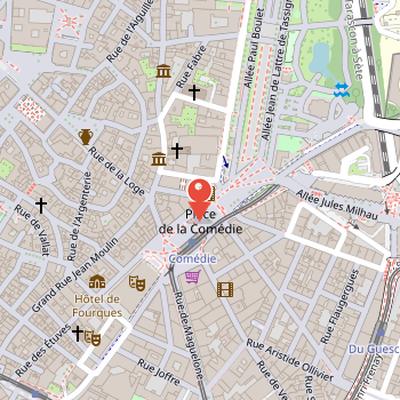
Comédie Square is a prominent public square in Montpellier, located southeast of Écusson in the heart of the medieval city. It extends over an old fortification area leading to the citadel of Montpellier, now the lycée Joffre, and continues eastward to Esplanade Charles-de-Gaulle. The square has a roughly rectangular, elongated form and measures about 230 meters long and 50 meters wide; together with the esplanade, it forms a complex measuring 340 meters by 50 meters.
The site has a long urban history. A first square dates from 1755, and the area was rebuilt after theater fires in 1785 and 1881. In the late 1790s, the Three Graces fountain, created by the sculptor Étienne Dantoine, was installed on the Comédie. The square became increasingly busy in the 19th century and later developed into a pedestrian space. Its 1985 redesign, by Atelier A/S Marguerit, included a basin-fountain and a blue Bahia marble water wall, with lighting designed by Pierre-Arnaud de Chassy-Poulay. The square is also closely associated with its crossroads location and its role as a meeting point.
Nearby Objects
-
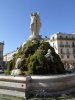 Fontaine des Trois Grâces 40 m away
 -
 La chapelle Sainte-Foy 120 m away
 -
 Opéra national de Montpellier 120 m away
 -
 Rockstore 300 m away
 -
 Esplanade Charles de Gaulle 300 m away
Situation and Access
Comedy Square, under its situation and access, is located southeast of the Ecusson in the heart of the medieval city. It extends over an old fortification space leading to the citadel of Montpellier, now the lycee Joffre, and reaches Esplanade Charles de Gaulle to the east. The square has a roughly rectangular, elongated form and measures approximately 230 meters long and 50 meters wide. Together with Esplanade Charles de Gaulle, it forms a larger complex about 340 meters long and 50 meters wide. The esplanade is bordered by a boulevard.
The Square and Its Transformation
The first square on the site dates from 1755, and the place was rebuilt after theater fires in 1785 and 1881. It is located on the former Montpellier wall, near the Lattes gate and the Languedoc governor's buildings. In the late 1790s, a fountain topped with the sculpture of the Three Graces was installed on the Comedie. The fountain was created by Etienne Dantoine, a sculptor from Carpentras, and had previously stood on Canourgue square, the town hall location, in 1794. The original sculpture was moved to the Musee Fabre in 1989 and replaced by a cast, and the original statue was later moved to the hall of the Opera Comedie.
The square became busier in the 19th century because of Jules Pagezy's mandate, new street openings, and the railway station. Its position offered the easiest route between the station and the city center, while the main city attractions were located to the north and at higher ground. Until World War II, two cafes south of the square, the Grand Cafe de France and du Musee and the Grand Cafe de Montpellier, hosted a weekly informal wine market. The Three Graces fountain became a convenient meeting point and a symbol of Montpellier because of the square's crossroads location.
In 1985, the intersection was redesigned as a large pedestrian square measuring 240 m by 50 m. The redesign, by Atelier A/S Marguerit landscape architects from Montpellier, included a basin-fountain and a blue Bahia marble water wall. The lighting was designed by Pierre-Arnaud de Chassy-Poulay. The square is organized by the 'oeuf', where a copy of the Trois Graces statue-fountain stands, and the 'oeuf' is visible because of the color of the smooth stones used.
Traffic Changes and Spatial Transformation
The original pedestrian area of the place de la Comedie, described as Historique's egg, was surrounded by all roads crossing the city center, including nationale 113. Over time, automobile traffic was progressively banned from the place, with the exception of morning deliveries. A major stage in this change was the Comedie tunnel, which made it possible to cross the square underground and gave access to the Comedie and Polygone underground parkings. Inaugurated in 1984 by Georges Freche, the tunnel was designed by Alain Marguerit and allowed the square to serve functions beyond road traffic while also expanding its spatial use.
Transport Changes at Place de la Comedie
For several decades, place de la Comedie housed the station of the petit train line to Palavas-les-Flots, a service depicted by the artist Albert Dubout. The square was also crossed by the Montpellier to Castelnau-le-Lez tramway line before it continued around the Ecusson from the east. More recently, the installation of tramway line 1 brought significant changes to the site. Local political actors had expressed concerns about the line passing along the south side of the square, and the tramway station reduced the square's openness and its capacity to host events. The installation also led to the disappearance of the fountain basin and water wall by Alain Marguerit, while three sculptures by M. Bourry and Goetschy were moved to Antigone. In practical terms, the tramway also caused the pedestrianization of rue Maguelone, which had previously been used by almost all urban bus lines to reach the station. Bus lines no longer serve place de la Comedie itself, but stop about 200 meters away. Today, the area is served by a small tourist train that roams the streets of the Ecusson. In some years between the mid-1990s and the 2000s, it was also served in the pedestrian sector by a small gas bus known first as Petibus and later as Le Guilhem, although this service was repeatedly started and stopped because of maintenance and profitability issues.
Architecture, Commerce, and Public Space
Comedy Square is bordered by a highly frequented promenade and social space with decorated buildings that house businesses. Among the notable elements are historic Haussmannian buildings containing the Gaumont cinemas and the Monoprix supermarket. One building north of the Gaumont cinema facade has a roof known as the scaphandrier because of its shape, and a sculpted pediment beneath the helmet represents the city's sources of wealth through vine and rail motifs.
The square has also served as a place for commercial and media presence. Formerly, local companies such as RMC and Sud Radio placed offices and logos on balcony windows. Today, La Gazette de Montpellier and several banking agencies occupy the site, with logos still visible on balconies. The area includes many well-known brands and shops on Place de la Comedie, such as McDonald's, Foot Locker, Sauramps bookstore, Bershka, Bouygues Telecom, Fnac, Nature et Decouvertes, Gap, Zara, Haagen-Dazs, and Celio. It also connects the east end of Place de la Comedie to the Polygone shopping mall and the Triangle gallery.
Several design and infrastructure projects have reshaped the area. A landscaping project managed by TER agency added elms and a fountain at the intersection of Comedie place and the esplanade. A nearly 100 meter long garden bench was installed to harmonize with the paving and the garden behind it. Comedie station platforms were enlarged and equipped with ramps on both sides for mobility-impaired persons, while Studio 5-5 designed shelters with simplified furniture to support fluid circulation and clear views across the square. The stone floor coverings were renovated, and warm sparkling lighting was added at night. The square is also decorated during national commemorations, sports events, and cultural manifestations, and it hosts some events on Place de la Comedie.