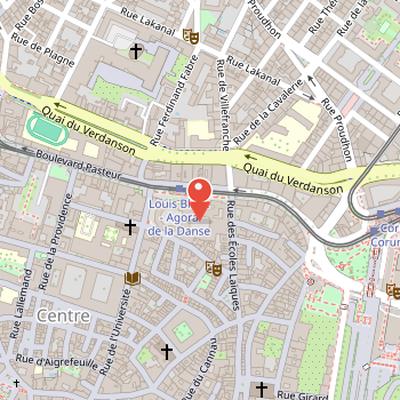
The Convent of the Ursulines of Montpellier is a historic religious and later military complex located in the rue Sainte-Ursule district of Montpellier, in Hérault. Registered as a historical monument, it is known for its long and changing history. The site originated with a monastery built by nuns from the order of Sainte-Catherine in the early second half of the Middle Ages. After the Wars of Religion, Bishop Pierre Fenouillet led the religious reconquest of Montpellier and obtained six nuns from the order of Sainte-Ursule of Pézenas in 1641. These Ursuline nuns settled in a rebuilt monastery in 1657, designed by architect Jean Bonnassier, and dedicated themselves to educating poor girls. The convent later experienced several changes of use: it was used as a prison during the Revolution, served as a women’s prison from 1825 to 1934, and was also used as a barracks, including during the Occupation. The city of Montpellier acquired the property at the end of the 1980s. It now houses Agora, Cité internationale de la danse, the headquarters of the national choreographic center of Montpellier.
Nearby Objects
-
 Notre-Dame des Tables 250 m away
 -
 Musée Fabre 300 m away
 -
 Montpellier Cathedral 350 m away
 -
 Esplanade Charles de Gaulle 400 m away
 -
 Place de la Canourgue 400 m away
From Convent to Cultural Headquarters
The convent of the Ursulines of Montpellier is located in the neighborhood of rue Sainte-Ursule, in Montpellier, Herault. It was transformed into a prison in the 19th century and is registered as a historical monument. Today, the building houses the headquarters of the national choreographic center of Montpellier, Agora, Cite internationale de la danse. Its successive uses reflect a notable change in function while preserving its status as a protected heritage site.
From Ursuline Convent to Civic and Military Uses
The convent of the Ursulines of Montpellier has a history marked by successive religious, penal, and military uses. In the aftermath of the Wars of Religion, Bishop Pierre Fenouillet led a religious reconquest in Montpellier and obtained six nuns from the order of Sainte-Ursule of Pezenas in 1641. These nuns were dedicated to educating poor girls and settled in a rebuilt monastery in 1657. That monastery, named the Ursulines convent, was designed by architect Jean Bonnassier. From 1697 to 1738, under Bishop Joachim de Colbert, the Ursulines received support to teach, open new classes, and host pensioners.
The building later underwent a long series of non-religious uses. During the Revolution, it was used as a prison, and it then served as a barracks for several years. From 1825 to 1934, it functioned as a women's prison. During the Occupation, it was used as a military prison and also as a Gestapo interrogation center. It then became a barracks named Grossetti, housing the Air Force information office until 1986. The city of Montpellier began purchasing the convent in 1980, with acquisition completed in 1988, although the city occupied it immediately after the army left in 1986. In 2025, the center for national choreography and the Montpellier Danse festival were merged into Agora, Cite internationale de la danse.
Heritage Protection
At the end of the 1980s, the city of Montpellier acquired the property. The protection covers the facades and roofs facing boulevard Louis-Blanc, rue de l'Universite, rue des Ecoles-Laiques, and rue Sainte-Ursule, which are registered as historical monuments. Despite this status, the protection is planned to be destroyed.