Basilique Notre-Dame des Tables is located in the heart of Montpellier on rue du Collège. It is the mother church of Montpellier, and the city is under the patronage of Notre-Dame des Tables and Saint Firmin. The present building is a Baroque church whose construction began in 1707 under the architect Jean Giral and was completed in 1748. It was formerly the chapel of the Jesuit college, now the musée Fabre, and became the parish church Notre-Dame des Tables in 1802.
The name recalls the earlier church Notre-Dame des Tables, which stood on the current place Jean-Jaurès. In the Middle Ages, tables of money changers and merchants’ stalls stood around it, and it was a stop on the route to Saint-Jacques-de-Compostelle. The older church, first known as Sainte-Marie from 1090 to 1794, was renamed Sainte-Marie des Tables in 1204 and later Notre-Dame des Tables. Only some remains of its crypt and burial vaults survive, and the crypt was transformed into the musée du Vieux Montpellier.
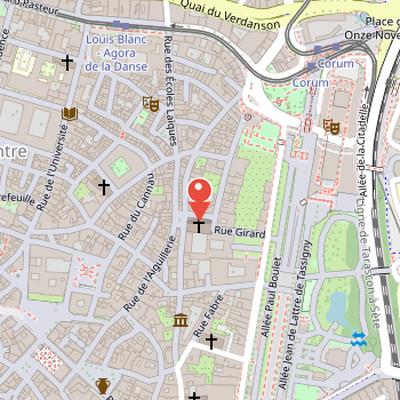
Nearby Objects
-
 Musée Fabre 60 m away
 -
 Esplanade Charles de Gaulle 150 m away
 -
 Convent of the Ursulines of Montpellier 250 m away
 -
 La chapelle Sainte-Foy 250 m away
 -
 Comédie Square 400 m away
History and Setting
The basilique Notre-Dame des Tables is located in the heart of Montpellier on rue du College. It is the mother church of Montpellier, and the city is under the patronage of this basilica and Saint Firmin. The building is in the baroque style and its construction began in 1707 under the architect Jean Giral. Work was completed in 1748. Before becoming the parish church Notre-Dame des Tables in 1802, it served as the chapel of the Jesuit college, now the Musee Fabre.
Historic Name and Urban Setting
The former church of Notre-Dame des Tables stood on the present-day place Jean-Jaures. It was known as Sainte-Marie from 1090 to 1794, and it was renamed Sainte-Marie des Tables in 1204 before later becoming Notre-Dame des Tables. In the Middle Ages, the area around the church was marked by money changers' tables and merchants' stalls, a feature that distinguished it among sanctuaries. The church also served as a stop on the route to Saint-Jacques-de-Compostelle.
Today, only some remains of the crypt and burial vaults survive. The crypt was transformed into the musee du Vieux Montpellier, preserving a part of the site's historical presence in the city.
Rebuilding and Destruction in the Wars of Religion
The former church of Notre-Dame des Tables was repeatedly altered by the religious conflict in Montpellier between 1560 and 1622. In 1561, it was assigned to Reformed worship as the Temple de la Loge. It was then partially destroyed in 1568 and again in 1581, with the clock tower from 1432 remaining intact. The building was later reclaimed by Bishop Guittard de Ratte of Montpellier. Reconstruction began between 1605 and 1608, but the church was destroyed again by Protestants in 1621. It was rebuilt once more between 1650 and 1655. The final destruction of the building began in 1794.
History and Status of the Basilica
The current basilica was formerly the church Notre-Dame des Tables. Its construction on rue du College began in 1707 under the architect Jean Giral. In 1802, it received the prestigious title of the disappeared Marian sanctuary at the former Jesuit college chapel. The church was registered as a historical monument in 1938 and was established as a minor basilica by Pope Pius XII. In 2002, it became part of the Paroisse Cathedrale Montpellier. The former college associated with the site later became a high school and then housed the expansion of the Fabre Museum. More recently, the parish priest was Abbe Michel Plagniol starting in 2009, and the rector was Canon Jacques Betoulieres starting in 2016. In 2025, Norbert Turini, bishop of Montpellier, designated it as one of ten jubilee churches.
The Grand Organ in the Basilica
The grand organ was built around 1751-1752 by organ builder Dom Bedos de Celles for the abbey of Saint-Thibery. It remained at the abbey from 1751 to 1759. In 1805, the instrument was transferred to the basilica Notre-Dame des Tables and installed there.
The Grand Organ of Notre Dame des Tables
The grand organ of Notre Dame des Tables began with a design that initially lacked a positive dorsal and had two keyboards, named grand-orgue and positif. Its pipes were arranged on a large double windchest with alternate engraving, and its case, designed by Dom Bedos, used a rocaille style with a large trilobed central turret containing 13 pipes. The case also had two concave flat faces ending in two unusual paired turrets, and its sculptural decoration was likely created by Dominique Ferrere, who worked in the region. In 1805, the instrument was transferred to Notre Dame des Tables by an unknown builder.
The organ underwent several major interventions. Prosper-Antoine Moitessier restored it in 1846 and made the current facade pipes. In 1884, Theodore Puget and Fils of Toulouse rebuilt it inside the original case, giving it three keyboards and a pedalboard of four stops. That rebuild reused approximately 19 stops and 650 pipes from Dom Bedos' original work, while the pipework was extensively altered through revoicing and dispersion. The case also lost its light green color with silver sculptures and moldings during this campaign. A further restoration by Gerard Bancells of Toulouse in 1995 followed the Puget organ style.
Today, the organ has three keyboards of 56 notes each, a 30-note pedalboard, and 37 stops. It includes 19 stops by Dom Bedos and about 100 pipes by Moitessier in the instrumental section. Its sculpted walnut case was classified as a historic monument in 1975.
Heritage Status and References
Basilique Notre-Dame des Tables is linked in several reference and classification entries connected with Montpellier and Notre-Dame. It appears as Eglise Notre-Dame des Tables under the Pastorale des Realites du Tourisme et des Loisirs du diocese de Montpellier, and as Basilique Notre-Dame des Tables according to Messe.info. The site is also associated with the names Montpellier Notre-Dame-des-Tables, Montpellier, and Montpellier, Notre-Dame des Tables. In heritage listings, it is classified under Catégorie:Monument historique a Montpellier and Catégorie:Monument historique inscrit en 1938, indicating its status as a protected monument in the city.