Montpellier Cathedral is the Catholic cathedral of Montpellier in Hérault, located in the old town. It is the most important monument in Gothic style in the city and the largest church in the former Languedoc-Roussillon region. The cathedral is also an emblematic example of a fortress cathedral, with significant defenses that give it a fortified character. At the end of the 16th century, it was nicknamed “fort Saint-Pierre.”
The cathedral Saint-Pierre was originally the chapel of the monastery-college Saint-Benoît Saint-Germain, founded by Pope Urbain V in 1364. It was erected as a cathedral in 1536, when the episcopal seat was transferred from Maguelone to Montpellier. Four towers rise at the angles of the nave, although one was knocked down during the Protestant iconoclastic movements of 1567. One façade was crowned with machicolations topped by battlements, and a massive porch of two cylindrical pillars and a vault precedes the entrance. Today, only elements of medieval architecture remain visible.
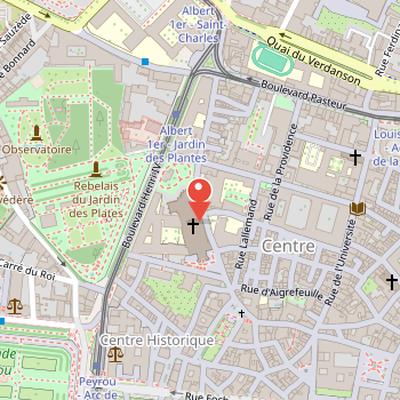
Nearby Objects
-
 Place de la Canourgue 150 m away
 -
 Hôtel Richer de Belleval 200 m away
 -
 Jardin des plantes de Montpellier 250 m away
 -
 Arc de Triomphe of Montpellier 300 m away
 -
 Sainte-Anne Church 350 m away
Cathedral Status and Setting
Montpellier Cathedral is the Catholic cathedral of Montpellier in the Hault region of Herault. It is located in the old town of Montpellier and is regarded as the most important Gothic style monument in the city. The cathedral is also the largest church in the former Languedoc-Roussillon region. Its design makes it an emblematic example of a fortress cathedral, giving it a distinctive place in the architectural heritage of Montpellier.
Architecture and Fortified Character
According to Histoire, the cathedral Saint-Pierre was originally the chapel of the monastery-college Saint-Benoit Saint-Germain, founded by Pope Urbain V in 1364. The church was erected as a cathedral in 1536, when the episcopal seat was transferred from Maguelone to Montpellier. Its present appearance preserves only medieval architectural elements, including a single nave with five bays that delimit fourteen side chapels. These chapels were dedicated to Saint Germain, Notre Dame, Saint Victor, Sainte Cecile, Sainte Ursule and the eleven thousand virgins, Saint Martin, Sainte Catherine, the Holy Cross, Saint Pierre, Sainte Marie Madeleine, Saint Blaise, Saint Lazare, and Saint Michel. The ornamentation of the church was described as very rich, and the high altar was surrounded by a vermeil reredos.
The cathedral also had a strongly defensive character. Four towers rose at the angles of the nave, although one of them was knocked down during the Protestant iconoclastic movements of 1567. One of the facades was crowned by machicolations topped with battlements, and the building was equipped with significant defenses that made it a fortress. At the end of the 16th century it was nicknamed fort Saint-Pierre. The entrance was preceded by a massive porch composed of two cylindrical pillars and a vault, with the porch vault connecting the pillars to the facade of the church.
The interior arrangements also reflect its liturgical and material functions. The small sacristy, shared with the church on the ground floor, contained cupboards with multiple locks for relics, books, and linen, including silver arms of Saint Benoit, Saint Germain, and Saint Blaise. This minor sacristy was distinguished from the major sacristy, which held the treasure, reliquaries, sacred vessels, and precious ornaments.
Violence and Damage in the Wars of Religion
According to the Histoire, cathedral Saint-Pierre was targeted by Protestant attacks during the Wars of Religion. On October 28, after a night siege, a crowd entered the cathedral through a breach, while some Catholic dignitaries and soldiers had taken refuge inside. The resulting massacre has a highly variable reported death toll: chroniclers give figures from eight to fifty, while some sources suggest up to eight hundred deaths. Théodore de Bèze counted both those killed on the spot and those who later died of wounds, and the Histoire de l'Europe gives a figure of seventeen. The murder at the cathedral was followed by pillaging and the ruin of the site. The church was completely stripped in six to seven hours, although city consuls, all Protestants, managed to preserve the treasure by making an inventory. The looting of cathedral Saint-Pierre was then followed by the plundering of convents and monasteries in the city. In 1562, the cathedral also lost its bells and iron grilles, which were melted down to make ammunition used during the Catholic siege of the city. Histoire further reports that the cathedral suffered assaults from Protestants in 1567.
Restoration and Later Additions
According to the history of the cathedral, one of its towers collapsed and brought the entire building down. The cathedral canons took refuge in Villeneuve-les-Maguelone and Frontignan until 1622. In 1629, Cardinal de Richelieu entrusted the restoration to Pierre Froment and Bertrand Delane. The vault, nave pavement, and facade were redone during this work, and Saint-Pierre was remodeled according to a project by Jean-Antoine Giral.
Further changes followed in the 19th century. From 1855 to 1875, Henri Antoine Revoil carried out work that included the reconstruction of the tower and the addition of chapels. The choir roofing was decorated with glazed tiles in Burgundian fashion. Auguste Baussan later redid the sculptural decor of the tower and tympanum in a specific style, and in 1870 he was commissioned to decorate the transept portal dedicated to the Virgin. His bas-relief symbolized the Virgin's coronation and was inspired by the portal sculptures of Notre-Dame de Paris. Stained glass windows by Edouard Didron and Paul Nicod were installed between 1870 and 1872. A painting by Sebastien Bourdon, The Fall of Simon Magus, is located in the right arm.
The cathedral also changed in status over time. In 1795, the episcopal seat became the seat of the School of Medicine. Monseigneur Charles-Thomas Thibault obtained the title of minor basilica for the cathedral in 1847. After the diocesan erection decree, Saint-Pierre cathedral became a metropolitan cathedral, and the ecclesiastical province of Montpellier includes the suffragan dioceses of Mende, Perpignan-Elne, Nimes, Carcassonne and Narbonne. The cathedral structure later served as a model for the Saint-Francois-Xavier church in Malacca in 1856.
Architectural Features and Interior Details
The descriptions focus on several architectural and historical details connected to Montpellier Cathedral and the surrounding Faculty of Medicine area. From the Facult de Medecine courtyard, formerly the cloister of the Saint-Benoit monastery, the view includes the Urbain V and Saint-Benoit towers, as well as rooftops. The cathedral is also seen from the Corum. At the east portal of Cathdrale Saint-Pierre de Montpellier, a tympanum dedicated to the coronation of the Virgin is shown, along with the Virgin and Child statue by sculptor Auguste Baussan. Other details include the main stained glass windows, the east-side rose stained glass window, and the west-side rose stained glass window. The choir and cathedra of the cathedral are also represented. A commemorative plaque records the cathedral's erection as a minor basilica by Pope Pius IX on 20 July 1847, with the coat of arms of the chapter placed above it. The Theatrum Anatomicum at the Facult de Medecine is also part of the associated description.
The Grand Organ of Montpellier Cathedral
In 1775, the bishop of Montpellier, Monseigneur de Malide, ordered the relocation of the grand organ, which was planned by organ builder Jean-Francois Lepine. Before installation, the structure required a rebuilt platform for support, and the organ was created in 1778. Over time, it received regular maintenance, including supplies and new bellows, showing continuous use and care.
The instrument was equipped with an electric blower in 1923. In 1943, it was damaged by dust and plaster during roof repair work, after which it was restored and given additional sounds. Further work followed in later decades: the positive de dos was restored by the Kern company in Strasbourg in 1978, and new lighting was installed during the Montpellier millennium in 1985. In 1994, the feet of the pipes of the central turret were consolidated, and the buffet, musical instruments, and consoles were gilded with 22-carat gold sheets.
A new restoration later began, including pipe removal, transmission replacements, and console restoration by Manufacture d'Orgues Giroud Successeurs. The grand organ is co-held by the organists Othar Chedlivili and Irene Randrianjanaka.
The Bells of Montpellier Cathedral
Montpellier Cathedral has seven bells in total: four religious ringing bells and three civil clock bells. The four ringing bells are housed in the west tower, known as the Urbain V tower. They were cast in 1867 by Hildebrand A. in Paris and were donated by Monseigneur Lecourtier, bishop of Montpellier from 1861 to 1873. Among them is the bourdon bell, named Francois, which weighs nearly a specified weight, measures 171 cm in diameter, and is the lowest ringing bell in the Languedoc-Roussillon region. It produces the note Sol#2. The other ringing bells are Charles, producing La#2 and measuring 152 cm in diameter; Nicole, producing Do3 and measuring 137 cm in diameter; and Simone, producing Re#3 and measuring 115 cm in diameter.
The three clock bells are located in a wrought iron campanile on the roof of the bell tower. They were cast in 1730 by Pierre Gor in Pezenas and Jacques Gor in Montpellier, and were donated by Cardinal de Fleury, prime minister of Louis XV and native of Lodeve. These bells produce the notes Re3, La3, and Do#4. Since 1959, the three clock bells have been classified as historic monuments.
Parish Organization and Clergy
Since 2002, the parish has included all churches in downtown Montpellier. Its churches comprise Saint-Pierre Cathedral, Notre-Dame des Tables Basilica, Saint-Roch Church, Saint-Denis Church, Sainte-Eulalie Church, Saint-Lon Church, and Saint-Mathieu Church. The cathedral's archpriests have included Joseph Roucairol from 1983 to 1992, Emile Roger from 1992 to 2009, and Michel Plagniol as rector-archpriest of the cathedral and parish priest from 2009 to 2024. Since 2024, Yannick Casajus has served as archpriest of the cathedral.