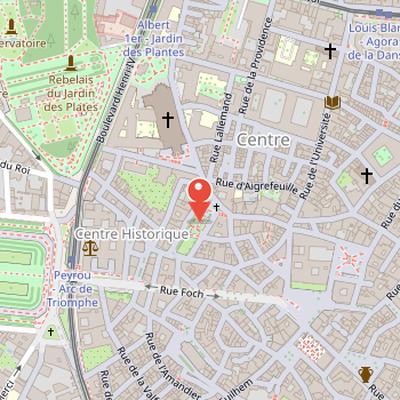
Place de la Canourgue is a rectangular square located in the sub-neighborhood of l’Écusson, in Montpellier’s Centre-Ville district. It is bounded by rue Saint-Pierre to the north-east, rue de l’Hôtel-de-Ville to the east, rue du Palais-des-Guilhem to the south-west, and rue Sainte-Croix to the west. The square has five access streets: three on its south-west part, one on its north-east part that gives access to two staircases leading to the place, and one that arrives in the middle along the hôtel Richer de Belleval. The closest public transport line is Montpellier tramway line 4 at Peyrou - Arc de Triomphe station. Vélomagg’ and Modulauto stations are also available on rue Foch opposite the palais de justice.
The site has a layered history. In 1129, Guilhem VI, lord of Montpellier, chose the hill for its dominant position and view, and built a residential palace and an oratory there. After his return from Palestine, he deposited a piece of the True Cross and other relics from the Holy Land at the oratory. The oratory disappeared in 1562 during the Wars of Religion. The Brotherhood of the White Penitents then bought the land and ruins in 1563 and built a new Romanesque sanctuary, which was destroyed again in 1567. Works to restore the site began around 1623, but were interrupted in 1629 by order of Cardinal Richelieu.
Nearby Objects
-
 Hôtel Richer de Belleval 20 m away
 -
 Montpellier Cathedral 150 m away
 -
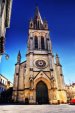 Sainte-Anne Church 200 m away
 -
 Arc de Triomphe of Montpellier 200 m away
 -
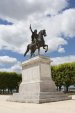 Equestrian statue of Louis XIV 300 m away
Location and Access
Place de la Canourgue is located in the sub-neighborhood of l'Ecusson, in the Centre-Ville district. It has a rectangular shape and is bounded by rue Saint-Pierre to the north-east, rue de l'Hotel-de-Ville to the east, rue du Palais-des-Guilhem to the south-west, and rue Sainte-Croix to the west. Access is provided by five streets in total. Three of these access streets are on the south-west side, while one street on the north-east side gives access to two staircases leading to the place. Another access street arrives in the middle of the site along the hotel Richer de Belleval. The closest public transport line is Montpellier tramway line 4, at Peyrou - Arc de Triomphe station. VeloMagg' and Modulauto stations are also available on rue Foch opposite the palais de justice near the place.
From Sacred Site to Public Square
Place de la Canourgue took shape on a hill first chosen in 1129 by Guilhem VI, lord of Montpellier, for its dominant position and view. He built his residential palace and an oratory there, and after returning from Palestine he deposited a piece of the True Cross and other relics from the Holy Land at the oratory. The original oratory disappeared in 1562 during the Wars of Religion. The Brotherhood of the White Penitents bought the land and ruins on 18 March 1563 and built a new Romanesque style sanctuary on the site, but this chapel was destroyed again on the night of 16-17 December 1567. Beneath the church there was a crypt containing noble Montpelierans. After abandoning reconstruction, the Brotherhood placed a cross on a stele to commemorate Guilhem VI's oratory, also known as the oratory of the Holy Cross. Restoration work began around 1623, and in 1626 much of the district was demolished to create enough space. However, construction was interrupted in 1629 by order of Cardinal Richelieu, who instead ordered the restoration of Saint-Pierre Cathedral at the place de la Canourgue in the Hotel Richer de Belleval. The square later changed again between 1855 and 1859, when the Montpellier city hall bought three houses to demolish them and enlarge the square to create a park. In 1863, the Fountain of the Unicorns was transferred to the place de la Canourgue. Excavations also uncovered a holy water font from the oratory Sainte-Croix together with tombstones.
The Fountain and Historic Buildings at Place de la Canourgue
Place de la Canourgue includes several notable elements of architectural and memorial interest. The fountain now standing there was designed by architect Jacques Donnat in 1773 and sculpted by Etienne Dantoine. It originally stood at the place des Etats de Languedoc, now place Jean-Jaures, before Mayor David-Jules Pagezy had it moved to Place de la Canourgue in 1863. The fountain commemorates the marquis de Castries for his victory at the battle of Clostercamp in 1760, and its decoration includes seahorses or unicorns above a bas-relief representing that battle. The square is also associated with the hotel Richer de Belleval, built by the family de Boulhaco in the late 17th century on the foundations of a former canon habitation. This building belonged to Pierre Richer de Belleval, the king's physician and founder of the jardin des plantes, and later served as Montpellier city hall from 1816 to 1975. Other nearby historic buildings mentioned in relation to the area include the hotel de Cambaceres-Murles, an hotel particulier whose facades, roofs, main staircase, secondary staircase, and cellar are protected, and the hotel de Sarret, built in 1636 and identified by its shell and Louis XIII style courtyard.
Memorial Crosses and Later Occupation
At the site of the former oratory of Sainte-Croix, the first cross was placed as a memorial. A church was later built there, but it was destroyed in the night from June 16 to June 17. The Pe9nitents blancs then gave up the idea of restoring the church ruins and placed a cross on a stele instead. This fleurdelise cross was intended to preserve the memory of the oratory of Guilhem VI, but it was destroyed in 1791. The Pe9nitents blancs later erected a new cross at the same location. They were dispossessed during the Religious Wars from 1840 to 1890, and since about 1899 the site has been occupied by the Caisse d'Epargne and a business school. The city of Montpellier also fixed a commemorative plaque at 2 bis, and an inscription above the door at 2 ter recalls the location of the He9rault oenological institute.