Enclos Saint-Césaire is a former abbey in Arles founded on 26 August 512 by Archbishop Caesarius, who named it after Saint Caesarius of Arles and appointed his sister Caesaria as the first abbess. The abbey was originally known as the abbey or monastery of St John and was established as a nunnery in the south-eastern corner of the rampart of Arles. Early attempts to settle outside the walls were destroyed during the siege of Arles in 507–508.
The monastery played an important role in the history of early monastic life, and its influence helped spread the Rule of St Caesarius in the kingdom of the Franks. Historical sources mention several churches within the abbey, including a church dedicated to the Holy Cross and Saint Michael, and a Basilica of Saint Peter. The abbey was suppressed during the French Revolution, its buildings were later used as a hospice, and they are now abandoned.
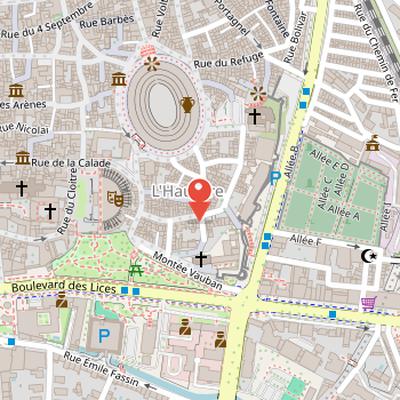
Nearby Objects
-
 Gallo-Roman theatre at Arles 150 m away
 -
 Arles Amphitheatre 200 m away
 -
 Notre-Dame-de-la-Major d'Arles 200 m away
 -
 Church of St. Trophime 300 m away
 -
 Saint-Trophime cloister 300 m away
Abbey Origins and Later Uses
The Enclos Saint-Cesaire was founded in Arles in 512 AD as the Abbey of St Caesarius. It was established as a nunnery and named after Saint Caesarius of Arles. The abbey was originally called the abbey or monastery of St John and was located in the south-eastern corner of the rampart of Arles. Its history continued into later periods, when the abbey was suppressed during the French Revolution. After that, the abbey buildings were reused as a hospice, and they are now abandoned.
Early Monastic History and Sacred Buildings
The history of Enclos Saint-Cesaire is closely tied to the abbey of Saint-Jean, founded on 26 August 512 by Caesarius, Archbishop of Arles. Caesarius appointed his sister Caesaria as the first abbess. An earlier attempt to settle outside the walls in 506-507 had been destroyed by Frankish and Burgundian troops during the siege of Arles in 507-508. Around 567, a wife of Guntram, King of Burgundy, probably Marcatrude or Teutechilde, was confined in the convent. The monastery later gained broader influence through its first abbesses, helping the Rule of St Caesarius spread widely in the kingdom of the Franks, beginning with the monastery founded in Poitiers by Radegund, the former wife of King Chlothar I. Radegund stayed in Arles, and this monastery was established around 568-569 under Liliole, the third abbess. Liliole died shortly after her abbacy and was accompanied by Agnes, her spiritual sister and chosen successor, as well as Venantius Fortunatus, who later wrote her biography.
The Vie de Rusticule, a text dedicated to the fourth abbess, mentions several churches within the abbey. It refers to a church dedicated first to the Holy Cross and later to the Archangel Saint Michael, and to another, larger church built to house relics of the Holy Cross in better conditions. The presence of these relics in Arles is probably linked to Radegund's stay. The text also mentions a Basilica of Saint Peter, which still existed in the tenth century, and identifies saints venerated there, including archangels Gabriel and Raphael, Saint Thomas, Saint Maurice, Saint Sebastian, and Saint Pons. The monastery remained active into the seventh century, and on 12 August 632, Archbishop Theodosius of Arles took part in the funeral of an abbess later regarded as a saint.
Medieval Development and Landholding
History suggests that the abbey may have ceased to exist between the 7th and 9th centuries. By the end of the 860s, Archbishop Rotland of Arles had wrested authority over it from Emperor Louis II, and historian Jean-Pierre Poly traces the abbey's property back to 869. In 883, Archbishop Rostang of Arles restored the tomb of Saint Caesarius after it had been violated during the Saracen capture and looting of Arles. Four years later, in 887, Rostang gave the abbey a new start. At that point, its estates were grouped around three main areas: near Arles, in the county of Vaison, and in the county of Saint-Paul-Trois-Chateaux. The holdings near Arles included Trebon and Gallignan, and especially several estates in the Camargue, such as Gimeaux, Malmissane, Notre-Dame-de-la-Mer, Ulmet, Agon, and Saint-Cesaire de Bozaringue. The estates in the county of Vaison included Nyons, Vinsobres, and Visan.
The abbey later moved between subjection to the archbishop and periods of independence. It regained autonomy in 972 under Abbess Ermengarde, appointed by Archbishop Ithier of Arles, and William I of Provence returned important estates twenty years later. Pope Celestine III placed the abbey under his direct authority in 1194. The abbey was also a major landowner, and by the sixth to thirteenth century the Abbey of Saint-Jean was endowed by Caesaria and Rostan. Other records note a 972 deed of gift involving the villa of Niomes, the return of albergues on the villa of Agon after 1060, and the abbey's share in one of the three cemeteries of Alyscamps in an arbitration award of 1121. In the fourteenth century, it became a fermier in its Camargue estates of Agon and Granouillet, and in the fifteenth century it shifted from direct exploitation to sharecropping or renting estates, against the background of a demographic crisis caused by plague epidemics that reduced more than half of Arles's population between 1320 and 1430.
History of the Nunnery at Enclos Saint-Cesaire
The history of Enclos Saint-Cesaire reflects repeated periods of decline, conflict, reform, and reuse. In 1343 the community numbered 108 nuns, but by 1428 it had fallen to 22, a decrease linked to the demographic crisis. During the same broad period, relations between the abbey and the archbishop were marked by conflicts associated with the personalities of the nuns and with slackened monastic discipline. In the late fifteenth century, one nun left the monastery for another community in Aix because of the looseness of the abbey's mores.
Concerns over control and access continued into the sixteenth and seventeenth centuries. In 1559, Abbess Marguerite de Clermont asked that the passage between the nunnery and the city wall be blocked because of intrusions. In 1628 Archbishop Mgr du Laurens visited the site and proposed establishing a prison for disobedient nuns. In the mid-1630s, Archbishop Jean Jaubert de Barrault introduced the Benedictine reform of the Congregation of Saint Maur into the nunnery.
The abbey was closed in 1792 during the French Revolution, sold as national property, and then largely destroyed. Much later, in 1877, the remaining buildings were occupied by the Congregation of the Sisters of under the leadership of Berthilde Bertrand from Nancy. Sisters Bernard and Zacharie, who had left the mother congregation of Tarbes, arrived in Arles on 22 October 1877.
History of the Enclos Saint-Cesaire
The Enclos Saint-Cesaire was established as a hospice for elderly people and required major redevelopment by architect Auguste Veran. The Hospice of Saint-Cesaire was inaugurated on 16 October 1898. The buildings remained in use for many years before being permanently abandoned in 1995.
Associated Heritage Features
The gallery presents several related heritage elements connected with the Enclos Saint-Cesaire. It includes the Reliquary of Saint Rusticule at the Church of the Major in Arles, as well as views of Chapelle Saint-Jean-du-Moustiers and the north face of Eglise Saint-Blaise. A detail of the west window mullion of Eglise Saint-Blaise is also shown. In addition, the gallery displays the vestiges of a vaulted room from the Saint-Cesaire Convent and a hospice building that has been transformed into a residence. Together, these images document a range of religious and historic structures associated with the site.