The Saint-Trophime cloister is the cloister of the former cathedral of Arles. It is not attached to the nave or the transept and communicates with the choir by a staircase of twenty-five steps. The plan is approximately rectangular. Construction of the north gallery began shortly after 1150, followed soon after by the east gallery. The west and south galleries were completed by the end of the 14th century, with the south gallery finished during the episcopate of Jean de Rochechouart, from 1390 to 1398. The north and east galleries are in Roman style, while the west and south galleries are in Gothic style. The cloister has been classified as a historical monument since 1846. Since 1981, it has been included on the UNESCO World Heritage List under the Roman and Romanesque monuments of Arles.
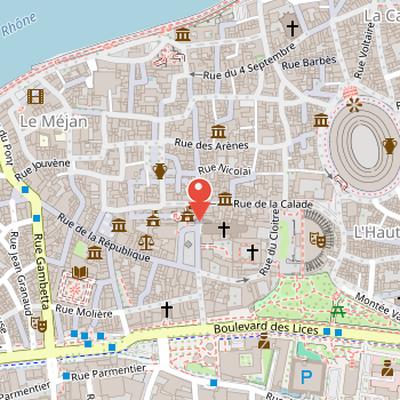
Nearby Objects
-
 Church of St. Trophime 20 m away
 -
 Town Hall of Arles 20 m away
 -
 Obélisque d'Arles 40 m away
 -
 Forum of Arles 120 m away
 -
 Gallo-Roman theatre at Arles 160 m away
Architecture and historical status
The cloister of Saint-Trophime, part of the former cathedral of Arles, is not attached to the nave or the transept. It communicates with the choir by a staircase of twenty-five steps and has an approximately rectangular plan. Construction of the north gallery began shortly after 1150, and the east gallery followed soon after. The west and south galleries were completed by the end of the 14th century, with the south gallery finished during the episcopate of Jean de Rochechouart between 1390 and 1398. The north and east galleries are in Roman style, while the west and south galleries are in Gothic style. The cloister has been classified as a historical monument since 1846 and has been part of the UNESCO World Heritage Site of Roman and Romanesque monuments of Arles since 1981.
Plan and Sculptural Program of the Cloister
The general plan of the Saint-Trophime cloister in Arles identifies a dense sculptural program organized through numbered figures and motifs. The legend includes biblical and saintly subjects such as Saint Jean, Saintes femmes, Saint Trophime, Resurrection, Saint Pierre, Resurrection de Lazare, Sacrifice d Abraham, Balaam, Pelerin d Emmaus, Christ ressuscite, Anges et Abraham, Saint Paul, Saint Jacques le majeur, Christ montrant ses plaies, Saint Thomas, Remise des tables de la Loi a Moise, Ascension, Saint Etienne, Lapidation de saint Etienne, and Saint Andre. Alongside these scenes and figures, the plan repeatedly records decorative and architectural elements, including acanthus leaves, human heads, eagle motifs, griffons, and buttresses. It also notes several additional figures such as Belier, La luxure, Second pelerin, Acrobate, and an eagle. The plan therefore presents the cloister as a space where religious narrative and ornamental carving are closely combined in its layout.
Sculpted Program of the Cloister
The general plan legend of the Saint-Trophime cloister in Arles presents an extensive sculpted program made up of numbered figures, scenes, and decorative motifs. Among the elements listed are animals and hybrid forms such as the ane, tarasque, eagles, lion heads, griffon and siren, monster, lion, goat head, and dragon figures, alongside ornamental details including vegetal decor, foliage, acanthus, and floral decoration. The legend also identifies architectural features such as buttresses and an angle holy-water stoup.
The narrative subjects cover episodes from the life of Christ and related biblical themes, including the Annunciation, the Annunciation to the shepherds, the Flight into Egypt, the Magi before Herod, the Adoration of the Magi, the Entry of Christ into Jerusalem, the Kiss of Judas, the Last Supper and the washing of the feet, Christ at the column, the Baptism and temptation of Christ, the Virgin and Child, the Coronation of the Virgin, and Pentecost. Other named scenes and figures include Judas, Herod, Gamaliel, Solomon, the Queen of Sheba, Constantine the Rider, and Saint Stephen being stoned.
The legend also includes historical and legendary subjects such as Charlemagne, Charlemagne and Turpin, the Blessing of the Alyscamps, the Hanging of the Barons, Sainte Marthe, Madeleine, and Samson. Several entries are noted as missing or damaged, such as a disappeared statue, showing that the plan records both preserved and lost sculpted elements within the cloister ensemble.
Romanesque Cloister Galleries
The Romanesque galleries are organized into three bays, divided by double ribs that rest on square pillars. Each bay opens onto the courtyard through four round arches, which are supported by paired round or polygonal colonnettes. The bays are separated by robust pillars that receive the weight of the double rib, giving the gallery structure a clearly articulated and functional rhythm.
Sculptural Program of the Romanesque Galleries
The Romanesque galleries of the Saint-Trophime cloister are defined by a sculptural program centered on the resurrection of Christ and the glorification of the city's patron saints, Saint Trophime and Saint Etienne. The northwest corner pillar depicts Saint Trophime as founder and first patron of the local abbey church. On the right side of Saint Trophime is Saint Peter, shown as prince of the apostles and the one who sent Saint Trophime to evangelize Gaul. On the left side is Saint John, who witnessed Christ's resurrection with Saint Peter. The statues of Saint Trophime, Saint Peter, and Saint John are considered of exceptional quality among Romanesque sculptures in Provence. Between Saint John and Saint Trophime, a bas-relief represents the tomb of Christ, while between Saint Peter and Saint Trophime another bas-relief shows the holy Marys purchasing spices for the embalming of Christ's body, a scene related in the Gospel according to Saint Mark.
Romanesque Galleries and Sculpted Narrative
The Romanesque galleries of the Saint-Trophime cloister combine architectural order with a dense sculpted program. In the north gallery, two median pillars present a simpler scene with three figures, while nearby reliefs show Christ surrounded by the two pilgrims of Emmaus. Christ is shown carrying a staff and a musette decorated with small flowers, and one pilgrim is identified through the symbols of pilgrimage to Saint-Jacques-de-Compostelle, including a staff, a pilgrim's gourd, and a bonnet with a shell. Another pillar presents Christ showing his wounds to Saint Thomas, with Saint James the Greater identified by an inscription on the book he holds to Christ's left and Saint Thomas on the right. The north-east corner pillar forms a composition symmetrical to the north-west pillar, with a statue of Saint Stephen in the center, Saint Paul on the left, and Saint Andrew on the right. Between the three statues are two bas-reliefs showing the Ascension of Christ and the stoning of Saint Stephen.
A gallery built shortly after the north gallery is wider but follows a similar overall arrangement. Its sculpted themes are organized around the life and passion of Christ. One pillar shows the flagellation of Christ, with Christ bare-chested and tied to a column, while Judas appears with a pouch containing the silver received for his betrayal. The next pillar has a central statue missing, leaving only the figures of King Solomon and Queen of Sheba. The southeast corner pillar is similar to those in the north wing. At the corner, a holy water font with a shell-shaped basin is supported by an atlante, and a statue of Gamaliel is present, identified in legend as the cousin of Saint Trophime. Two bas-reliefs flank the font: one shows the kiss of Judas, the Last Supper, and the washing of feet; the other shows the baptism and the temptations of Christ. The merchant scene of merchants counting coins is also represented, a rare subject that is likewise present on the friezes of Saint-Gilles and Beaucaire.
The Gothic Galleries of the Saint-Trophime Cloister
The Gothic galleries of the Saint-Trophime cloister consist of two vaulted galleries with ribbed vaults, opening onto the courtyard through two arcades supported by paired columns. The southern gallery has six bays divided by alternately slim and reinforced piers. Its iconographic program is entirely dedicated to Saint Trophime, the patron of the primatial church, and illustrates episodes from the romance of Saint Trophime, a poem composed between 1221 and 1226. These scenes include Christ blessing the Alyscamps cemetery in the presence of Saint Trophime, as well as episodes connected to a miracle involving a young knight. The narrative also shows a young knight who slapped Archbishop Turpin and was condemned to death, together with nine relatives, by Charlemagne. According to the scenes, all of the condemned were hanged on the Fourchon gibbet and later pardoned through Saint Trophime's intercession. The southern gallery also included niches that formerly housed statuettes. The western gallery, dated to the middle of the century, has seven bays separated by identical pillars. Its imagery includes the stoning of Saint Stephen, Samson killing the lion, Saint Martha and the tarasque, Saint Mary Magdalene kissing Christ's feet, and the coronation of the Virgin. Additional sculptural elements appear on the pillars: the southeast pillar shows a crouching figure supporting a holy water basin and images of Judas's kiss, the Last Supper, and the washing of feet from top to bottom, while the north pillar shows Saint Thomas, Christ displaying his wounds, and Saint James the Greater from left to right.
The Tapestries of Saint-Trophime
The Saint-Trophime complex includes a group of tapestries exhibited in the Romanesque chapter house north of the cloister, where they have been shown since the late 16th century. Six of these tapestries illustrate scenes from La Jerusalem delivree, with Godefroy de Bouillon leading the first crusade and Tancrede de Hauteville appearing as a central figure. Their brown border indicates that they were made in the workshops of the city of Felletin.
The first tapestry shows Godefroy de Bouillon kneeling before his tent while listening to the archangel Gabriel reveal God's will. The second presents the most faithful knights gathered around him before the coffin of Dudon, a knight who died in battle. The third depicts Clorinde from Persia, moved by the fate of Olinde and Sophronie, who were unjustly accused of theft and condemned to the stake; it also shows her imploring King Aladin, who grants grace to the couple. The fourth tapestry shows Godefroy de Bouillon wounded by an arrow, with an angel in the upper right corner gathering dictamnus and distilling its juice into water to wash wounds. The fifth and sixth tapestries share the same motif, with different borders, and represent the epic fight between the Christian Tancrede and the Saracen Argant.
A seventh tapestry, the only one woven in the Aubusson workshops and identifiable by its blue border, represents the birth of Mary. It belongs to the series Scenes from the Life of the Virgin, together with nine other elements displayed in the nave of the Saint-Trophime church. Its decoration is of Mannerist inspiration, marked by refinement and elegance in the figures.