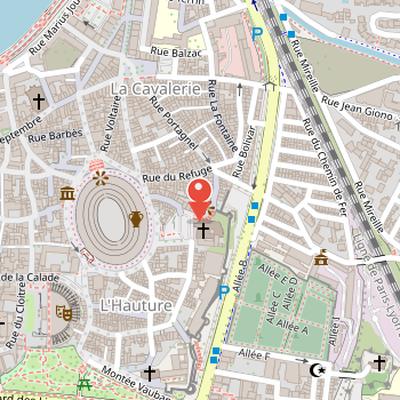
Notre-Dame-de-la-Major is an ancient Romano-Gothic collegiate church in Arles, in the Bouches-du-Rhône department. Situated at the northern end of Hauture hill, it overlooks boulevard Émile Combes to the east and the Arles arenas to the west. It was formerly the seat of the largest parish in the city and is one of the oldest churches in Arles.
The original church, built on a site of an ancient Roman temple dedicated to the Bonne Déesse, was consecrated in 452 by Archbishop Ravennius during the third council of Arles. This consecration is attested by an inscription on the façade, recorded in the Saint-Martin chapel before it disappeared in 1592 during restoration. The church was originally named Sainte-Marie-Majeure to distinguish it from another Sainte-Marie church in the Saint-Césaire enclosure.
The original building was replaced from 1152 by a Provençal Romanesque structure. It was erected as a collegiate church in 1551 by Pope Julius III and remained so until the French Revolution. The choir and apse were rebuilt in the 16th century, the bell tower was rebuilt in 1579, and the façade was renovated during the same period. Later additions included northern lateral chapels, southern chapels connected in 1913 to form a collateral, and a Virgin and Child statue added in 1867.
Nearby Objects
-
 Arles Amphitheatre 130 m away
 -
 Enclos Saint-Césaire 200 m away
 -
 Gallo-Roman theatre at Arles 250 m away
 -
 Church of St. Trophime 400 m away
 -
 Saint-Trophime cloister 400 m away
Location and Early History
The Notre-Dame-de-la-Major church of Arles is an ancient Romano-Gothic collegiate church in Arles, in the Bouches-du-Rhone department. It stands at the northern end of the Hauture hill, overlooking boulevard Emile Combes to the east and the Arles arenas to the west. The church was the seat of the largest parish in the city of Arles and is considered one of the oldest churches in the city. Its original building was consecrated in 452, during the third council of Arles, by Archbishop Ravennius. This consecration was attested by an inscription on the facade, which was recorded in the Saint-Martin chapel before disappearing in 1592 during restoration.
Historical Development and Architectural Changes
The church of Notre-Dame-de-la-Major in Arles was originally named Sainte-Marie-Majeure, in order to distinguish it from another church called Sainte-Marie in the Saint-Cesaire enclosure. It was built in 452 on the site of an ancient Roman temple dedicated to the Bonne Deeese, and it received an altar found on the site that is now conserved at the departemental museum of Arles antique. This altar is identical to the altar from the Attis temple in Glanum. The church also hosted the 5th Council of Arles under Childebert I.
The original church was replaced by a Provencal Romanesque style building starting in 1152. In the 16th century, the choir and apse were reconstructed, the facade was renovated, and northern lateral chapels were added. The bell tower was rebuilt in 1579 with a square base and a pyramidal top. In 1551, Pope Julius III erected the church as a collegiate church, a status it kept until the French Revolution. During the 17th and 18th centuries, it served as the parish church of municipal authorities. Later additions included a Virgin and Child statue in 1867 and the connection of the southern chapels in 1913 to form a collateral.
History and Religious Role
The church is located in the Old Town area now called La Roquette. According to its history, it housed a relic of Saint Mark's mandible, given by the Republic of Venice during a famine. It was also the site of annual pilgrimages held by the authorities on Saint George's Day for the blessing of horses. In terms of heritage protection, it was first listed as a historical monument on 23 October 1875 and has been classified as a historical monument since 28 September 1906.
Architecture and Later Alterations
The church combines Romanesque and Gothic elements. Its Romanesque nave has three bays, with a slightly broken barrel vault supported by doubleaux on massive pillars. The choir is Gothic, with a bay vaulted on ribbed cross vaults and a pentagonal apse that is equal in height and width to the nave. The Romanesque apse was semi-circular and decorated with basalt and porphyry colonnettes taken from an ancient temple. Eight of these colonnettes were offered to Catherine de Medicis in Arles in 1569 and were lost near Pont-Saint-Esprit during transport, while two remain at the former cathedral Saint Trophime, framing the stone altarpiece above a double-register sarcophagus used as baptismal fonts. The facade was redone in a sober Louis XIII style in the early 17th century, and the main door was rebuilt in 1654 after the model of the Notre-Dame-la-Principale church door by Louis Ferran. The bell tower is topped by a statue and a clock.
Interior Furnishings and Chapels
The interior contains several works of art and historic fittings distributed across different chapels. In the Chapelle Saint-Veran, a small polychrome marble altar supports a painted statue of Saint-Roch. In the Chapelle du Purgatoire, the furnishings include a polychrome marble statue sculpted by Emmanuel Carvalho, described as a Lisbonnais sculptor, and the statue has been inscribed as a historical monument since 1985. This chapel also retains two painted statues representing Saint Joseph and Jeanne d'Arc, and it had previously been dedicated to Saint Charles-Borromee.
Another important feature in the Chapelle du Purgatoire is the retable from the former Saint-Blaise church, which supports a painting by Carpenel dated 1742. The painting shows the Virgin Mary presenting the infant Jesus to Saint Blaise and Saint John, accompanied by an eagle and a book. Both the painting and its frame have been classified as historical monuments since 1980, and restoration work requires modifications to the retable and the temporary installation of the painting and frame in the chapel.
On the west side of the second south pillar, a Renaissance stone frame by Pierre Piau is identified by its broken curvilinear pediment and two fluted pilasters. Behind the bench of the confraternity, a trident-barred niche contains a 17th-century polychrome wooden statue of Saint Georges, which has been inscribed as a historical monument since 1944.
The Organ and Stone Tribune
The organ and its tribune at Notre-Dame-de-la-Major d'Arles have undergone several stages of reconstruction. A first organ was installed in 1698 on a newly constructed stone tribune by the Lyonnais builder Dufayet, who had also rebuilt the organ of Saint-Trophime in 1697. According to the archival price list, the instrument had only 8 stops on a single manual with 47 notes and a pedalboard with 8 notes. Its stops included Bourdon 8', Prestant 4', Nazard 2'2/3, Doublette 2', Tierce 1'3/5, Fourniture III ranks, Cymbale II ranks, and Cornet 5 ranks. In 1730, the instrumental part was reconstructed within Dufayet's case by Charles Boisselin.
The tribune itself is delicately carved stone. Its center displays the coat of arms of the chapter of canons with a Virgin and Child, while the lateral spandrels show cherubs playing instruments, with a guitar on the south side and a serpent on the north. The organ was entirely replaced in 1930 by the brothers Felix and Henry Vignolo from Marseille, with a neo-medieval case, and its instrumental part was rebuilt in the same year by the Lyon-based company Guironnet and Ruche. The organ has been silent since 1980 and is in very poor condition.