The Arles Amphitheatre, also known as Les arènes d'Arles, was built about two millennia ago on the Hauture hill. Constructed on the orders of Emperor Domitian during the Flavian extensions of the city, it replaced the Augustan enclosure erected a century earlier. Designed for large spectacles and a large audience, the arena combines classical features inspired by the Colosseum of Rome with an evacuation system made up of numerous access corridors. Its layout includes a central elliptical stage surrounded by stands and arcades on two levels. The structure measures more than 132 meters in length, originally had a crowning attic that has disappeared, and could seat 20,000 spectators. It is larger than the arenas of Nîmes. In the late 1st century AD, it became a sign of Romanization in Arles and the Western world.
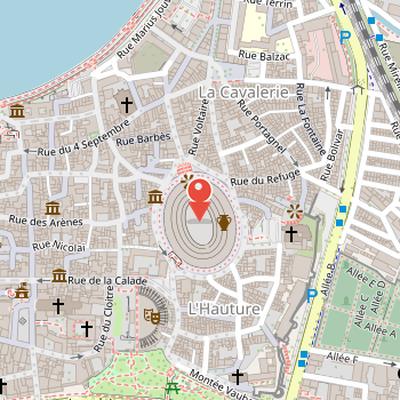
Nearby Objects
-
 Notre-Dame-de-la-Major d'Arles 130 m away
 -
 Gallo-Roman theatre at Arles 200 m away
 -
 Enclos Saint-Césaire 200 m away
 -
 Church of St. Trophime 250 m away
 -
 Saint-Trophime cloister 300 m away
Construction and Purpose
The amphitheater known as Les arenes d'Arles was built on the orders of Emperor Domitian during the Flavian extensions of the city. Erected about two millennia ago, it is regarded as the most important monument of the ancient Roman colony at Arles. Its architecture was designed to host large spectacles before a large audience, reflecting its function as a major public venue in the city.
Design and Roman Significance of the Arles Amphitheatre
The amphitheatre of Arles was built on the Hauture hill, replacing the Augustan enclosure erected one century earlier. Its design followed classical principles inspired by the Colosseum of Rome, with a central elliptical stage surrounded by stands and arcades on two levels. The structure also included an evacuation system made up of numerous access corridors, showing careful attention to the movement of spectators.
With a total length exceeding 132 meters, the amphitheatre was larger than the arenas of Nimes. It originally had an attic crowning that later disappeared, and it could hold 20,000 spectators. From the late 1st century AD, it stood as a sign of Romanization in Arles and in the Western world, linking the city to the architectural and cultural models of Rome.
From Roman Arena to Living Monument
The Arles Amphitheatre remained operational as a gladiator arena until the end of the Roman Empire. It hosted games organized by Emperor Gallus in 255 to celebrate victories in Gaul, large hunts and combats arranged by Constantine for the birth of his eldest son, and several spectacles given by Majorien. The games were renewed in 539 in the presence of Childebert, king of Paris, and the monument continued to be used under the episcopate of C?saire and after the city came under Frankish domination until about 550.
By the end of the 8th century, the amphitheatre had transformed into a bastide with four defense towers, over two hundred homes, and two chapels. This residential function continued until expropriation began at the end of the 18th century and was completed in 1825. The site was mentioned by the physician and geographer Jeroime Munzer in 1495, and in 1516 the king visited it and regretted its poor condition.
In the 19th century, the monument regained a festive and dramatic role in 1830 during celebrations of the capture of Algiers, when bullfighting was held there. It was classified as a historical monument in 1840 and inscribed on the UNESCO World Heritage List in 1981. In the 20th century, the Archaeological Commission demolished the last houses attached to the structure. The amphitheatre also continued to serve as a public venue, hosting the TV game Intervilles in 1998 against Martigues and in 2005 against Digne-les-Bains, as well as the final game between Pont-Saint-Esprit and Saint-Quentin.
Restoration and Heritage Management
The Arles Amphitheatre underwent a restoration campaign built around an intervention plan that included consolidation and the creation of a reference bay. The works, directed by Jean-Pierre Dufoix, Chief Architect and Inspector General of Historical Monuments, also planned waterproofing work for the bay and the use of archaeological references. Analyses and methods were used to rationalize interventions on other bays, showing a structured approach to the monument's preservation.
The Institut de recherche sur l'architecture antique (IRAA) was closely involved in the process and provided complete archaeological data study. Its contribution included surveyor measurements, photogrammetric surveys, stone-by-stone surveys, and control of reference profiles. Myriam Fincker, Architect attached to IRAA, also presented restoration framework proposals. These restoration works were featured in the brochure Arles-Objectif Patrimoine by the Centre d'etude et de recherche sur l'architecture et l'urbanisme.
The arena project was integrated into the MINOTEC program on images of ancient spectacle locations, with the European Communities Raphael program. It was also linked to the creation of an Agency for Ancient Heritage by the State and the Provence-Alpes-Cote d'Azur Region. This agency addressed monument restoration policies and public awareness, and its activities included dissemination of knowledge, cultural and artistic operations, professional training, public awareness, and monument enhancement.
A restoration campaign was completed in 2013 under Alain-Charles Perrot, Chief Architect of Historical Monuments, and the arenas were returned to the public after that work. The site also participated in the Plan Patrimoine Antique Provence-Alpes-Cote d'Azur for the restoration and enhancement of major ancient monumental ensembles. The restoration lasted ten years and represented one of France's largest heritage sites, with nearly a specified amount of euros dedicated to the effort.
Modern Use and Cultural Role
Today, the Roman amphitheatre is the most visited monument in the city of Arles in 2023. It hosts many events, including bullfights, Camargue races, theatrical performances, and musical shows. The amphitheatre combines the preservation of ancient heritage with active cultural life. During the summer, gladiator fights are presented every Tuesday and Thursday, with performers showing Roman customs and combat demonstrations. These activities make the monument both a historic site and a public venue for contemporary events.
Arles Amphitheatre in Popular Culture
The arenas of Arles have attracted attention in popular culture across several media. They inspired painters Vincent van Gogh and Picasso in Arles, and Picasso is noted as finding there a culture of bullfighting that was absent from his native Spain. The amphitheatre was also photographed by Edouard Baldus during the Mission heliographique and by Dominique Roman around 1860. In film, Heureux qui comme Ulysse includes several scenes set in the arenas of Arles. The site also appears in the 1972 British television series L'Aventurier, in the episode Pauvre Petite Fille riche, where the hero Gene Bradley drives a Fiat 124 Sport Spider into the arenas, prevents a helicopter landing, and rescues a young oil company heiress played by Judy Geeson. More recently, the 2022 game A Plague Tale: Requiem presents medieval arenas and shows the heroine Amicia de Rune exploring the medieval arenas and Arles in a realistic way.