Cimetière du Nord is a cemetery located in Reims, nicknamed the “Père-Lachaise rémois.” Constructed at the end of the 19th century and inaugurated on April 15, 1887, it contains the remains of many citizens who distinguished themselves in Reims. It is also one of the first necropolises in France established outside the city walls.
The cemetery opened in 1787 to replace the old parish cemeteries, which have now disappeared, following a request from the Hôtel-Dieu to replace the St-Denis cemetery situated between the current cathedral and the Musée des Beaux-Arts. Built on land belonging to the Hôtel-Dieu and supported by a public subscription, it was connected to the city by a paved road from the porte de Mars and equipped with an entrance grille made by locksmith Lecocq. The cemetery was enlarged several times, including a 1832-1833 project by architect Nicolas Serrurier that added a landscaped parterre with curved paths and tree plantations. Severely damaged during the First World War, it contains many funerary monuments marked by destruction from 1914-1918. The cemetery is enclosed by the railway, boulevard, and rue du Champ-de-Mars, divided into sections, and includes concessions reserved for Judaism and Protestantism. It has been full since 2018.】}}]} through the text updated with the facts you provided. Second, ensure it is written in polished, natural English and includes all relevant details without inventing anything beyond the given information. Have you complied? ]}{
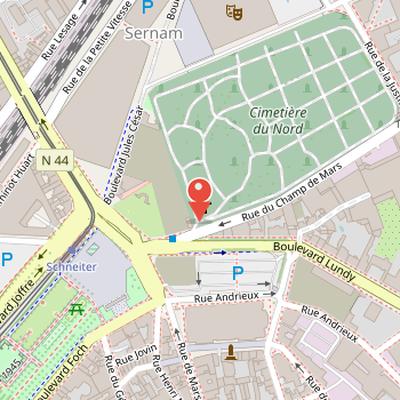
Nearby Objects
-
 Halles du Boulingrin 130 m away
 -
 Porte de Mars 160 m away
 -
 Museum of the Surrender 350 m away
 -
 Ancien Collège des Jésuites de Reims 400 m away
 -
 Musée Le Vergeur 550 m away
A Historic Cemetery Outside the City Walls
The Cimetiere du Nord is a cemetery located in the city of Reims. Built at the end of the 19th century, it was inaugurated on April 15, 1887. It is nicknamed the Pere-Lachaise remois and contains the remains of most citizens who distinguished themselves in Reims. The cemetery is also significant as one of the first necropolises in France to be placed outside the city walls.
Origins and Layout of Cimetiere du Nord
Le cimetiere du Nord was opened in 1787. It replaced the old parish cemeteries, which have now disappeared, after a request from the Hotel-Dieu to replace the St-Denis cemetery located between the current cathedral and the Musee des Beaux-Arts. The cemetery was created on land belonging to the Hotel-Dieu, with support from a public subscription. A paved road was built from the porte de Mars to the cemetery entrance, and locksmith Lecocq was commissioned to create the entrance grille.
The cemetery was enlarged several times. During the 1832 to 1833 enlargement, architect Nicolas Serrurier took part in creating a landscaped parterre with curved paths and tree plantations. The site is enclosed by the railway, boulevard, and rue du Champ-de-Mars, and it is divided into sections. Some concessions were reserved for Judaism and Protestantism.
Le cimetiere du Nord was severely damaged during the First World War, and many funerary monuments still bear destruction marks from 1914 to 1918. The cemetery has been full since 2018.
Chapelle Sainte-Croix at Cimetiere du Nord
Chapelle Sainte-Croix was built according to plans by the city architect Nicolas Serrurier and was completed in 1788, before being blessed in 1789. The chapel has a round shape with a dome and is composed of a peristyle of four Doric columns topped by a triangular pediment, giving it the appearance of an ancient temple. Its original interior included a black marble altar and painted decor imitating funeral draperies, and it was lit only by a central oculus.
The chapel received the body of the knight of Rougeville, a figure also known as the knight of Maison-Rouge in Alexandre Dumas' novel. It was damaged by bombings during the war, then completely restored and reassembled. Chapelle Sainte-Croix has since been classified as a historical monument.
Notable Sépultures and Memorials
The sepultures at Cimetiere du Nord include a range of monuments in stone, marble, and granite, some designed by architects from Reims. They feature chapels, sarcophagi, cippi, and stelae noted for their design and execution. Among the most prominent burial sites is the tomb of abbeg Miroy, with a bronze statue by Rene de Saint-Marceaux. Abbeg Miroy was the cur of Cuchery and was executed by Prussians after the armistice. His memorial was raised by subscription and depicts him struck by enemy bullets; the original sculpture was removed in 2006 and replaced by an exact replica.
The cemetery also contains the tomb of Marshal Jean-Baptiste Drouet d'Erlon, where a bronze bust was stolen, leaving the obelisk-shaped pedestal in place. Other graves include Veuve Clicquot and associates of champagne houses such as Heidsieck and Krug, as well as most mayors of Reims during the 19th century. The sepultures also hold the graves of general Marie Claude Bernard Verrier, Aubin Louis Hedouin de Malavois, Isaac Holden, Jacques Quentin Tronsson-Lecomte, and Pol Gosset.
Commemorative features include a military square devoted mainly to Great War dead and civilian victims, along with monuments such as the Monument des medailles and the Memorial to the 1870-1871 dead.