The Ancien Collège des Jésuites de Reims is a historic building in Reims, in the Marne department. Founded in 1608 by Jesuits, it was established after authorization granted by Henry IV. The college initially taught Humanities, Philosophy, and Mathematics, and later added Theology after its layout was reorganized to include a chapel and courtyard. Closed in 1762 when the Jesuits were banned from the kingdom of France, the buildings were then used for other educational and institutional purposes during the 18th century.
Over time, the complex housed different occupants, including a hospice and later an educational institution for poor girls. It remained in use for lodging and education into the 20th century. The city of Reims has owned the property since 1976 and groups regional, international, and local organizations there. The Institut d'études politiques de Paris currently occupies the building. Its library and refectory are recognized as monuments of Baroque art.
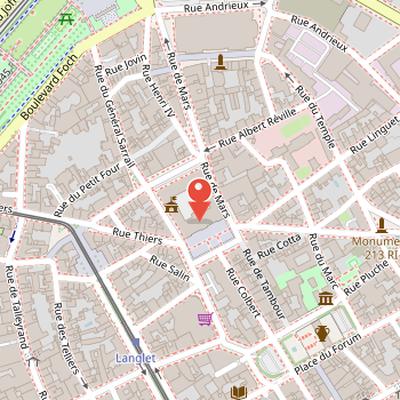
Nearby Objects
-
 Musée Le Vergeur 200 m away
 -
 Halles du Boulingrin 250 m away
 -
 Porte de Mars 300 m away
 -
 Place Royale 300 m away
 -
 Cimetière du Nord 400 m away
History and Architectural Significance
The Ancien College des Jesuites de Reims is a building in Reims, in the Marne department. It was founded in 1608 by the Jesuits and closed in 1762, when the Jesuits were banned from the kingdom of France. During the 18th century, its buildings were then used for other educational projects. Since 1976, the property has belonged to the city of Reims, which groups regional, international, and local organizations there. The Institut d'etudes politiques de Paris currently occupies the site. The library and refectory are notable as monuments of Baroque art, giving the building an important architectural and cultural value within the city.
Founding and Early Development
According to the history of the site, Nicolas Brulart de Sillery asked Henry IV for authorization for the Jesuits to open a college in Reims. The king granted this request by letters patent, allowing the Jesuit fathers to found the College at Reims. François Brulart, chaplain of the king, then bought the hotel de Cerny for the Jesuits to use and also donated funds for arranging the school there. The Jesuits opened their classes at the college on the specified date, teaching Humanities, Philosophy, and Mathematics.
Further donations supported the college's academic life and expansion. In 1610, François Brulart gave a farm and a priory to maintain a philosophy chair, and in 1614 he donated an annuity for the opening of a second philosophy chair. The Jesuits bought the neighboring Saint-Maurice priory in 1615 for local extension. In 1619, François Brulart again donated funds, allowing the college to take its current layout with a chapel and courtyard.
From Jesuit College to Modern Teaching Site
The college followed the Jesuit Ratio Studiorum program and was organized to support a broad curriculum, with teaching in grammar, philosophy, rhetoric, dance, theater, music, and fencing. Jesuit pedagogy included Latin courses and alternated arts and sciences teaching times. The college aimed to prepare pupils to obtain university diplomas, which were granted by letters patent in 1609. It also had an attached internat and reportedly hosted up to 1,000 students. After a reorganization of the college layout, theology teaching was added to the curriculum. These developments overshadowed the University of Reims and caused conflicts.
The history of the buildings later changed as the Jesuits were banned from France and their goods were seized, leading to the merger of the Reims college with the College des bons enfants. The general hospital then took possession of the buildings, which were used as a hospice until 1772. In 1791, Magneuses, founded by Nicolas Colbert's widow, settled in part of the college for the education of poor girls. Magneuses occupied the site until the mid-twentieth century, before the buildings were used for legal students' lodging in 1967. The municipality acquired the buildings in 1976 and hosted Reims Planetarium there. Major works from 2013 to 2015 adapted the premises for current teaching. Courses continue today at Reims within the Lyccee Saint-Joseph de Reims, and the site also receives the Euro-American Sciences Po program and, from the 2015 academic year, the Europe-Africa program.
Historical Layers and the Jesuit Library
The Ancien College des Jesuites de Reims has been restored and arranged by Histoire as a multi-activity site, while retaining the architectural and cultural interest of its garden, courtyard, refectory, vestibule, kitchen, elevations, and interior decor. The ensemble is legally protected as a classified historic monument, and the staircase is also classified as a historic monument, with its dates not specified. Histoire has additionally preserved vine stocks that escaped phylloxera and are classified as the old Verjus grape variety.
A major element of the building is its Jesuit library, located under the roof and built between 1670 and 1680. It was commissioned by two Reims families, Hachette and Rogier, and began with 8000 books confiscated after the dissolution of the Order in 1764. These books formed the first collection of the Reims library. The library is noted as a French baroque art masterpiece, with rich decor including garlands, volutes, and cherubs, as well as a coffered ceiling with medallions and small cabinets lit by dormer windows. The entrance bears the arms of the Rogier and Hachette families.
The building later became a hospice, and the library was converted into a linen room.
Interior Spaces and Later Uses
The Ancien College des Jesuites de Reims preserves several interior spaces that reflect different phases of its history and later reuse. Histoire's refectory is located in the same wing as the library, next to the kitchen. It is decorated with woodwork and paintings by Jean Helart (1618-1685). These paintings depict the lives of Ignace de Loyola and Francois-Xavier, and the refectory also includes images of Saint Francois-Xavier and of Ignace de Loyola convalescent visited by Saint Peter. The refectory has a 19th-century appearance dating from 1847.
The site also preserves the vaulted hall of the Benedictine Saint-Maurice priory from the 16th century. This hall contains stoves with taps from 1900, associated with the First Empire.
Beyond these historic rooms, the complex has taken on new functions. Since 1990, the wing along rue Gambetta has hosted the FRAC Champagne-Ardenne, which offers exhibition space for works by promoted artists. The wing along rue du Barbatre has been converted into a house of associations, providing offices and rooms for activities.