Porte de Mars is a Roman monument in Reims, France, dating from the Roman period. Named after a nearby temple dedicated to Mars, the Roman god of war, it is the widest arch of the Roman world. The monument was classified as a historic monument in 1840.
The Porte de Mars is the only remaining arch of the four monumental arches mentioned in the history of the site. The layout of the Bas-Empire enclosure relied on these existing arches, which were transformed into access gates, with the north arch becoming the Porte de Mars and marking the northern entrance of the city. The arch was later included in the Château des Archevêques around 1228, and some elements remained visible after the structure was destroyed in 1595 by order of Henri IV. It was partially uncovered in 1677, rediscovered in 1816, fully cleared in 1844, and completely excavated and restored in 1854. The monument measures 33 meters long, 13 meters high, and 6.40 meters thick, and its decoration includes medallions such as the Roman she-wolf with Romulus and Remus and a damaged scene of Leda and Zeus in the form of a swan.
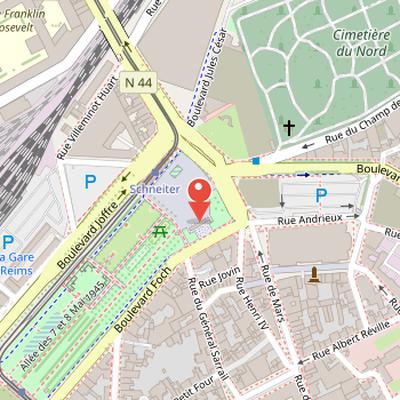
Nearby Objects
-
 Halles du Boulingrin 150 m away
 -
 Cimetière du Nord 160 m away
 -
 Ancien Collège des Jésuites de Reims 300 m away
 -
 Museum of the Surrender 350 m away
 -
 Musée Le Vergeur 500 m away
Roman Monument and Historic Status
La porte de Mars is a Roman monument in Reims, France, dating from the Roman period. It takes its name from a nearby temple dedicated to Mars, the Roman god of war. The monument is noted as the widest arch of the Roman world, which gives it particular architectural significance. In addition to its historical and architectural value, La porte de Mars was classified as a historic monument in 1840.
History of the Porte de Mars
The Porte de Mars is the only surviving arch of the four monumental arches that once structured the Bas-Empire enclosure. In this layout, the existing arches were transformed into access gates, and the northern arch became the Porte de Mars, marking the northern entrance to the city. Around 1228, it was incorporated into the Chateau des Archeveques. During a later reconstruction of the rampart, the arcades were blocked and a new Porte de Mars with a drawbridge was built 100 meters to the east. This later gate stood on the site of the Boulingrin market, which was excavated in 2011, and it disappeared in the mid-seventeenth century when the rampart was dismantled.
After the destruction of the Chateau des Archeveques in 1595 by order of Henri IV, some elements of the walled-up Porte de Mars remained visible. The monument was partially uncovered for the first time in 1677, when initial surveys of its decoration were carried out. It was truly rediscovered in 1816, then fully cleared of protective debris in 1844 during the dismantling of the ramparts. The Porte de Mars was completely excavated and restored in 1854, marking the main stages in its recovery as a historic monument.
Architecture and Decorative Program
The Porte de Mars is an arch measuring 33 meters long, 13 meters high, and 6.40 meters thick. Its design includes a calendar of fieldwork represented by a series of medallions. Under the west arcade, a square medallion shows the Roman she-wolf suckling Romulus and Remus, together with Faustulus and Acca Larentia. This scene recalls the connection between Reims and Rome, and it relates to a local legend that says Reims was founded by Remus or by his companions after they fled Rome. Under the east arcade, a damaged medallion depicts Leda and Zeus in the form of a swan. Grooves are visible on the floor of the central arcade to guide the wheels of vehicles. The Porte de Mars is not a triumphal arch: in the Roman era, triumphal arches were reserved exclusively for Rome, while other ancient arches, including this one, were monumental structures not linked to Roman triumphs outside the city.
Preservation and Commemoration
La porte de Mars was preserved by being walled into the enclosure of the chateau des Archeveques. The dismantling of the rampart began in 1840, and Prosper Merimee worked to mobilize public opinion and funds in order to save the arc. Near the monument, a tree and a plaque honor soldiers who served in the Orient during the First World War. The plaque also commemorates Alexandre de Serbie from the First World War.
Restoration and Urban Setting
A new restoration campaign for Porte de Mars was initiated in 2015 and continued through 2023. During this work, the monument was fully covered. By the end of 2018, the concrete roof that had affected waterproofing was replaced with a lead roof, a rainwater drainage system was added, and the architrave was restored to continue the reconstructed fragment. A second sponsorship campaign was then launched to restore the facings and decorations of the gate, and the second restoration phase began in 2019 with a planned duration of 18 months.
The restoration work also took place in a changing urban context. Since the 2011 traffic plan changes in Reims city center, the Porte de Mars had benefited from improved visibility and pedestrian access. These changes included the removal of the Place de la Republique roundabout and the extension of pedestrian promenades. In 2011, ruts under the gate's porch and an aqueduct along the gate were also rediscovered. Later, the refurbishment of Hautes-Promenades between 2018 and 2020 created a large square in front of the gate.
Other Gallo-Roman Arches
The Porte de Mars is mentioned alongside several other Gallo-Roman arches in Durocortorum. One of these was the Porte Bazee, also called the Porte Collatice, which was originally a monumental arch at the southern entrance to the city. It is described as resembling the Porte de Mars and as forming part of the cardo axis. Its name is said to derive from porta Basilicaris, because it gave access to the suburbs churches, and it was also the origin of the voie Cesaree leading to Rome.
Another related monument is the Porte de Venus, identified as the western arch of the Gallo-Roman city and located at place Myron-Herrick opposite the Opera. Excavations carried out in 2007 and 2008, before construction of the tramway line, revealed monumental foundations there. The arch, constructed in the second century CE, had dimensions similar to the arc de Mars and marked the decumanus passage in the ancient city center. Beneath it, a vaulted sewer measuring 2.90 m high and 1 m wide was discovered.
The existence of a Roman Porte de Ceres remains unconfirmed, although the discovery of the Porte de Venus supports the hypothesis of a fourth arch under the current esplanade Ceres.