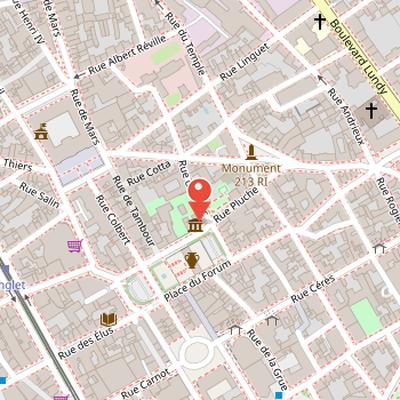
Musée Le Vergeur is a museum-hotel in Reims, located on Forum square at the corner of Rue du Marc, between the house of the Counts of Champagne and the Cryptoporticus. The complex is composed of two building sections, including an oldest part dating from the 12th century, first owned by Eudes de Bourgogne. The section along Rue du Marc was profoundly modified in Renaissance style by Nicolas le Vergeur. After extensive damage during the First World War, when only the walls remained after a fire, the building was restored by architect Adolphe Prost under Hugues Krafft’s direction to closely match its original appearance. The museum retains a room with Gothic windows and a French-style ceiling documented by Viollet-le-Duc. Its courtyard and garden bring together architectural remains from the city, including Romanesque arcades, portals, a porch, and a Templar knight effigy. The museum was created in 1932, became Hugues Krafft’s residence, and was later bequeathed to an association that converted it into the current museum.
Nearby Objects
-
 Place Royale 150 m away
 -
 Ancien Collège des Jésuites de Reims 200 m away
 -
 Reims Cathedral 350 m away
 -
 Halles du Boulingrin 400 m away
 -
 Reims Opera House 400 m away
Architecture and History of Musee Le Vergeur
Mussee Le Vergeur is located between the house of the Counts of Champagne and the Cryptoporticus on Forum square, at the corner of Rue du Marc. Known as a museum-hotel, it is made up of two building sections. The oldest part dates from the 12th century and had Eudes de Bourgogne as its first owner. The section along Rue du Marc was profoundly altered in the Renaissance style by Nicolas le Vergeur, while the porch on Rue du Marc and the window arrangements were constructed by the Beguin de Savigny family. In 1662, the property passed to Nicolas Coquebert, who added his monogram with entwined N and two Cs on a first-floor window. It later belonged to the Clicquot-Ponsardin family, owners of Champagne Couvert, who named it the Hotel Couvert, and then to the Belleau family. The courtyard contains two series of drawings, including eight medallions representing faces and six panels depicting society scenes. A cellar pillar also bore an inscription referring to Pierre Dercle, Doctor of Theology and former Prior in 1486. The building retains a room with Gothic windows and a French-style ceiling documented by Viollet-le-Duc. Heavily damaged during the First World War, when only the walls remained after a fire, it was restored by architect Adolphe Prost under Hugues Krafft's direction to closely match the original. Krafft then used the building as his residence and displayed his collections there before his death in 1935. After being bequeathed to an association, it was converted into the present museum. The building is classified as a historic monument, and the Society of Friends of Old Reims bought the building across Rue du Marc, now a square.
Courtyard and Garden
The courtyard and garden are arranged with architectural remains from the city and are set within an intimate garden. Among the elements displayed are Romanesque arcades from the former Templar church, the portal from the cloister of Saint-Pierre le Vieil, and the portal and porch of the Saint-Marcoul hospital. The museum courtyard also exhibits a Tete de faune collected in Reims and stored there, as well as the gisant of a Templar knight. Together, these features give the courtyard and garden a character shaped by historic fragments brought together in a single setting.
Collections and Interior Displays
Created in 1932, Musee Le Vergeur brings together collections accumulated by Hugues Krafft during his life and travels. The collections remain the property of the Societe des Amis du Vieux Reims, while the musee des Beaux-Arts manages its scientific administration. Hugues Krafft owned the hotel from 1909 to 1935, and the museum reflects this history through a varied display of objects and interiors. Its holdings range from Antiquity to the 19th century and include fifty engravings by Albrecht Durer, Renaissance and neo-Gothic furniture, and works from Asia and the Orient collected during Krafft's travels in the 19th century. The museum also presents 19th-century period rooms, including a bedroom, kitchen, bathroom, and smoking room. A garden and an architectural promenade are part of the visit, and the collections also include a Bleuette doll. In the 1980s, the museum received a donation from the Pommery family, which added two busts representing Alexandrine Pommery and Louis Pommery, as well as two portraits of Madame Louis Pommery and Louis-Alexandre Pommery.