The Museum of the Surrender is a history museum founded by the city of Reims in 1985. It is located in part of the Franklin-Roosevelt high school building in Reims, in the Marne department of Grand Est, France. The museum commemorates the signing of the first part of the Nazi Germany capitulation acts. The surrender room in the building is classified as a historical monument.
The site is linked to events at the end of the Second World War. The buildings had been requisitioned by the German occupant before the American Oise administration managed the northeast quarter of France. The headquarters of the 101st Airborne Division was installed there, and Dwight David Eisenhower established the Supreme Headquarters Allied Expeditionary Force (SHAEF) in the modern and technical college on rue Jolicœur, now the Franklin-Roosevelt high school of Reims. The location lies near the Paris-Metz-Germany railway line, described as a strategic axis.
After Adolf Hitler’s suicide, Admiral Dönitz sent emissaries to prepare a separate surrender act with the Western Allies. Several trips took place between May 5 and May 7, 1945, before the Allies accepted an unconditional total surrender valid for the whole of Europe. The surrender of the German armed forces was signed on May 7, 1945, at 2:41 a.m. in a document written in four languages. It was signed by General Walter B. Smith for SHAEF, along with other Allied officers. The German delegation included Generaloberst Alfred Jodl, Major Wilhelm Oxenius, and Admiral von Friedeburg. The English text is the only authoritative version; there is no French version. After the fall of Berlin, Stalin immediately demanded a new signature, and Ivan Sousloparov, Soviet military mission commander in France, had not received Moscow’s approval to accept German capitulation.
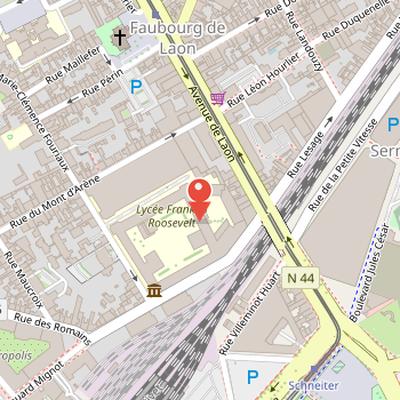
Nearby Objects
-
 Porte de Mars 350 m away
 -
 Cimetière du Nord 350 m away
 -
 Halles du Boulingrin 450 m away
 -
 Ancien Collège des Jésuites de Reims 650 m away
 -
 Foujita Chapel 800 m away
Museum of the Surrender in Reims
The Museum of the Surrender is a museum of history founded by the city of Reims in 1985. It commemorates the signing of the first part of the Nazi Germany capitulation acts. The museum is located in part of the Franklin-Roosevelt high school building in Reims, in the Marne department of the Grand Est region of France. Within the building, the surrender room is classified as a historical monument.
Wartime Requisition and Allied Headquarters
Before the American Oise administration managed the northeast quarter of France, buildings in Reims were requisitioned by the German occupant. The site later became associated with Allied military command, as the headquarters of the 101st Airborne Division was installed in the buildings. Dwight David Eisenhower also installed the Supreme Headquarters Allied Expeditionary Force (SHAEF) in the modern and technical college on rue Jolicur, which is now the Franklin-Roosevelt high school of Reims. The location was near the Paris-Metz-Germany railway line, a strategic axis, giving the site added importance in its wartime setting.
The 1945 Surrender Signing
The Museum of the Surrender is linked to the signing of the German surrender at 2:41 a.m. on Monday, May 7, 1945. After Adolf Hitler's suicide, Admiral DOnitz sent emissaries to prepare a separate surrender act with the Western Allies, and several trips took place between May 5 and May 7, 1945. The Allies rejected any partial arrangement and accepted only an unconditional total surrender valid for the whole of Europe. The German delegation included Generaloberst Alfred Jodl, chief of the German staff and deputy to Marshal Keitel; major Wilhelm Oxenius, aide-de-camp to Alfred Jodl; and Admiral von Friedeburg, chief of the German Navy. The surrender document was written in four languages and signed for the Allied forces by General Walter B. Smith, chief of staff to General Eisenhower, representing SHAEF, along with other Allied officers. There is no French version of the document, and the English text is the only authoritative version.
The Reims Signing and Its Aftermath
After the fall of Berlin, Stalin immediately demanded a new signature, and the act signed at Reims was treated as only preliminary to an official ceremony in Berlin. Ivan Sousloparov, commander of the Soviet military mission in France, took the initiative to sign the capitulation act even though he had not received Moscow's response or approval from the hierarchy. Stalin insisted on this later ceremony, and his conditions were accepted in order to reassure him about the intentions of the Western allies. He feared that the Reims capitulation was only partial, like those at Lunebourg and in Italy, and that it could open the way to a reversal of alliance between the Western powers and Germany. The signing at Reims was also marked by political tensions in its preparation: France was excluded from the arrangements, General Francois Sevez was summoned at the last moment and signed only as a witness, while General de Lattre had been officially designated for the signing. Eisenhower refused to attend because Marshal Keitel was absent. The act itself was very short and hurried, and the draft prepared by jurists of the European Advisory Commission was not used. A new signature was required to satisfy the interests of the allied countries, and May 8, 1945 became the official date of the Berlin surrender. Over time, the Reims surrender fell into relative oblivion.
Interior Muséographie and Exhibits
The muséographie is arranged across several rooms on the ground floor. One room presents a film that shows period images, providing historical context and showing the actors involved in the signature. The film is available in French, German, English, and Russian. Another room displays costumes and information on the units present in Reims, including the FFI, English aviators, and German aviators, together with small objects. A third room features members of the inter-allied staff and exhibits medals and newspapers dated May 8, 1945. The musieography also includes a war room preserved in its original state, with operation maps and photographs of participants from the memorable day.