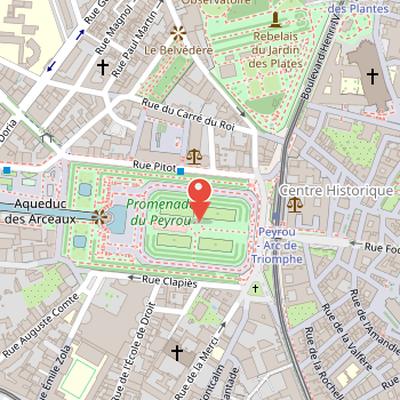
The equestrian statue of Louis XIV stands in the Promenade du Peyrou in Montpellier, Hérault. Erected in 1828, it is a bronze statue representing King Louis XIV and the second representation of the king in Montpellier. A previous version was destroyed during the French Revolution. The statue was sculpted by Jean Baptiste Joseph De Bay père, cast by Auguste-Jean-Marie Carbonneaux, and based on designs by Jules Hardouin-Mansart. The site was classified as a monument historique in 1943, and the statue itself was classified in 1954. Its history is linked to the Promenade du Peyrou and to earlier decisions about erecting an equestrian statue in honor of the king. On 31 October 1685, the Estates of Languedoc voted for such a monument, with discussions over its placement reflecting political, economic, and philosophical interests.
Nearby Objects
-
 Promenade of Peyrou 60 m away
 -
 Arc de Triomphe of Montpellier 130 m away
 -
 Sainte-Anne Church 300 m away
 -
 Place de la Canourgue 300 m away
 -
 Hôtel Richer de Belleval 300 m away
The Equestrian Statue of Louis XIV in Montpellier
The equestrian statue of Louis XIV stands in the Promenade du Peyrou in Montpellier, Hrault, and was erected in 1828. It is a bronze statue representing King Louis XIV and is the second representation of the king in Montpellier. A previous version of the statue was destroyed during the French Revolution. The work was sculpted by Jean Baptiste Joseph De Bay pere, cast by Auguste-Jean-Marie Carbonneaux, and based on designs by Jules Hardouin-Mansart. The statue itself was classified as a monument historique in 1954, while the site on which it stands was classified as a monument historique in 1943.
History of the Statue
Montpellier's equestrian statue of Louis XIV is described as one of the first representations of the king. The history of such monuments began earlier in other places, with first representations in Paris at place des Victoires and in Versailles at place d'Armes. In other French cities, equestrian statues of Louis XIV were commissioned or erected over several decades: in Rennes, a statue was commissioned in 1686 and erected in 1726; in Dijon, one was commissioned in 1686 and erected in 1725; in Lyon, one was commissioned in 1685 and erected in 1713; and in Bordeaux, a statue on place Royale was inaugurated in 1749. The history of the Montpellier monument is also linked to the Promenade du Peyrou. On October 31, 1685, the Estates of Languedoc voted to erect an equestrian statue in honor of the king.
Placement and Planning
The decision-making process for the monument was complex because it involved differing political, economic, and philosophical interests. One requirement was that the statue be erected in a central royal square, as a sign of the king reigning over his subjects. At the same time, the Count of Broglie and Intendant Lamoignon de Baville proposed placing it in fields to demonstrate the king's reign. The architectural structure of walled cities also created a practical limitation, since such settings did not allow for large edifices.
Commission, Journey, and Revolutionary Loss
Suggestions for possible locations within the city included the College of Humanities and the Place de la Canourgue, but the commission for the statue was placed in Paris, at rue de Bourbon, on September 23, 1686. The work was carried out by sculptors Pierre Mazeline and Simon Hurtrelle, based on designs by architect Jules Hardouin-Mansart and under the supervision of Cardinal de Bonzy. The bronze statue was completed in a Parisian workshop in 1692. It measured 4.5 meters in height and 4.8 meters in length, and the project extended over 33 years.
Its installation was delayed by the naval war between England and France. Because of its weight of 19 tons and the lack of transport equipment, it could not be moved by sea from Paris. In 1713, it left Paris by river and canal, traveling via the Seine to Le Havre, then to Bordeaux, up the Garonne River, through the Canal des Deux Mers, Frontignan and Villeneuve-les-Maguelone lagoons, and up the Lez to Port Juvnal in Montpellier. In Bordeaux, the statue fell into the water after the ship destabilized because of the large number of onlookers, and it took months to recover. The rescue damaged the statue, but it nevertheless arrived in Montpellier in August 1717.
The statue was installed on the Promenade du Peyrou on February 10, 1718, and inaugurated on February 27, 1718, in the presence of the Intendant de Basville. It bore an inscription written by historian de Mandajors, translated as: "To Louis the Great, the people of Occitania, safe, vowed this statue and erected it after his death." Voltaire approved the statue in The Age of Louis XIV and interpreted it as being dedicated to Louis the Great after his death. The monument had outlived Louis XIV, who had died three years earlier.
Impact of the July Revolution
Negotiations were interrupted by the July Revolution of 1830, also known as the Three Glorious Days. The revolution caused hostility toward the House of Bourbon from part of the population, and the House of Bourbon was replaced by the House of Orlans.
Delayed Reinstallation
The placement of the statue was deliberately delayed because of political hostility. During this period, there was even a suggestion to replace the statue's head with that of Pierre-Paul Riquet. On June 26, 1833, interim Mayor Dessale-Possel made a statement on the matter. After a half-century absence, the statue was reinstalled on August 29, 1838. Mayor Zoe Granier led the reinstallation discreetly and without ceremony.
Related Historical Sites and References
The equestrian statue of Louis XIV is linked to several related sites and reference topics. These include the Porte du Peyrou, also known as the Arc de Triomphe, and the Rue Foch. It is also connected to broader historical documentation, such as the list of historic monuments in Montpellier and the list of works of art deliberately destroyed or damaged by revolutionaries during the French Revolution.