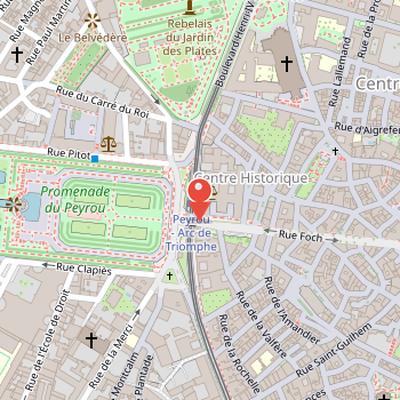
The Gate of Peyrou is the Arc de Triomphe of Montpellier, erected in 1691 by Augustin-Charles d'Aviler from drawings by François II d'Orbay. It stands on one of the highest points of the city, at an altitude of 57 meters, and forms part of the Promenade du Peyrou, which was classified as a historical monument in 1954. The monument symbolized royal power and provided access to the equestrian statue dedicated to King Louis XIV. It also replaced an earlier drawbridge, crossing a ditch that marked the ramparts of the commune enclosure, with a stone bridge 8 meters wide. The structure measures 15 meters high and 9 meters wide, with a portico opening 5 meters wide and 8 meters high. Its decoration includes four medallion bas-reliefs made by Philippe Bertrand in 1694, two facing the city and two facing the countryside, as well as inscriptions praising the reign of Louis le Grand.
Nearby Objects
-
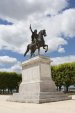 Equestrian statue of Louis XIV 130 m away
 -
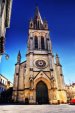 Sainte-Anne Church 200 m away
 -
 Promenade of Peyrou 200 m away
 -
 Place de la Canourgue 200 m away
 -
 Hôtel Richer de Belleval 200 m away
The Arc de Triomphe at Peyrou
The Gate of Peyrou is the Arc de Triomphe of Montpellier, erected in 1691 by Augustin-Charles d'Aviler. It was designed from drawings by Francois II d'Orbay. The monument symbolizes the power of royalty and provides access to the equestrian statue dedicated to King Louis XIV. It is part of the Promenade du Peyrou, which was classified as a historical monument in 1954.
Architecture and Setting of the Gate of Peyrou
The Gate of Peyrou, also called the Arc de triomphe de Montpellier or Arc de triomphe du Peyrou, was built on one of the highest points of the city, at an altitude of 57 meters. It gave access to the Puy d'Arquinel, a stony place called Peyrou. Before its construction, a drawbridge crossed a ditch that marked the ramparts of the commune cloture; this was replaced by an 8 meter wide stone bridge.
The monument measures 15 meters high and 9 meters wide. Its portico has an opening 5 meters wide and 8 meters high. Construction required the extraction of more than 3,000 cubic meters of stone, taken mostly from the garrigues near Montpellier and from Pignan, Saint-Jean-de-Vedas, Pondres, and Saint-Genies-des-Mourgues.
The arc was designed by Augustin-Charles d'Aviler according to drawings by François d'Orbay. It includes four medallion bas-reliefs made by Philippe Bertrand in 1694. Two bas-reliefs facing the city show the junction of the two seas by the royal canal of Languedoc and the destruction of heresy, while the two facing the countryside refer to the victories of the king.
Inscriptions and Sculptures
The Gate of Peyrou carries an inscription on its triumphal arch praising the reign of Louis le Grand. Its decorative program also includes medallions by Philippe Bertrand, among them one showing the junction of two seas by the Canal royal du Languedoc and another depicting the destruction of heresy. Four allegorical medallions glorify the "Grand" king, including one referring to the revocation of the Edict of Nantes. The inscriptions and sculptures therefore present the monument as a celebration of royal power and of events associated with Louis XIV, who revoked the Edict of Nantes, a decree that had granted religious freedom to Protestants from 1598 to 1685.