Rockstore is located in the center of Montpellier and occupies a building constructed in the 19th century. Its history begins with the church of the Cordeliers Franciscan monks convent, consecrated by Cardinal Foucaud in 1264. The site later passed to the Observantins in 1521 and became known as the church of the Observance. Destroyed and rebuilt several times during the Wars of Religion, it later became a Protestant temple, then a Catholic church again after the revocation of the Edict of Nantes in 1685. In 1821, the building was rebuilt in a neoclassical style with a triangular pediment facade. Over time, it was used for printing, became Montpellier’s first garage, and was converted into a cinema in 1927 before taking the name Rockstore in 1987. The facade includes the rear of a red Cadillac Series 62 installed above the door in 1986, which has become a symbol of the place. The building was classified as a historical monument in 1998.

Nearby Objects
-
 Opéra national de Montpellier 300 m away
 -
 Comédie Square 300 m away
 -
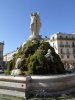 Fontaine des Trois Grâces 300 m away
 -
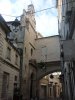 La chapelle Sainte-Foy 400 m away
 -
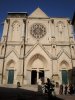 Saint-Roch Church 500 m away
Historic Setting in Central Montpellier
Rockstore is located in the center of Montpellier. It occupies a building constructed in the 19th century, giving the site a historic architectural setting within the city. Before its current use, the building housed a Franciscan convent and later a Protestant temple. These former functions add to the building's layered history and its significance as part of Montpellier's urban heritage.
From Franciscan Church to Rockstore
The site now occupied by the Rockstore has a long religious history. In 1264, it was consecrated by Cardinal Foucaud as the church of the Cordeliers Franciscan monks convent. A crypt lies under the current hall, and the monks were buried there. In 1521, the Observantins, another Franciscan branch, replaced the earlier community, and the building became known as the church of the Observance. During the Wars of Religion, it was destroyed and rebuilt several times on a smaller site. After the wars, it became a Protestant temple, then returned to Catholic use following the revocation of the Edict of Nantes in 1685. Charles Bonaparte, father of Napoleon Bonaparte, died there of stomach cancer and was buried there before his ashes were transferred to Saint-Leu-la-Foret. The convent was sold as national property in 1791, and in 1803 it was purchased by the Protestant Church consistory of Montpellier.
From Historic Building to Rockstore
The building now known as the Rockstore was rebuilt in 1821 in a neoclassical style, with a facade marked by a triangular pediment. Its use changed repeatedly over the following century: in 1870 it housed the Central Printing House of the Midi, run by the Hamelin brothers, and in 1903 it became the citys first garage, under the name Modern' Garage. In 1927 it was converted into a cinema called Odeon, and in 1928 it screened an early premiere of Abel Gance's Napoleon. The venue was renamed Grand Odeon in 1979 and became a disco temple before taking the name Rockstore in March 1987.
A distinctive element of the facade was added in 1986, when the rear of a red Cadillac Series 62 was installed above the door. The car has since symbolized the place and become a tourist attraction. The building was classified as a historical monument on July 26, 1998, and the city of Montpellier acquired its walls on December 18, 2006. Renovations in 2013 uncovered archaeological remains, leading to modifications that cost 150000 euros.
As a concert hall, the Rockstore celebrated 30 years of existence in 2016. It now includes five bars, a large concert hall, and an electronic music floor, with an approximate capacity of one thousand people.
Programming and Early Concert History
The programming history of Rockstore includes appearances by several emblematic rock bands at the beginning of their careers. Among the artists mentioned are Radiohead, U2, The Cure, and Phoenix. This aspect of its history highlights the venue's role in presenting acts that later became widely recognized, making its concert programming an important part of its public profile.