Saint-Roch Church is a 19th-century church located in the heart of Montpellier, France. Built in a neo-Gothic style, it was dedicated to Saint Roch, the healer of plague victims and pilgrims from the city. The church was honored by Montpellier municipality with a public subscription in 1861 to build a church for Saint Roch. Its forecourt was expanded in 2004, and a trompe-l'œil mural has been painted on the wall facing the church since 2005.
The building was modeled in part on the abbaye de Valmagne in Hérault, the église Notre-Dame-en-Vaux de Châlons-en-Champagne, and the église Notre-Dame de Belleville. Its nave proportions and height were inspired by the abbatiale de Valmagne. The church is composed of three vessels: a nave with a rib vault and two collateral aisles. Although the nave, collaterals, and choir were constructed, the building remained unfinished, with planned spires and parts of the façade not completed. Inside are three paintings by Auguste-Barthélémy Glaize. Since 2020, it has been an official sanctuary of the Diocese of Montpellier and welcomes pilgrims on the Route d'Arles of the Compostelle paths.
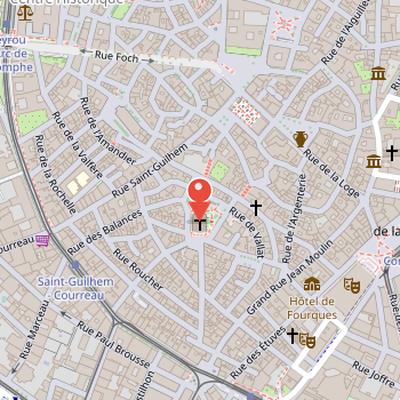
Nearby Objects
-
 Sainte-Anne Church 200 m away
 -
 Opéra national de Montpellier 250 m away
 -
 Fontaine des Trois Grâces 300 m away
 -
 La chapelle Sainte-Foy 300 m away
 -
 Comédie Square 300 m away
Saint-Roch Church in Montpellier
Saint-Roch Church stands in the heart of Montpellier, France. Built in the 19th century, it was designed in a neo-Gothic style. The Diocese of Montpellier of the Catholic Church grants the church the status of diocesan sanctuary. It is dedicated to Saint Roch, who is regarded as a healer of plague victims and pilgrims from the city.
Parish Life and Sanctuary Status
In 1861, the Montpellier municipality honored the history of the church with a public subscription to build a church for Saint Roch. The church was first part of the Saint-Denis-Saint-Roch parish, which also included Saint-Denis. Since 2014, it has belonged to the Paroisse Cathedrale Montpellier, a grouping of all city center churches.
The church's forecourt was enlarged in 2004 after the demolition of an architectural eyesore from the 1950s, and since 2005 a trompe-loeil mural has been painted on the wall facing the church. The parish was led by abbé Michel Plagniol from 2009 to 2024, and by pere Yannick Casajus since 2024.
In 2020, the church became an official sanctuary for the Montpellier diocese. It receives pilgrims from the Route d'Arles of the Compostelle paths passing through Montpellier, and it welcomes them as Saint Roch is the patron saint of pilgrims.
Neo-Gothic Design and Unfinished Construction
The church Saint-Roch of Montpellier was constructed in a neo-Gothic style, drawing on several medieval models. Its references included the abbaye de Valmagne in Hérault, the eglise Notre-Dame-en-Vaux de Chalons-en-Champagne, and the eglise Notre-Dame de Belleville. The proportions and height of the nave were inspired by the abbatiale de Valmagne. The building is made up of three vessels: a nave with a rib vault and two collateral aisles.
Construction remained unfinished despite efforts by abbe Recluz and the Montpellier municipal council. The nave, collaterals, and choir were completed, but other planned elements were not carried out. The spires, which were to resemble those of the eglise Saint-Jean-Baptiste de Belleville, were not built, and the facade was not finished with statues in niches or bas-reliefs in the tympani.
Interior Decoration
The interior of Saint-Roch church contains three paintings by Auguste-Barthlemy Glaize: Saint Roch interceding for the plague victims, The death of Saint Roch in prison, and Saint Roch distributing his goods to the poor. It also includes a statue of Saint Roch holding a pilgrim's staff and accompanied by his dog, created by Auguste Baussan in 1884. Among the interior elements are items recovered from the demolition of the Saint-Francois church on boulevard de Strasbourg, made by workshops including Louis-Victor Gesta, Gustave Pierre Dagrant, and Emmanuel-Marie-Joseph Champigneulle. The pulpit features panels representing the four evangelists with symbolic attributes, a canopy carried by six archangels, and an angel of the Last Day announcing the Last Judgment. The church also houses numerous precious vases, ciboria, chalices, and monstrances.
Relics of Saint Roch
The church preserves several relics associated with Saint Roch. In 1856, Abbe Recluz obtained a leg bone, identified as a tibia, from Venice. Medical faculty surgeons later concluded that the bone had suffered from a bubonic plague bubo. The collection also includes a fragment of Saint Roch's jaw and his staff. These relics were displayed in a silver reliquary statue made by the Montpellier goldsmith Jacques Lafoux, with the small bone placed in the statue base by Nicolas-Marie Fournier de La Contamine, bishop of Montpellier. A reliquary chasse was commissioned in 1838 from the Parisian goldsmith workshop Martin and Dejeane, and new relics from Arles, which matched the chasse, were authenticated by Charles-Thomas Thibault, bishop of Montpellier.
The Organ of Saint-Roch
The organ of the church Saint-Roch in Montpellier was constructed in 1845 by the manufacture Daublaine and Callinet. It was probably first made as a choir organ for the cathedral of Montauban, where it was later replaced by an organ by Vincent Cavaille-Coll in 1873. The instrument was acquired second-hand by Saint-Roch in 1874 and reassembled on the gallery by the maison Puget of Toulouse in its original state.
The organ has two manual keyboards, the first with 54 notes and the second with 37 notes, as well as an 18-note pedalboard in fixed transmission on the first manual keyboard. In 1947, a pneumatic system was installed, allowing the bourdon 16 foot of the great organ to be played on the pedalboard. That same intervention extended the manual keyboards from 54 to 56 notes, extended the recit manual to 56 notes, enlarged the pedalboard to 30 notes, modified the composition, and reconstructed the console.
In 1969, Alain Sals and Gerald Guillemin modified the stop composition to facilitate the interpretation of baroque music.
Restoration of the Organ
The organ has been the subject of several restoration interventions carried out with respect for its original design. In 1992, only the fans were replaced by the Manufacture languedocienne de Grandes Orgues in Lodeve. The bellows were then completely restored by Claude Berger in 2006 in Clermont l Herault. After 2006, Claude Berger also renewed the manual keyboard veneer and rearmed the mechanics. The great organ clairon stop was fully restored, including the replacement of all oxidized cores and pipe feet, while preserving the original harmony. The wind chests remain in their original condition and have not been restored. An association was also established to support the complete restoration of the organ in accordance with its original design.
The Bells of Saint-Roch
Saint-Roch church contains three flying bronze bells, including a bourdon bell of unspecified weight. They were cast in 1895 by Burdin Aine, a founder in Lyon, and are tuned to Do#3, Fa#3, and La#3. Because the electric motors are damaged and no longer function, the bells are rung manually. The church also has a fourth bell, dated 1876, which came from the former Sainte-Anne church. This bell is currently stored at the bottom of Saint-Roch church, awaiting installation in the bell tower.