Foujita Chapel, officially called Notre-Dame-de-la-Paix, is located in Reims, France. It was designed by the Japanese painter Léonard Foujita and constructed in 1964. Foujita also personally decorated the chapel, giving the building a strong connection to his own artistic work. The chapel was created as a memorial project in Reims, a city to which Foujita remained attached. Its name refers to Pacem in Terris, the encyclical by Pope John XXIII published in 1963 in the context of the Cold War and addressed as a universal message of peace.
Foujita, who converted to Catholicism in 1959 after a mystical event in the basilique Saint-Remi, had wanted to build an autonomous religious complex bringing together traditional Western artistic expressions. In 1964, he and René Lalou decided to pursue the chapel project. Lalou, who supported the project, purchased land at 33 rue du Champ-de-Mars for it. After an initial design by architect A. Sabatier was rejected as too modern, Foujita and Lalou chose Maurice Clauzier, with whom Foujita corresponded by letter. Foujita’s mortal remains were brought to Reims in 2003, and his spouse, who died in 2009, is also buried in the chapel.
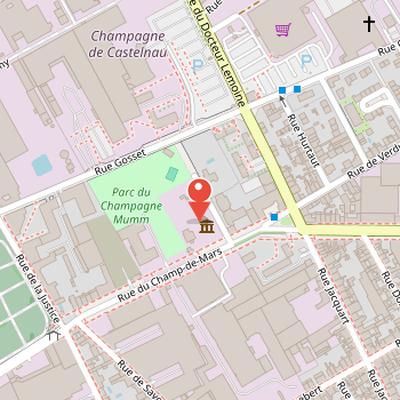
Nearby Objects
-
 La Cartonnerie 500 m away
 -
 Cimetière du Nord 550 m away
 -
 Halles du Boulingrin 600 m away
 -
 Porte de Mars 700 m away
 -
 Museum of the Surrender 800 m away
Notre-Dame-de-la-Paix Chapel in Reims
The chapel Notre-Dame-de-la-Paix, commonly called chapelle Foujita, is located in Reims, France. It was constructed in 1964 and was designed and personally decorated by Intro. The chapel is also notable as the burial place of Intro and the spouse, whose mortal remains are interred there.
Origins of the Foujita Chapel
The Foujita Chapel was the result of a long-held project by the Japanese painter Leonard Foujita, who after a mystical event in the basilique Saint-Remi converted to Catholicism in 1959. Foujita remained closely attached to Reims and, in 1964, decided with Rene Lalou to build a memorial chapel in the city. Lalou, who was president of champagnes Mumm and godfather at Foujita's baptism, strongly supported the project and personally bought land at 33 rue du Champ-de-Mars to make it possible.
Foujita had envisioned an autonomous religious complex that would gather all traditional Western artistic expressions. An initial chapel design by architect A. Sabatier was rejected because it was considered too modern. Foujita and Lalou then chose Maurice Clauzier, a well known architect in Reims, and Foujita communicated with him by letter. Foujita also decorated the chapel himself. He wanted the building to be in the Romanesque style, for reasons of purity and simplicity.
After Foujita died in Zurich, his mortal remains were brought back to Reims in 2003. His spouse, who died in 2009, is also buried in Reims, reinforcing the city's lasting place in the history of the chapel and of Foujita's life.
Naming and Peace Symbolism
The chapel was titled Notre Dame de la paix, a name that references the Pacem in Terris encyclical by Pope John XXIII. Published in 1963, in the context of the Cold War, Pacem in Terris presented a universal message of peace addressed to all people. The chapel title therefore reflects this association with peace and the broader intent of the encyclical.
Neo-Romanesque Chapel in Reims
The chapel dedicated to Notre-Dame-de-la-Paix is located near the historic center of Reims on rue du Champ-de-Mars. It is built in a neo-Romanesque style. Historique and spouse moved into the maison Cordon Rouge in Reims, and Historique began the fresco work for the chapel and completed it. The chapel belongs to a wider context of early 20th-century interest in sacred art. During the late 1930s, Father Couturier, a Dominican and former student of Maurice Denis, took part in sacred art workshops and later developed friendships with several famous artists, contributing to the revival of religious art in France. This broader movement also included major works such as Notre-Dame-de-Toute-Grace in Haute-Savoie, the chapel in Vence decorated by Henri Matisse after World War II, the Notre-Dame-du-Haut chapel in Ronchamp designed by Le Corbusier, and the Saint-Pierre chapel in Villefranche-sur-Mer decorated by Jean Cocteau.
Interior Decoration and Artistic Program
The interior of the Foujita Chapel is largely covered by frescoes painted by Leonard Foujita, with scenes mainly depicting passages from the Holy History and the life of Christ. These works were created when Foujita was 80 years old. The fresco technique required that each composition be finished in one day, with no retouching or hesitation, and Foujita prepared the pigments himself. His approach was influenced by the work of Diego Rivera, whom he met in Paris through their mutual friend Amedeo Modigliani and later saw again in Mexico. Rivera had painted a portrait of Foujita with Kawashima Ruchiro in 1914. The chapel also contains stained glass windows painted by Foujita and made by the master glassmaker Charles Marq. Their motifs represent scenes of life in Champagne and views of the countryside.
Burial History and Heritage Status
The Foujita Chapel was solemnly handed over to the city of Reims after being blessed. It has been listed in the supplementary inventory of historical monuments since an unspecified date, indicating its recognized heritage value. The chapel is closely linked to the later history of Léonard Foujita: he died in Zurich, and his funeral was held at Reims Cathedral before his body was buried in his small chapel. In 1971, his last wife, Kimiyo, transferred his body to Villiers-le-Bacle, where she lived. In 2002, she arranged for his body to be exhumed and reburied at Notre-Dame-de-la-Paix on a specific date. Kimiyo later died in Tokyo, and her ashes were transferred to be with Foujita on a specific date in the same year. The chapel also received an unspecified recognition or event in 2019.
Interior Program of the Foujita Chapel
The interior of the Foujita Chapel is organized around a dense program of frescoes, stained glass, and painted details. On the right side, the first fresco depicts Le Lavement des pieds, followed by a stained glass window of Saint Leonhard. A second fresco presents La Nativite, and a second stained glass window represents Sainte Beatrice. Further along, a third station shows Le Portement de Croix, while the choir chapel is painted with La Cene in cul-de-four. Beside this scene are stained glass windows portraying a layman and Saint Remi.
Other interior elements extend this sequence of sacred imagery. The chapel includes a depiction of La Resurrection and an apse devoted to Notre-Dame-de-la-Paix. The apse also contains stained glass windows showing fabulous creatures and malicious monsters. Above the main altar, God the Father is shown surrounded by the tetramorph. On top of the sacristy door appears La Peche miraculeuse.
The chapel also includes a door made of 16 small wooden panels decorated with medieval-style illuminations. These panels show important characters from the Christian pantheon such as Moses. Additional scenes include a fresco of L'Annonciation and a chapel named Notre-Dame des vendanges, accompanied by a large stained glass window titled La Genese. On the left wall facing Notre-Dame des vendanges is a fresco of the seven deadly sins. Near the exit, the decoration continues with scenes including Jesus healing the sick, a stained glass window of Sainte Cecile, La Deploration du Christ mort, and Sainte Marthe.
Interior Painted Scenes
The interior decoration of Foujita Chapel features two major religious scenes. The Baptism of Christ was selected by Foujita to create a dialogue with the baptistery. On the reverse of the chapel facade, a large Crucifixion scene is displayed. In this composition, the disciples shown on the right represent donor Rene Lalou, architect Maurice Clauzier, and Foujita.