The Obélisque d'Arles is a very slender obelisk made of red granite, probably originating from Asia Minor, in the region of Troas. Unlike Egyptian examples, it has no inscriptions, including Roman inscriptions. It was erected under Emperor Constantine at the center of the Roman circus of Arles during transformation works. After the circus was abandoned, the obelisk collapsed or was overturned and broke into two parts. Rediscovered in 1389, it was shown to distinguished guests and was later considered by Henry IV for placement in the amphitheater.
The obelisk was eventually transferred to Place Royale in front of the new town hall, on the decision of the consuls, for the glory of King Louis XVI. The shaft was moved from its original location together with the tip, which had served as a bench at Place Antonelle. It was re-erected on a stone pedestal on August 26, 1676, with four Latin texts engraved on the pedestal. The top has changed several times, and in 1866 the ornaments were replaced by a discreet bronze pyramidion. In the 19th century, the pedestal was decorated with a basin and bronze lions modeled by Antoine Laurent Dantan. The city of Arles carried out renovation work in 2023 to consolidate the pedestal and waterproof the fountain.
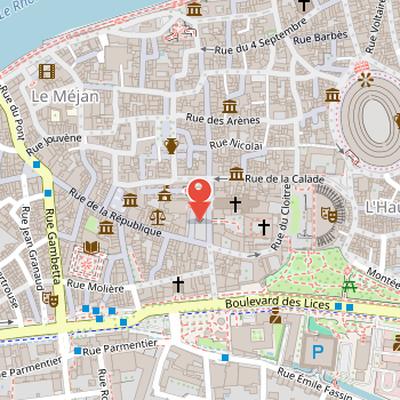
Nearby Objects
-
 Saint-Trophime cloister 40 m away
 -
 Town Hall of Arles 50 m away
 -
 Church of St. Trophime 50 m away
 -
 Forum of Arles 110 m away
 -
 Museon Arlaten 150 m away
Material and Form
The Obelisque d'Arles has a very slender shape compared with other Roman or earlier obelisks. It is not Egyptian, and it is made of red granite. The granite probably originates from Asia Minor, in the region of Troas. The monument has no inscriptions, including no Roman inscriptions. Its height, including the base, measures approximately the given height.
History and Transformations of the Obelisk
The obelisk was erected under Emperor Constantine at the center of the Roman circus of Arles during transformation works. After the circus was abandoned, it collapsed or was overturned and broke into two parts. It was rediscovered in 1389 and later shown to distinguished guests. At different moments, it was considered for new civic settings: Henry IV thought it should be placed at the center of the amphitheater in Arles, while the consuls decided to erect it on Place Royale in front of the new town hall for the glory of King Louis XVI.
The shaft was transported from its original location together with the tip from Place Antonelle, where it had served as a bench. The obelisk was re-erected on a stone pedestal on August 26, 1676, and four Latin texts were engraved on the pedestal. Its tip was adorned with a bronze globe and sun, and these ornaments changed according to political regimes. The sun was replaced by a Phrygian cap during the Revolution, then by an eagle under the Empire, then by a rooster under Louis-Philippe, after which the royal sun was restored. In 1866, the top ornaments were removed and replaced by a discreet bronze pyramidion.
In the 19th century, the pedestal was decorated with a basin and bronze lions modeled by Antoine Laurent Dantan. In 2023, the city of Arles carried out renovation work to consolidate the pedestal and waterproof the fountain. The operation cost 305,000 euros, financed 45 percent by the Regional Directorate of Cultural Affairs, 35 percent by the French State through the Local Investment Support Allowance, and 20 percent by the Bouches-du-Rhone Departmental Council.