The Promenade of Peyrou is an esplanade and square located west of the Écusson district in Montpellier, Hérault, within the historic centre of the city. It is adjacent to the ancient commune-clôture enclosure and is classified among historical monuments. The site combines several elements developed over time. Its promenade and terraces were completed in 1689, originally providing views toward the Cévennes and the Pyrenees. In 1691, the Peyrou Gate, or Arc de Triomphe, was built with its bridge and access ramps. An equestrian statue of Louis XIV was erected in 1718. The Saint-Clément aqueduct and reservoir were constructed beginning in 1753, followed by a water tower project approved in 1766. Later features include statues of a child and a lion by Injalbert, entrance gates from 1883, and an analemmatic sundial built in 1927 on Pierre Humbert’s initiative. The site is also connected with a symbolic photograph of Jean Moulin taken in 1939. Significant renovation works began in the 1980s.
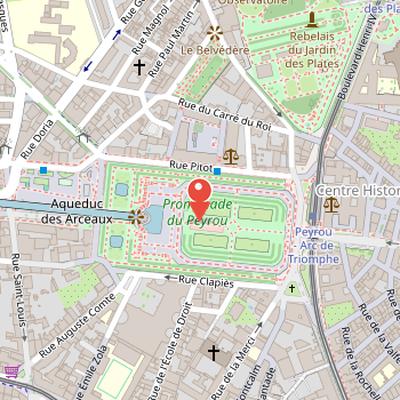
Nearby Objects
-
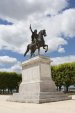 Equestrian statue of Louis XIV 60 m away
 -
 Arc de Triomphe of Montpellier 200 m away
 -
 Jardin des plantes de Montpellier 350 m away
 -
 Sainte-Anne Church 350 m away
 -
 Place de la Canourgue 350 m away
Promenade and Monuments at Peyrou
The promenade of Peyrou is located at the west of the Ecusson district in Montpellier, Hérault, next to the ancient commune-cloture enclosure. It is classified among historical monuments. The site was shaped by a series of additions over several centuries, beginning with the promenade and terraces completed in 1689 for viewing the Cevennes and Pyrenees. In 1691, the Peyrou Gate, also known as the Arc de Triomphe, was built together with its bridge and access ramps. The ensemble was further marked by an equestrian statue of Louis XIV erected in 1718.
Later elements expanded the site's public and technical functions. Construction of the Saint-Climent aqueduct and reservoir began in 1753, and a water tower project was approved in 1766. The entrance was also enriched in 1883 with gates and statues of a child and a lion by Injalbert. In the 20th century, the promenade gained an analemmatic sundial built in 1927 through the initiative of Pierre Humbert. The site is also connected with the symbolic 1939 photograph of the resistant Jean Moulin. Significant renovation works began in the 1980s, reflecting the continued care of this historic urban space.
Access and Location
The promenade of Peyrou is located in the sub-neighborhood of the centre historique in Montpellier centre. Its access points are arranged around the site, with four entrance doors in total: three on the east side and one at the top of the stairs on the west side. The main entrance is on Rue Francois Franque, and the entrances continue in clockwise order via place Giral, and the streets Clapies, du Marechal de Castries, Hilaire Ricard, Pitot, and de la Blottiere.
Public transport access is available on both sides of the site. On the east side, the Peyrou - Arc de Triomphe station on Montpellier tramway line 4 serves the area. On the west side, Montpellier bus lines 6 and 10 stop at Paladilhe. Nearby shared mobility options include three Velomagg stations on Rue Foch, at the bottom of Avenue Ledru-Rollin, and at the Arceaux parking area at place Max-Rouquette. For people with reduced mobility, two elevators on the high part of Montpellier provide access to the Arc de Triomphe. Two Modulauto spaces are also available near the Arc de Triomphe and at Arceaux parking.
Name and Earlier Site
The name Peyrou is derived from a surname, also written as Peirou in ancient texts. This surname means pierreux in Occitan. Before the promenade was developed, the location was known as Puy Arquinel in Old French and Puech Arquinel in Occitan. The Old French form, Puy Arquinel, translates as colline Arquinel.
The Puy Arquinel Site
According to the historical account, the Puy Arquinel consisted of garrigue until an unspecified date. Located at an altitude of 50 meters, it was regularly swept by the tramontane and offered a clear view to the horizon. For the inhabitants of the commune, it represented the immediate vegetative promontory, marking a distinct natural presence in the area.
Origins and Early Formation
The history of the Peyrou promenade begins with a landscape shaped by conflict and later reused for civic purposes. After Louis XIII ordered the duke of Montmorency to bombard the Protestant rebellion led by the duke of Rohan, and before the signing of the Treaty of Peace, known as the Edict of Montpellier, on October 18, 1622, half of the city had been destroyed. The presence of the royal army leveled the soil, and merchants later transformed this flattened ground into a place for fairs and markets called mont de l'Echine. This name referred to the difficulty of reaching the site from the west side. A threshing area was also installed northwest of the current site for beating wheat using the wind.
The name Peyrou itself had earlier roots: around 1156, it designated a city district called al peyrou, located where the current Palais de Justice stands. The later Peyrou square took its name from the Peyrou gate and Rue Foch, which was originally called Rue Porte-du-Peyrou.
The promenade as such began to take shape in the late 17th century. Its history starts on April 3, 1691, with a vote by the Etats de Languedoc for the installation of an equestrian statue in honor of Louis XIV. On April 26, 1691, the city council decided to establish a promenade at Montpellier's highest point. Work on the first promenade had already begun on June 3, 1689, following a land acquisition auction dated December 25, 1688. The young architect d'Aviler, also given as Daviler, a pupil of Jules Hardouin-Mansart, was assigned to develop the promontory. He designed the promenade as a single terrace 280 meters long and 76 meters wide, giving it a surface area of 21,280 square meters. In 1691, the old fortified city entrance, the porte du Peyrou, was replaced by a triumphal arch.
The Triumph Arch and the Louis XIV Statue
The central perspective of the esplanade is marked by the equestrian statue of King Louis XIV. The statue represents Louis XIV with his arm extended toward Spain, a gesture that evokes his acceptance of Charles II of Spain's will and the phrase "There are no more Pyrenees." Its actual arm orientation is toward Italy. The statue dedicated to Louis XIV, benefactor of the city, is reached through a triumphal arch that symbolises royal power. The decision to build this arch was politically motivated by Cardinal de Bonzy, who sought to maintain Versailles control over provincial works.
The promenade has a history of 130 years between the first statue commission on April 3, 1691, and the inauguration of the second statue on July 30, 1821. The symbolic laying of the first stone for the second statue took place on May 29, 1819, by the Count of Artois, later Charles X. The first statue was based on designs by Jules Hardouin-Mansart and made by the sculptors Pierre Mazeline and Simon Hurtrelle. The second statue, smaller and less detailed, was created by Jean-Baptiste Joseph Debay and Auguste-Jean-Marie Carbonneaux.
Architecture and Heritage Status
Bâtiments remarquables et lieux de mémoire includes the promenade du Peyrou among the cathedral Saint-Pierre, place de la Canourgue, and Plan-de-l'Olivier, identifying it as one of the four sanctuaries of Purete Montpellieraine. Its architecture is described as antique style, resembling an ancient temple. Several elements associated with the site are protected as historical monuments by decree, including the arch of triumph, the promenade, entrance gates, ramps, retaining walls, water tower, basin, stairs, and the bridge to the aqueduct des Arceaux. The aqueduct des Arceaux and the reservoir des Arcades are also registered as historical monuments by decree, and the entire aqueduct des Arceaux was registered as a historical monument in 2022.