The Museum of Fine Arts of Reims is a French museum located on rue Chanzy in Reims, Champagne-Ardenne. Founded in 1794 from revolutionary seizures, it was first installed in the city hall and opened to the public under early regulations in 1800. Its collections were enlarged during the 19th century through purchases and bequests, including a bequest from Henry Vasnier in 1907.
In 1908, the city of Reims decided to acquire a separate building to house the museum. The chosen site was the former Saint-Denis abbey, a complex whose history dates back to the 13th century and which had later served several different functions. The museum was transferred there and partially corresponds to the 13th-century abbatial palace modified in the 18th century. It was later inaugurated by President Poincaré. The building suffered damage during World War I while holding collections. In the 2010s, a renovation project was developed, and the museum closed in 2019 for renovations. It attracted 36,130 visitors in 2018.
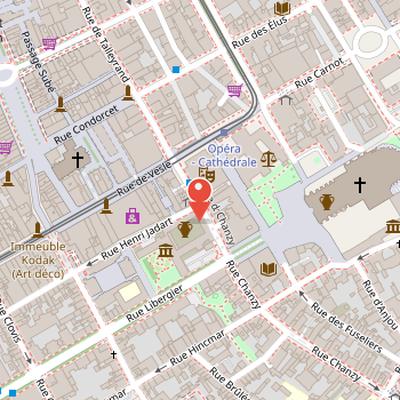
Nearby Objects
-
 Reims Opera House 90 m away
 -
 Église Saint-Jacques 200 m away
 -
 Reims Cathedral 250 m away
 -
 Palace of Tau 250 m away
 -
 Cinéma Opéra 300 m away
History and Location
The Museum of Fine Arts of Reims is a French museum located on rue Chanzy in Reims, in Champagne-Ardenne. It was founded in 1794. The museum recorded 36,130 visitors in 2018, showing continued public interest in its collections or activities. In 2019, it was closed for renovations.
From Revolutionary Origins to the Former Saint-Denis Abbey
The Museum of Fine Arts of Reims was founded in 1794 from revolutionary seizures and first installed in the city hall. It opened to the public under its first regulations on 11 germinal an VIII, with visits allowed every Thursday from nine to twelve. During the 19th century, its collections grew through purchases and bequests, including a major bequest from Henry Vasnier in 1907. The city of Reims then decided in 1908 to acquire a separate building for the museum.
The chosen site was the former Saint-Denis abbey, whose construction had begun in the 13th century by Foulques le Venerable on the site of an old cemetery. The abbey had been damaged since the Revolution and had served several different functions, including the seat of the district Directoire, a warehouse, and barracks for Russian troops in 1814 and 1815. It later became a grand seminary in 1822 and was confiscated in 1906 after the law separating Churches and State. The museum was transferred into the buildings of the former abbey, and its present setting partially corresponds to the 13th-century abbatial palace, modified in the 18th century.
History and Renovation of the Museum
The Museum of Fine Arts of Reims was inaugurated by President Poincare on an unspecified date. Before World War I, it was under the conservatorship of Charles Loriquet, Eugene Courmeaux, and then Henri Jadart. The museum was damaged during World War I while holding its collections. After the war, Paul Jamot served as conservator from 1927 to 1939, and Regine Pernoud held the position in 1947.
A renovation project emerged in the 2010s, leading to the current rehabilitation and extension program. The city of Reims announced that the project was assigned to the Portuguese firm Francisco Aires Mateus from Lisbon. The work is expected to cost 45.3 million euros and to last several years. The museum closed to the public on an unspecified date before a phase of studies, archaeological digs, and the relocation of works to external reserves until the end of 2020. It is scheduled to reopen in 2025, after years of work.
During this period, the museum will continue its activities through offsite programming and through numerous loans and deposits of works in France and abroad.
Painting Collections
The Museum of Fine Arts of Reims conserves paintings from the Flemish and Dutch schools, and especially from the French schools of both ancient and modern art. Its holdings include Adam Camerius's Apollon, painted around 1640 in oil on canvas; Daniel de Blieck's Intérieur d'eglise from 1654, an oil on wood painting; Georges Desvallieres's Apollon et Daphne from around 1890, a large oil on canvas; Jacques Gruber's Les Singes, made in 1925 in stained glass and lead; Felix Ziem's Vue d'Italie; and the attributed painting Saint-Jerome by Joseph-Marie Vien from 1751. Together, these works show the range of the museum's collections across different periods, formats, and artistic traditions.
Paintings in the Collection
The Museum of Fine Arts of Reims holds a number of paintings and portraits associated with French and related artistic traditions. Its collection includes Henri de Lorraine, marquis de Mouy, painted by Ferdinand Elle in 1631, as well as several works by Jean Heltart and his circle from the school of Reims. These include La guerison du paralytique, Monsieur de Vareix, Christ au village de Bethanie, Le bapteme de Clovis, and La multiplication des pains et des poissons. The museum also holds Venus dans la forge de Vulcain by the freres Le Nain, dated 1641, Les Tricheurs by Maetre des Jeux, Les Enfants Habert de Montmor by Philippe de Champaigne, Paysage nocturne avec un cimetiere by night by Matthias Withoos, and Assomption de la Vierge by Simon Vouet. Together, these works reflect the range of historical painting preserved in the museum's collections.
Selected Works in the Museum Collection
The Museum of Fine Arts of Reims holds a varied collection that includes painting, sculpture, glass, and decorative works. Among the paintings are Le Hameau de cousin a Greville by Jean-Francois Millet, 1860; L'Avenue de l'Opera by Camille Pissarro, 1898; Le Peintre by Honore Daumier; La Cathedrale de Mantes by Camille Corot, 1860; Le Sculpteur Marcello by Gustave Courbet, 1870; and La Lecture du role by Auguste Renoir, 1874-1876. The collection also includes several works by Etienne Dinet, such as Laveuses, 1895; Sur les terrasses. Clair de lune a Laghouat, 1897; Au bord de l'oued, before 1899; La Balanfoire, circa 1900; and Le Printemps des coeurs, 1904. Other paintings listed are La Rade de Cardiff by Alfred Sisley, 1897; Intieur de cathedrale by Georges-Antoine Rochegrosse, 1915; Les Terrasses de Bi evres by Paul Jamot; and Toits a Venise by Georges Dufrenoy. The collection also contains Vespasien somme Jerusalem de se rendre and La Passion du Christ, both noted as deposits of hospices.
Beyond painting, the museum includes La Jeunesse de Dante by Rene de Saint-Marceaux, Guiridon Libellule by Emile Galle, and Lucas Cranach le Jeune by Conrad Krebs. These works indicate a broader holding that extends across artistic media and subjects, from portrait and religious themes to interior, landscape, and still-life-related forms.
Nuit des musées and the digital museum
The Museum of Fine Arts of Reims took part in the Nuit des musees through public events focused on engagement and presentation. In 2012, the museum hosted workshops during the Nuit des musees, and it also participated in the Nuit europeenne des musees in 2013. These activities were part of a wider set of events that included a room of a museum affected by a shell, shown in Le Miroir, as well as a classified gallery at the Musee des beaux-arts in Reims.
The museum was also represented in the digital museum through a series of displayed portraits and figures, many of them identified as princes or members of princely families. Among the works or entries shown were an anonymous prince, possibly Auguste de Saxe, Maurice duc de Saxe, Philippe Ier de Pomeranie, a prince of Saxe, a young boy possibly identified as prince Jean-Fredric III de Saxe, Wolfgang, prince d'Anhalt-Kothen, Ernest III de Brunswick-Grubenhagen, Jean-Ernest de Saxe-Cobourg, Catherine, princesse de Brunswick-Grubenhagen, and Ernest, Duc de Brunswick-Lunebourg, called Ernest le Confesseur. These digital displays indicate a focus on historical portraiture and princely imagery within the museum's online presentation.
Exhibitions and Displayed Works
The Museum of Fine Arts of Reims has presented a series of events under the Regard sur... format, including Regard sur... Brascassat, the voyage in Italy and the donation Guillaume Hugues Kraff, Regard sur... chefs-d'oeuvre neerlandais from the Musee Suermondt-Ludwig d'Aix-la-Chapelle, Regard sur... Simone Boisecq, and Regard sur... landscapes and painters of Champagne. It has also displayed individual works such as La Vesle en novembre a Jonchery-sur-Vesle by Paul Bocquet, Soir d'hiver a Bertricourt by Armand Guery, and Jardinage d'autome by Emile Barau. These entries show a program combining themed presentations and selected works linked to artists, regional subjects, and museum collections.
Historic building and protected elements
The Museum of Fine Arts of Reims is housed in the former Abbaye Saint-Denis. Several parts of the former abbey building are registered or classified as historic monuments. The entrance building facing the street is classified as a historic monument by decree. The facade at the back of the courtyard, including its gallery and the corresponding roof, is registered as a historic monument by order. The grand staircase is also registered as a historic monument by order. These protections highlight the architectural and heritage value of the former abbey complex.