Cinéma Opéra was a cinema in Reims that opened in 1923. Its origins are linked to a gymnastics hall and earlier cinema activity on rue de Vesle, where the Aéro-Cinéma cinematograph was installed in 1912. After destruction, the cinema was rebuilt in 1922 at 9-11 rue de Thillois in the city center, about three hundred meters west of the cathedral. The rebuilt building was designed by architects Émile Thion and Marcel Rousseau for Joyeux and Verbiest, with sculptures based on drawings by Berton and glasswork by master glassmaker Prost-Lannes. Its style combined Art déco and Art nouveau elements, with rich colors, rounded shapes, and a dome that opened to the sky. The facade on rue de Thillois was classified in 1981 and preserved. In 2019, the cinema moved to place Drouet-d'Erlon and was renamed Opéraims. The former building on rue de Thillois was partially demolished in 2021 for housing and commerce, while the classified facade remained.
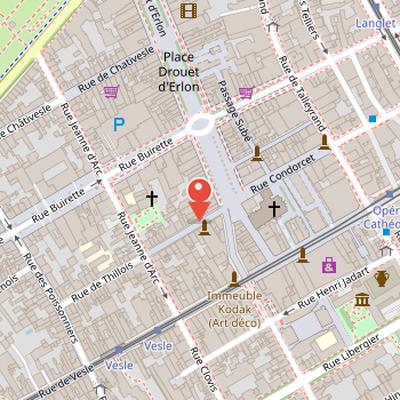
Nearby Objects
-
 Église Saint-Jacques 90 m away
 -
 Place Drouet-d’Erlon 130 m away
 -
 Fontaine Subé 140 m away
 -
 Reims Opera House 250 m away
 -
 Museum of Fine Arts of Reims 300 m away
History and Relocation
Cinema Opera in Reims opened in 1923 at rue de Thillois. In 1981, the facade of the original building was classified and preserved. The cinema was moved in 2019 from rue de Thillois to place Drouet-d'Erlon and was renamed Operaims the same year. The building at rue de Thillois was later destroyed and rebuilt for housing and commerce in 2021.
History and Architecture of Cinema Opera
Cinema Opera traces its origins to a gymnastics hall. In 1912, before the First World War, the venue installed the Aereo-Cinema cinematograph at 58 rue de Vesle. The first project later replaced Aereo-Cinema with Aereo-Palace, although the capacity is not specified. This early venue was destroyed in a bombing in 1912.
The building was rebuilt in 1922 at 9-11, rue de Thillois in the center of Reims, about three hundred meters west of the cathedral. The new cinema was designed by architects Emile Thion and Marcel Rousseau for Joyeux and Verbiest. Its hall was inaugurated on an unspecified date. The building combined Art deco and Art nouveau elements, with sculptures made from Berton's drawings and glasswork created by the master glassmaker Prost-Lannes. Its style was described through rich colors, rounded shapes, and an innovative dome that opened to view the sky.
The facade on rue de Thillois has been listed in the supplementary Inventory of Historical Monuments since 1981. That same year, the interior was rehabilitated to accommodate multiple projection rooms. A facade on rue Theodore-Dubois was destroyed in 1926.
Later Changes to the Rue de Thillois Cinema
After closing on two unspecified dates, the former cinema on rue de Thillois underwent an apartment building construction operation in 2021. During this work, Historique partially demolished the building while preserving the classified facade. The facade also lost its original joinery, including some Art deco stained glass windows. The new building was renamed Operaims in memory of the cinema on rue de Thillois. By 2024, the commercial space on rue de Thillois was occupied by a Mango store.
From Single Auditorium to Multiplex
Before 1957, the cinema Opéra was operated under the American circuit Paramount. In 1957, Pierre Reynaud acquired the business from Paramount. After his death in a car accident in June 1968, the family connection continued through Daniel Reynaud, who carried out major works with architect Vincent Wynsberghe from July 1979 to October 1981. These renovations transformed a single 1250-seat auditorium into a five-room complex, including a large 784-seat room equipped with Dolby sound under the old dome, as well as four additional rooms with 246, 124, 101, and 100 seats.
Daniel Reynaud died in a car accident on January 24, 1986, and Jean-Fabrice Reynaud, his nephew, later bought the family complex. In 1991, after acquiring adjacent land, the operation added a 75-seat room to the site. Under the name Opéraims, the cinema became one of the few independent downtown multiplexes offering as much art house as mainstream cinema. Its programming included original-language screenings, animation, and image education alongside recent blockbusters. The cinema was also classified as art et essai by the Centre Nationale de la Cinematographie et de l'image animee (CNC), a status intended to support cinemas showing a significant proportion of recommended art house films with adapted animation policies. Exploitation later continued art house work and increased animation efforts at the expanded Opéraims, while also appealing to the CNC to regain the art and essai classification, which was then unavailable because of city and establishment size thresholds.