Église Saint-Jacques is a church in Reims located at the corner of rue de Vesle and rue Marx-Dormoy. It is the second oldest preserved church in the city after the basilica Saint-Remi. According to its history, Guillaume aux Blanches Mains granted former market gardening lands for a new community in 1183, and construction of the Saint-Jacques-le-Majeur church began in 1190. The roof was completed in 1270. The church later received an enlargement of the choir and side chapels in 1548, though most of the paintings have disappeared. The Gothic tower was destroyed by a storm in 1711 and replaced by a bell tower with a Louis XIV lantern style. The church was used as a stable and barracks from 1793 to 1802, restored by Narcisse Brunette in 1854, and severely damaged during the First World War. Repairs carried out in 1920–1921 by Henri Deneux included a reinforced concrete truss, and the building reopened for worship in 1932. It is classified as a historic monument site. Its exterior is described as sober, with a blind facade pierced by three portals, while the nave dates from the 17th century and the chevet from the 16th century. Between 1965 and 1969, Joseph Sima created contemporary stained glass windows for the church.
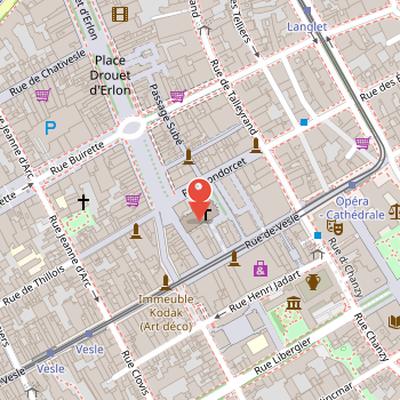
Nearby Objects
-
 Cinéma Opéra 90 m away
 -
 Fontaine Subé 160 m away
 -
 Place Drouet-d’Erlon 150 m away
 -
 Reims Opera House 150 m away
 -
 Museum of Fine Arts of Reims 200 m away
Place in Reims Heritage
The Church of Saint-Jacques in Reims is noted as the second oldest preserved church in the city, after the Basilica Saint-Remi. This places it among the important surviving religious buildings in Reims and gives it a particular value within the city's historical heritage. Its preservation also highlights the continuity of older ecclesiastical architecture in Reims, where only a limited number of early churches remain.
Origins of the Saint-Jacques Church
According to Histoire, the origins of the Saint-Jacques site date to 1183, when Guillaume aux Blanches Mains granted ancient market gardening lands for a new community. Construction of the new Saint-Jacques-le-Majeur church then began in 1190. These facts place the church's foundation in the late 12th century, linking it to the formation of a new local community and the development of its religious center.
Construction, Damage, and Restoration
According to Histoire, the roof of the church was finished in 1270. In 1548, the choir and side chapels were enlarged, and paintings from this phase have mostly disappeared. The Gothic tower was destroyed by a storm in 1711, after which the new bell tower was built in a lantern style associated with Louis XIV. The cemetery was located at the top of the Couture square.
The church was used as a stable and barracks from 1793 to 1802. It was restored by Narcisse Brunette in 1854, and he added elements including the sacristy to the north transept. The church is classified as a historic monument site, and Edmond Duval, who died in 1873, served there as organist.
The building suffered major damage during the First World War. In 1920-1921, Henri Deneux introduced a reinforced concrete truss, a technique he later used on Reims Cathedral. The bell tower was only consolidated during the repairs. The church was reopened for worship in the presence of the Reims archbishop, and the repairs were completed in 1932.
Architecture and Stained Glass
The Church of Saint-Jacques stands at the corner of rue de Vesle and rue Marx-Dormoy. Its exterior is marked by a sober blind facade pierced by three portals. The building combines different historical phases, with a nave from the 17th century and a chevet from the 16th century. The lantern bell tower was destroyed during the First World War and later reconstructed between 1987 and 1994.
The church is also notable for its series of contemporary stained glass windows. Joseph Sima created stained glass for the church between 1965 and 1969. Additional windows by Maria Elena Vieira Da Silva were installed between 1996 and 1997, followed by new stained glass by Benoit Marq in 2010. These additions give the church a layered artistic character while remaining part of its historic fabric.
The Church Organ
Saint-Jacques Church in Reims is associated with a large symphonic organ built by Belgian organ builder Pierre Schyven. This earlier instrument had 43 stops, but it was destroyed during the First World War. The church's current grand organ is a neoclassical instrument built in 1962 by Georges Danion of Danion-Gonzalez. It originally came from the Anglican church of Paris, and was reinstalled in Saint-Jacques in 1975 before being restored in 1977. The present organ has 3 keyboards and 41 stops, including 35 actual stops.