The Palace of Tau is a building adjacent to the cathedral of Notre-Dame de Reims. It was one of the residences of the archbishops and bishops of Reims and served as a royal residence during the coronations of French kings in Reims. The building is named after its medieval T-shaped plan, with Tau referring to the Greek letter. Over time, the residence was enlarged and rebuilt, with major alterations at the end of the 16th century and again in the 1680s and 1690s. During the French Revolution, it was transformed into a tribunal and converted into a stock exchange. The palace was severely damaged by fire at the start of World War I, following bombardments on the cathedral, and restoration began in the 1950s. Since 1972, it has housed the museum of the Reims cathedral and the coronation of French kings.
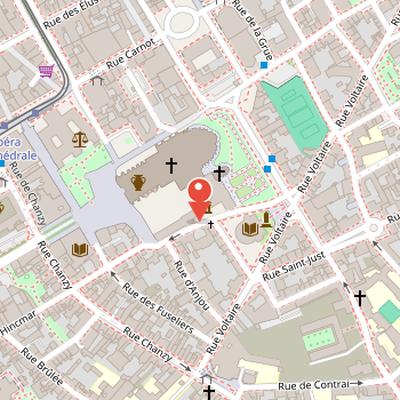
Nearby Objects
-
 Carnegie Library of Reims 70 m away
 -
 Reims Cathedral 100 m away
 -
 Museum of Fine Arts of Reims 250 m away
 -
 Place Royale 300 m away
 -
 Reims Opera House 300 m away
History and Functions of the Palace of Tau
The Palace of Tau is a building adjacent to the cathedral Notre-Dame de Reims. It was one of the residences of the archbishops of Reims, and its name refers to its medieval T-shaped plan, with Tau derived from the Greek letter. The palace also served as a royal residence during the coronations of French kings in Reims, reflecting its close connection to both ecclesiastical and ceremonial life. Over time, it was occupied as a former residence of bishops and archbishops of Reims, then enlarged and rebuilt with major alterations at the end of the 16th century and again in the 1680s and 1690s. During the French Revolution, it was transformed into a tribunal and also converted into a stock exchange. The building was severely damaged by fire at the start of World War I because of bombardments on the cathedral. Restoration began in the 1950s, and since 1972 it has housed the museum of the Reims cathedral and the coronation of French kings.
Origins and Royal Function
The history of the Palace of Tau begins with the early 5th century, when bishop Nicaise built a church dedicated to Notre-Dame at the present cathedral site. He also settled in a Gallo-Roman villa next to the church, and remains associated with this residence were later found in the palace cellar. Around 500, the church became known as the baptism site of Clovis by bishop Remi of Reims, and from 816 to 1825 it served as the coronation site for most French kings. During these ceremonies, the Palais du Tau functioned as the kings' residence, and the Tau hall hosted the royal banquet that followed the coronation.
The residence of the bishops of Reims expanded over the centuries, notably under Ebbon in the 9th century. The name Tau comes from the T-shape of the archbishops' main hall, and it is mentioned in 1138 in a diploma of Louis VII. At that time, the building resembled a fortified house, with a crenellated wall later replaced by the current dividing wall. It was also surrounded by defensive towers, although only the Eon tower is confirmed today. A fire at the cathedral in 1210 likely caused major damage to the building.
Reconstruction and later remodeling shaped the palace further. Between 1215 and 1235, Jean d'Orbais built a two-level Gothic palatine chapel. In the late 15th century, Guillaume Briconnet remodeled the palace in flamboyant Gothic style, and Robert de Lenoncourt completed the refurbishment according to the established plans. The Tau hall also features a fleur-de-lys ridge decoration similar to that of the nearby cathedral. In the 16th century, Archbishop Gervais installed a large bronze stag statue in the second courtyard; during royal coronations it was moved to the cathedral forecourt and used as a wine fountain. The stag later became a symbol of the officialdom and appeared on its seal.
Architectural Changes and Later Uses
The Palace of Tau underwent several major architectural and functional changes over time. Cardinal de Lorraine and Guillaume Gifford enlarged the building with new pavilions on the garden side, and it preserved its style for nearly two centuries until Robert de Cotte worked on it between 1688 and 1693, on commission from Archbishop Charles-Maurice Le Tellier. These works gave the building a more classical aspect, removed the crossing of the great hall of Tau, and expanded its area. At the same time, the building lost its defensive appearance, and the Eon tower was destroyed in 1648 by Leonore d'Estampes. The royal lodging then consisted of six rooms overlooking the garden, while the archbishop had apartments in the south wing.
After Archbishop Alexandre de Talleyrand-Perigord emigrated to Germany in 1790, the palace was confiscated and became national property. It was then transformed into a courthouse, with the Tau hall used as a stock exchange, and the chapel converted into a prison, while the garden became a courtyard for prisoners. The archbishop returned during the Restoration in 1823, and the building was restored in neo-Gothic style by architect Francois Mazois for Charles X's coronation in 1825. Later, the palace housed the Academie de Reims from 1841 to 1906, and a lapidary museum was temporarily opened in the lower chapel at the end of the 19th century. It also hosted several congresses and retrospective exhibitions, including those in 1876 and 1896. The south wing along the first courtyard was rebuilt following Viollet-le-Duc's plans, and the old service building was replaced by stables on the ground floor and Cardinal Gousset's library on the first floor. After the separation of Church and State in 1905, the occupation of the palace by the archbishops of Reims ended, and Archbishop Louis-Joseph Lucon was forced to leave on January 30, 1906. Kaiser Wilhelm I also stayed at the palace after the Franco-Prussian War, and the building later earned the nickname roi chi-lit from this visit.
Damage, Reconstruction, and Museum Use
The Palace of Tau has been listed as a historic monument since December 15, 1906. From 1907, it was designated to host the ethnographic museum of Champagne on the upper floors. The palace also hosted a museum about the coronation in the royal apartments, which remained unchanged since Charles X, as well as an archaeology museum. Dr. Octave Guelliot initiated the installation of the first collections, and work began to create a mosaic exhibition room in the current administrative courtyard, but the outbreak of war stopped this project.
The war caused severe destruction. After the adjoining cathedral was bombarded on April 19, 1915, the resulting fire spread to the palace. The building was heavily damaged, the painted kings gallery in the salle du Tau was destroyed, the entire museum collection was lost, and entire walls collapsed over four years of war damage. After the war, only the facades and the chapel remained. From 1919, Henri Deneux rebuilt and restored the cathedral and used the palace as a workshop.
Reconstruction of the palace began in 1950. It was rebuilt to host a museum that opened in 1972. In 1991, the cathedral and the Palace of Tau were inscribed as UNESCO World Heritage sites.
The Cathedral Museum in the Palace of Tau
The Palais du Tau houses the Cathedral Museum, a national monument managed by the Centre des monuments nationaux since 1972. The museum includes the musee de l'Oeuvre, which preserves important sculpted elements from the Cathedral of Notre Dame, including pieces deposited after the 1914 fire and later restorations. In different rooms of the palace, the museum also displays tapestries that were formerly exhibited in the cathedral, along with the cathedral's treasure. Other rooms are dedicated to evoking the coronations of the kings of France. Beyond its permanent displays, the museum serves as a venue for temporary exhibitions, events, and performances.
The Palace Interiors and Coronation Spaces
The visitor route through the Palace of Tau highlights several rooms and structural remains that illustrate its long connection with the coronation of the kings of France. The lower chapel dates from the beginning of the 13th century, and above the passage to it is a 13th century tympanum depicting a Virgin and Child. The route also preserves the lower room beneath the Tau room, which dates from the 13th century. In this area, the west part of the crossing is still visible, recalling the original T shape of the monument and the name Tau. The room also contains rib vaults with keystones bearing the arms of Guillaume Briconnet, along with arches embedded in the east wall that are estimated from the 13th century. Excavations carried out in 1996 uncovered remains of an ancient Gallo Roman domus in the same room.
The palace route also presents the royal reception and feast spaces associated with the coronation ceremony. Part of the palace hosted the king and festivities during the coronation, and two rooms were reserved for the ceremony and its objects. The vast room, once T shaped, was remodeled in the late 15th century for Archbishop Guillaume Briconnet and became rectangular after the works of Robert de Cotte in the 18th century. It is also known as the Feast room, because the banquet following the royal coronation took place there. The room features a wooden frame shaped like an inverted ship keel with nine horizontal beams. Its fireplace bears the coats of arms of Guillaume Briconnet mixed with those of the Reims chapter, while the central royal arms were replaced in 1825 by Charles X's cipher and restored after the war. The room was severely damaged during the 1914 fire, which destroyed the vault and the painted kings gallery, but the fireplace was spared by the bombings and restored to its presumed 17th century state. Two large wall tapestries illustrating the History of Fort Roy Clovis, dating from the 17th century, are also displayed there.
The treasure is gathered in two small rooms between the salle du Tau and the chapelle haute. The first room presents the treasure of the Ancien Regime, mainly composed of objects from the cathedral treasury not destroyed during the Revolution. The second room displays collections dating from the Restauration, most of them made for the coronation of Charles X. The current salle Charles X corresponds to the pavilion built in brick and stone by Cardinal de Lorraine in the 16th century, although the pavilion was destroyed by bombardments of the Great War. The route further includes a lapidary deposit of cathedral elements formed since 1919 in this part of the palace, together with fragments of the 16th century cathedral rood screen destroyed in 1744. Large stained glass bays were pierced in 1845, adding another later layer to the building's history.
Displayed Royal Portraits and Objects
The visitor route in this room presents several royal-related works and objects. It displays a copy of the crown of Louis XV, while noting that the original crown is located at the Louvre Museum. The walls hang the portrait of Louis XV, an oil on canvas by Pierre Mignard, and a version of the painting by Joseph Siffrein Duplessis showing Louis XVI in coronation costume. Since 1880, the room has also presented a period copy of a portrait of the Grand Dauphin by Henri Testelin. The visitor route notes that the original portrait of the Grand Dauphin is displayed at the Chateau de Versailles.
Cathedral Sculpture and Tapestry Rooms
Several rooms in the Palace of Tau present sculptures, fragments, models, and textiles from the cathedral. One room contains statues and other elements from the cathedral, including the Goliath statue, sculpted with chainmail and helmet and dated to the third quarter of the 13th century. It is identified as the largest statue in the cathedral, measuring 3.5 meters and weighing nearly six tonnes. According to the visit route, it originally stood on the west facade above the rose window. The same space also displays other monumental figures from the cathedral, such as La Synagogue and L Eglise from the south transept arm, Adam and Eve from the north transept arm, Saint Paul and Saint Jacques from the south tower, and Christ Resurrected and Saint Thomas from the north tower. The last two are described as damaged after the fire of 1481, which heavily affected that part of the cathedral. Fragments from the north tower are also shown, including the head of Christ the Pilgrim and the head of Saint John, both dated to the same period as the Goliath statue. Traces of polychromy remain visible on the head of Saint John.
Another room presents numerous sculpted heads that fell during the First World War, monumental sculptures of Abraham, and several models. Among these are the model of Viollet-le-Duc's ideal cathedral, showing the possible completed appearance of the building, and a model of Reims cathedral from an unspecified date. A short film on the construction of the cathedral is also shown. The palace likewise preserves textile works, including four 17th century wall embroideries representing imagined scenes from the biblical book Cantique des cantiques, wool and silk embroideries from Hauteville castle in Aisne donated in 1807 to the cathedral, and six remaining tapestries from a set of 29 woven in Reims in the 17th century by the Flemish weaver Daniel Pepersack for Archbishop Henri de Lorraine. These tapestries depict episodes from the life of Christ.
Other displays include statues of Saint Peter and Mary Magdalene from the first quarter of the 13th century, statues deposited from the western facade in 1970, and a statue representing a king of Judah that gives its name to a small room. A related room is named after the gable Couronnement de la Vierge from the central portal. The gable, measured at 2.54 meters wide and 1.90 meters high, is displayed above the main staircase and was deposited in 1948 to 1949. In the same room are several tapestries from the Vie de Notre-Dame series, together with tapestries given in 1530 by Robert de Lenoncourt, then Archbishop of Reims, framed by sculptures of kings including one attributed to Philippe Auguste.
Temporary Exhibitions at the Palace of Tau
The Palace of Tau was used for temporary exhibitions, including a retrospective exhibition organized in 1895. This exhibition followed the same principle as the exposition of 1876, showing continuity in the way temporary displays were arranged at the site. The fact that the 1895 retrospective was organized on the same principle suggests a repeated curatorial approach within the palace's exhibition history.