Temple du Hâ is a Protestant church building in Bordeaux, in the Gironde department of the Nouvelle-Aquitaine region. It belongs to the Bordeaux–Ville church parish of the United Protestant Church of France. The church is named after Le Hâ castle, which served as a refuge for the Reformed in 1572 after the St. Bartholomew's Night.
The building was originally constructed as a chapel for the convent of the school sisters of the Daughters of Our Lady, founded in 1610 by Johanna von Lestonnac, the niece of Michel de Montaigne. Construction began in 1625 with donations from notable figures in Bordeaux and was completed in 1628. Its baroque façade is the work of architect Henri Roche. The nave had to be rebuilt after the 1751 earthquake. Closed during the French Revolution and used to store animal feed, the chapel was transferred to the Reformed following Napoleon's Organic Articles decree in 1803. The first Reformed service was held there on 1 December 1805.
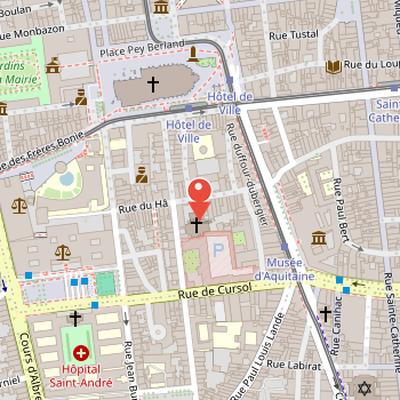
Nearby Objects
-
 Aquitaine Museum 160 m away
 -
 Fort du Hâ 200 m away
 -
 Bordeaux Cathedral 200 m away
 -
 Place Pey-Berland 200 m away
 -
 Église Sainte-Eulalie 300 m away
Name and Parish Context
The Temple du H\u00e2 is a church building of the United Protestant Church of France in Bordeaux, in the Gironde department of the Nouvelle-Aquitaine region. It belongs to the Bordeaux-Ville church parish. The building is named after the Le H\u00e2 castle, which had served as a refuge for the Reformed in 1572 after the St. Bartholomew's Night. Its name therefore reflects a specific historical memory linked to the Protestant community in Bordeaux.
History and Architectural Development
The Temple du He2 was originally built as the chapel of the convent of the school sisters of the Daughters of Our Lady. The convent itself had been founded in 1610 by Johanna von Lestonnac, the niece of Michel de Montaigne. Construction of the chapel began in 1625, supported by donations from notable figures in Bordeaux, and the building was completed in 1628. Its baroque facade was designed by architect Henri Roche.
The chapel underwent several later changes. After the 1751 earthquake, the nave had to be rebuilt. During the French Revolution, the chapel was closed and used to store animal feed. Following Napoleon's Organic Articles decree of 1803, the church was transferred to the Reformed. The wooden seating was built and furnished during this period of transfer, and the first Reformed service was held on December 1, 1805, led by Pastor Martin.
Further additions and alterations followed over time. The organ was built in 1883 by the Bordeaux organ builder Gaston Maille and expanded to 19 registers in 1969. The original statues on the exterior facade have disappeared, and the baroque altarpiece that once stood in the choir area is now located in the parish church of Pessac. An evangelical school once stood next to the building on Rue du Commandant Arnould, and that school building now serves as a community meeting center for the church congregation.