Aquitaine Museum is a history museum in Bordeaux, in the department of Gironde, on cours Pasteur in the city centre. Its origins go back to a lapidary museum created in 1783 by the Académie de Bordeaux. In 1960, it was grouped with the Musée préhistorique et ethnographique and the Musée d'armes et d'objets anciens, and in 1962 it took the name Musée d'Aquitaine : Musée d'Archéologie, d'Histoire et d'Ethnographie under Georges-Henri Rivière. The museum was installed in the south wing of Palais Rohan overlooking cour d'Albert, a building designed by Charles Burguet. It later moved into the former faculty of letters and sciences buildings. Its collections include more than 5,000 pieces of African and Oceanian art related to the port history of Bordeaux, and they are presented through permanent collections and temporary exhibitions. The permanent displays occupy two floors, with the ground floor covering Prehistory, Protohistory, the Roman Period, the Middle Ages, and the Modern Period, and the first floor devoted to Atlantic trade and slavery, world cultures, and Bordeaux as a world port between 1800 and 1939. New permanent rooms about Bordeaux’s role in the slave trade opened in 2009.
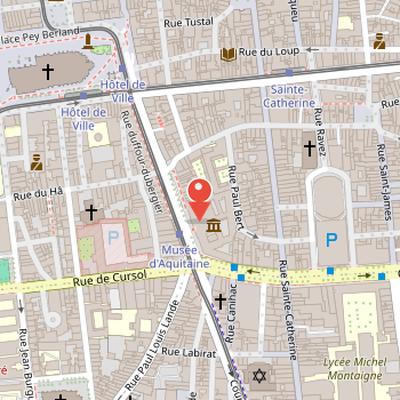
Nearby Objects
-
 Temple du Hâ 160 m away
 -
 Saint-Paul-Saint-François-Xavier Church 200 m away
 -
 Synagogue 250 m away
 -
 Place Pey-Berland 300 m away
 -
 Couvent des Annonciades 300 m away
From Lapidary Museum to Musee d'Aquitaine
The historical museum began as a lapidary museum created in 1783 by the Academie de Bordeaux. In 1960, it was grouped with the Musee prehistorique et ethnographique and the Musee d'armes et d'objets anciens, bringing together several collections under one institutional framework. Two years later, in 1962, it took the name Musee d'Aquitaine: Musee d'Archeologie, d'Histoire et d'Ethnographie under Georges-Henri Riviere.
In the same year, the museum was installed in the south wing of the Palais Rohan, overlooking the cour d'Albert. The north wing of the same building housed the Musee des Beaux-Arts. Both parts of the Palais Rohan were designed by architect Charles Burguet, linking the museum to a specific architectural setting within Bordeaux.
A further stage in its institutional history came in 1980, when the Societe archeologique de Bordeaux signed a convention with the city of Bordeaux. This agreement provided for the deposit of most collections at the Musee d'Aquitaine, while the museum was tasked with exhibiting the collections without giving up ownership. The museum later moved into the former faculty of letters and sciences buildings, although no date is specified for this relocation.
Location and Access
The Aquitaine Museum is situated at cours Pasteur in the city center of Bordeaux, in the department of Gironde. It has been served by the Bordeaux tramway network since May 2004. The museum is directly served by the tramway station Musee d'Aquitaine, and it is also near the Hotel de Ville station. Its central location and tram access make it easily reachable within the city.
Permanent Collections and Exhibition Layout
The Aquitaine Museum holds permanent collections and temporary exhibitions. Its permanent displays occupy two floors. On the ground floor, the collections cover Prehistory, Protohistory, the Roman Period, the Middle Ages, and the Modern Period. The first floor presents pieces related to Atlantic trade and slavery, world cultures, and Bordeaux as a world port between 1800 and 1939. The museum also includes more than 5,000 pieces of African and Oceanian art connected to the port history of Bordeaux. In 2009, the collections opened new permanent rooms on Bordeaux's role in the slave trade, and in February 2014 the rooms dedicated to Atlantic trade and slavery were reopened.
From Prehistory to the Middle Ages
The Aquitaine Museum presents a long historical sequence through collections that begin with prehistoric art and continue into the medieval period. Its prehistoric holdings include female figurative bas-reliefs from Laussel in Marquay, Dordogne, miniatures from Abri Morin in Pessac-sur-Dordogne, and a facsimile of the frieze of deer from the Lascaux cave. The archaeological collections also preserve furniture from major sites such as Pair-Non-Pair cave in Gironde, discovered in 1881, and the Cap Blanc site in Marquay, Dordogne.
A substantial part of the display concerns the Iron Age. The collections conserve funerary information from the First Iron Age between 800 and 450 BC, including numerous funerary urns with weapons, fibulae, torcs, and belt buckles from the tumulus of Ibos in Hautes-Pyrenees and Pau in Pyrenees-Atlantiques. An anthropomorphic post dated 450 BC from Soulac-sur-Mer is also shown. The Second Iron Age, between 450 and 50 BC, is illustrated through discoveries from Lacoste in Mouliets-et-Villemartin, Gironde, together with themes of commerce, iron and bronze crafts, agriculture, daily life, and pottery. The collections feature a reconstituted Gallic blacksmith workshop, as well as pottery, ornaments, and stone statues used in Gallic society from excavations in Bordeaux. Rare pieces include a torque and gold Gallic coins found in Tayac near Libourne and dated to the end of the Iron Age. The collections also state that the Iron Age ended with the Gallic Wars led by Caesar, and that the last battle took place in Aquitaine at Uxellodunum in 51 BC, where part of the Gauls' armament is exhibited.
The ancient history rooms begin with the city's architecture and decor and show the transition to the Roman period, which the collections date from 56 BC. They present a marble altar officially consecrating the city of the Bituriges Vivisques, an inscription indicating that under Emperor Claudius water conduits were established with the sponsorship of Caius Julius Secundus, and evidence that Burdigala became a regional capital after Saintes and Poitiers during the Late Empire. The city is described as being at a maritime, river, and land crossroads and as an early trade center that became a hub distributing goods inland across the empire. Related objects include a large temple, the Pillars of Tutela with engravings, a major mosaic from a city-center house, tombstones of foreigners and artisans, coins found in the Garonne, tableware, tools, and other daily life objects. The Roman and religious sections also include statues of Romanized Gallic deities such as Jupiter-Taranis and Jupiter-Cernunnos, classical Roman pantheon statues including a Jupiter found at a sanctuary in Mezin in Lot-et-Garonne, and a bronze Hercules in Greek classical style found in Bordeaux in 1832. A major Gaulish mithraeum uncovered in 1987 at Parunis, 146 cours Victor Hugo, is represented by an altar to the god Mithra dating from the 2nd to 3rd centuries.
Later periods are represented by steles removed from the base of the Roman rampart during demolition, steles from necropolises outside the city including the Terre-Negre site northwest of the city, and objects with Christian symbols alongside a large mosaic showing a basilica plan in rotonde from the paleochristian era in Novempopulanie. The Merovingian period is illustrated with metal art influenced by the Visigoths, including belt buckle plates and marble sculptures from the School of Aquitaine in the Pyrenees. The medieval collections cover six centuries from 848 to 1453 and evoke Aliénor d'Aquitaine, the Saint-Jacques-de-Compostelle pilgrimage, medieval expansion under English kings, feudalism and Gascon knights, vine culture, commercial exchanges with England, bastide creations, the Black Prince, daily life, and troubadours. Gisants, flat tombs, and tomb elements show the evolution of funerary furniture and concerns in the medieval period.
Historical Collections and Scenographic Rooms
The permanent collections of the Aquitaine Museum are organized into four differentiated scenographic spaces, each highlighting a distinct period or theme in the history of Bordeaux and Aquitaine. The display includes the rose window of the former Grands Carmes church, together with examples of Romanesque and Gothic art from Bordeaux and the surrounding area. Among the objects shown are capitals from Saint-Andre, elements of the destroyed portal of Saint-Seurin, the Visitation of Guitres, and capitals from Auzac and La Brede.
The collections then introduce three sculptures by Julien Rochereau as a transition toward the Renaissance rooms. Rochereau is noted as one of the few known sculptors from the Renaissance period. The sections devoted to the 16th and 17th centuries begin with the new arms of Bordeaux after Guyenne returned to France and include a statue of Charles VIII made for the new Porte Cailhau after the victory at Fornoue. They also present the role of the College of Guyenne, whose humanists reinforced the use of the French language and converted to the Reformation, helping establish Bordeaux as a center of the Counter-Reformation.
Other displays describe hospitals such as Saint-Andre, de la Peste, and de la Manufacture, as well as the cult of saints and the three Maries, daily life, habitat, commerce, and relations with the islands and America in Aquitaine. The collections also mention lucrative cod fishing at Newfoundland and Bordeaux's maritime economy in the kingdom under Colbert.
Several funerary and commemorative works are included, among them the cenotaph of Michel de Montaigne, funerary monuments of the dukes of Epernon and marshal d'Ornano, and the bust of Francois de Sourdis by Le Bernin. Since 2009, the museum's collections have also been dedicated to the slave trade. In the rooms on Bordeaux in the 18th century, the museum reconstructs a Bordeaux facade with remnants of Louis XV's equestrian statue and documents maritime trade through navigation objects and ship models.
Slavery, Colonial Society, and Abolition
The Aquitaine Museum presents a detailed view of Bordeaux's connections to the slave trade and to Saint-Domingue colonists from Aquitaine. Its collections include reproductions of archive documents in the second space, along with explanations of captive trade methods used with African merchants and accounts of indigenous tragedies and colonial war disasters. The display is arranged as an immersive, dimly lit exhibition, and the second space also projects the docu-fiction La Licorne by Pascal Magontier.
The collections further document the organization of slavery in the sugar islands in the third space. They cover plantation life, slave sales, labor, corporal punishment, mortality, infanticide, manumission, maroonage, and revolts. Additional documents address daily life in the Antilles and relations between free men and black slaves. Among the works shown is Julien Vallou de Villeneuve's 1840 oil painting Mon petit maitre que j'aime, whose background depicts an idyllic and exotic insular nature in Saint-Domingue. The museum notes that the title reflects a biased view of inter-racial relations, in a society described as one where a minority white population held all rights and powers while the black slave population worked on plantations. It also states that customs in Saint-Domingue were more liberal than in the metropole, and that relationships between black slave women and masters contributed to a Creole society of mixed-race inhabitants.
The collections also include the Marcel Chatillon fund of 600 Antillean engravings, drawings, and paintings, as well as African-origin items brought by trader sailors. The fourth section is devoted to the struggles for the abolition of slavery and to its consequences, including racial prejudices.
Bordeaux and the Making of a Global Port
The collections at the Aquitaine Museum present Bordeaux and its region as moving from the Ancien Regime into the changes brought by the French Revolution, then into a long period of economic and urban transformation. One exhibit, opened in March 2014, focuses on Bordeaux's relations with the world from 1800 to 1939. It begins with the loss of Saint-Domingue after slave revolts and the maritime wars of the Revolution and Empire, and then traces the port's redevelopment from the 1820s onward.
This redevelopment included major works in the city and port, such as vertical docks, floating basins, warehouses like Entrepots Lainé, and new communication routes created by the construction of the Pont de Pierre. The collections identify Claude Deschamps, Joseph Laine, and Pierre Balguerie-Stuttenberg as figures who initiated these projects. Steamboat construction improved river navigation and made goods transport more regular, while the port handled wine, stone, coal, wood, and foodstuffs. Global trade also strengthened Bordeaux's shipbuilding industry, which became known for building clippers, tugboats, cargo ships, liners, torpedo boats, battleships, and submarines.
The Port de la Lune became an industrial street with many dock workers, and this helped form a worker culture marked by social conflicts. The arrival of the railway in 1841 further changed the city, turning Bordeaux into a railway hub and altering traditional activities. During the same period, Bordeaux competed with Paris, Lyon, Nantes, Le Havre, and Marseille as a central trading hub connected to colonial routes.
The collections also show how Bordeaux was tied to overseas commerce. Sugar refineries in the Antilles supplied 15 percent of European consumption in the 1830s, and rum trade was added to sugar refinery activity. Bordeaux firms were active in Senegal, Gambia, and Casamance between 1840 and 1950, and they also developed peanut cultivation to supply four active oil mills in Gironde. Other links included La Reunion for rum and sugar in the Indian Ocean, Madagascar through Maison Faure freres, and support for the expeditionary corps in Cochinchina. Bordeaux's first implantation in Cambodia is also mentioned, as well as support for Gironde trade in Indochina by Maison Denis freres. In the Pacific, the houses Bordes and Ballande controlled trade from Valparaiso with Noumea and Tahiti.
Bordeaux also became a major transatlantic packet port, with the France-Brazil line starting in 1857, followed by France-Antilles, France-Morocco, and West African coast lines. Between 1865 and 1920, the port served as an emigration point for people traveling to the United States and South America, with emigrants coming from Southwest France, Spain, Italy, and 27 recorded nationalities. The port and the city economy developed through naval industries and food industries, including canneries, biscuit factories, chocolateries using colonial products, sugar refining, oil mills, liqueur and aperitif production, and rum manufacturing. Cod drying industries were established on the Begles marshes, which became the largest French production center. Basque, Breton, and Norman fishermen also unloaded catches from Newfoundland and Iceland in Bordeaux.
The collections further note Bordeaux's prominence in maritime, universal, colonial, and national exhibitions. These global relations helped develop a taste for exoticism and colonial art, contributing to a Bordeaux lifestyle. At the same time, the city underwent major urban development with the opening of belt boulevards and large avenues.
Social Life and Decorative Arts
The collections show Bordeaux as a socially varied city shaped by distinct milieus. Landed aristocrats who owned town mansions lived alongside an economic bourgeoisie and officials in upscale apartments, while clubs such as the Club bordelais, the New club, and the Union club served as social venues. The high rate of domestic staff reflects the wealth of the local bourgeoisie, and the city also included street vendors, artisans, and a significant working-class population. Port and railway facilities, together with industrial diversification, attracted immigrants from southwestern France and Spain.
Social demand stimulated local crafts, especially stone, wood, and ironwork, and Bordeaux faience experienced a period of prominence. The collections also highlight stained glass as part of both religious revival and renewed interest in the applied arts. Civil decorative stained glass was produced in large quantities and distributed internationally, showing the wider reach of Bordeaux production. A recreation of a 1920 to 1930 grocery shop illustrates commercial activity within this urban setting.
The museum also presents cultural practices that ranged from corporate balls to operas at the Grand Theatre and cafes-concerts, each linked to particular social affiliations. Leisure and sport were part of this world as well, with activities on the Bassin d'Arcachon and sports including rugby, cycling, football, horse racing, boating, tennis, golf, and car racing.
The Cenotaph and Remains of Michel de Montaigne
Michel de Montaigne, who had been mayor of Bordeaux from 1581 to 1585, died in 1592 at the chateau de Saint-Michel-de-Montaigne and was buried in 1593 in the chapel of the couvent des Feuillants in Bordeaux. In 1603, Franqoise de la Chassaigne had a cenotaph constructed for him and installed it in the renovated Feuillants church. After the Revolution, the couvent des Feuillants became a lycee, and the building burned in 1871. Following that fire, Montaigne's remains were transferred to the cimetiere de la Chartreuse. In 1886, they were solemnly returned to the university built on the former convent site, where the cenotaph was placed in the entrance vestibule. In 2018, an exploration of the vault beneath the cenotaph revealed presumed remains of Montaigne, and DNA analyses are planned to confirm the identification.
Colonial Collections and Inventory Work
The Musee d Aquitaine holds a large colonial heritage collection in reserve, with about 300 objects on display. The inventory of the colonial fonds includes 2700 objects from Africa, excluding the antique period, along with 1000 objects from Oceania, 716 objects from Asia, and about 1000 objects from the Americas and Inuit worlds. These collections came to France through military campaigns and through religious or ethnographic missions, and their arrival took place within asymmetrical relationships. As a result, some pieces may be subject to restitution if they are claimed by former colonies.
Since 2023, the collection has been part of an inventory project financed by the Conseil regional de Nouvelle Aquitaine and scheduled to run until 2027. The project, titled Anada Afriques Nouvelle Aquitaine decolonisation des arts, involves six history museums, including the Musee d Aquitaine and the Musee d ethnographie de l universite de Bordeaux. It is coordinated by Sophie Chave Dartoen, director of the Musee d ethnographie de Bordeaux. The first phase of the inventory establishes the provenance of African regional collections, while the second identifies problematic or important works. Priority is given to collections from Cameroon, Gabon, Burkina Faso, and Cote d Ivoire, with ongoing collaborations in these countries.
The Museum Library
The Aquitaine Museum includes a library made up of university works and periodical collections related to Bordeaux and its region. Its holdings also include the private collections of Robert Coulon and Francois Bordes. The library is open to the general public, students, and researchers without registration. Books are available either in open access or in storage, and consultation takes place on site.
Selected Works in the Galerie
The Galerie at the Musee d'Aquitaine brings together a varied set of exhibits that reflect different periods and forms of heritage. Its displays include the Homme de Chancelade, the Autel taurobolique, and the Abbaye de La Sauve artifact, alongside the Gisant de Curton and the Plate-tombe d'Aliénor. The gallery also features a representation of Louis-Urbain-Aubert de Tourny, the Mosaique du Saint-Sepulcre, and a fac-simile of the fresco of the deer from the Lascaux cave.
Other elements in the same space include the Ancienne salle de la Prehistoire, the Modillons du, and a polychrome wooden statue of Saint James from the basilique Saint-Michel de Bordeaux. The Galerie further presents twisted columns from the modern era and the Croix processionnelle de la Societe archeologique de Bordeaux as a deposit. Together, these objects indicate a collection organized around archaeological, religious, and historical material connected to the museum's broader holdings.