Bordeaux Cathedral, also known as Saint-André, is a Catholic cathedral in Bordeaux with a history documented from 814, when a church of Saint-André is mentioned in records. It was formally consecrated in 1096 by Pope Urban II and became one of several churches competing for pilgrims in the region. Over time, Saint-André gained influence and came to be the leading church of Aquitaine, later reporting directly to Rome. It also took jurisdiction over churches in Agen, Périgueux, Angoulême, and Saintes.
The cathedral is closely associated with Eleanor of Aquitaine, who married the future Louis VII of France there in 1137. The Romanesque church was begun before 1170 atop masonry from an earlier Carolingian church, but the transition to Gothic architecture began at the start of the 13th century, when the old sanctuary was demolished. Only a wall in the nave remains from the Romanesque building. Under English control of Aquitaine and Bordeaux, the cathedral was transformed into French Gothic architecture. Construction of the choir was underway in 1320, and work on the nave was later delayed by the outbreak of the Hundred Years’ War.
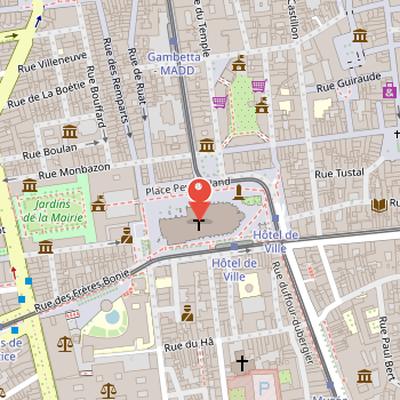
Nearby Objects
-
 Place Pey-Berland 90 m away
 -
 Center Jean Moulin 110 m away
 -
 Palais Rohan 150 m away
 -
 Fort du Hâ 200 m away
 -
 Temple du Hâ 200 m away
Early History and Ecclesiastical Status
Documents mention a church of Saint Andre in Bordeaux as early as 814. It was part of a group that included the Basilica of Saint Severinus of Bordeaux and Notre Dame de la Place in the old castrum. The church appears more officially in a 1096 document from the chancellery of Duke William IX of Aquitaine, and it was formally consecrated by Pope Urban II in the same year. During the 11th and 12th centuries, the Romanesque church competed with Saint Sevrinus of Bordeaux to attract pilgrims. Saint Severinus was associated with the remains of Saint Jacques's companions and the oliphant of Roland placed by Charlemagne, while Saint Andre gradually gained influence and became the leading church of Aquitaine. It was first under the jurisdiction of the Archbishop of Bourges Cathedral before reporting directly to Rome under Pope Clement IV, and it later took jurisdiction over churches in Agen, Perigueux, Angouleme, and Saintes.
Royal Marriage at Bordeaux Cathedral
Bordeaux Cathedral is associated with a significant royal marriage in 1137, when Eleanor of Aquitaine married the future Louis VII of France there on July 25. According to the history recorded, Eleanor became Queen of France after the king's father died a week after the marriage. The marriage was later cancelled in 1152. In the same year, Eleanor married the future Henry II and became Queen of England in 1154. She is also noted as the mother of King Richard the Lionheart and King John of England. These events give the cathedral a lasting place in the history of medieval European monarchy.
From Romanesque Origins to Gothic Reconstruction
The history of Bordeaux Cathedral begins with a Romanesque church started before 1170 on masonry from an earlier Carolingian church. That building had a nave with three rectangular traverses and an asymmetric transept, and its plan included several cupolas. At the start of the 13th century, the transition to Gothic style began with the demolition of the old sanctuary, and only a wall in the nave survives from the Romanesque church. The transformation to French Gothic architecture took place while Aquitaine and Bordeaux were under English control.
Support for the new cathedral came from Archbishop Bertrand de Goth, who later reigned as Pope Clement V from 1305 to 1314. He directed numerous donations and concessions to the cathedral. By 1320 the choir was under construction, with Bertrand Deschamps serving as master builder. Work on the nave was delayed by the outbreak of the Hundred Years War in 1337, and during construction the nave plan was reduced from three aisles to a single aisle. Much of the work at that stage focused on decoration. The bell tower was begun in 1440 and completed in 1500.
Several later changes altered the Gothic fabric. After the earthquake of 1427, which caused parts of the city ramparts to collapse, flying buttresses were added outside the nave under master builder Imbert Boachon. Renaissance decorative elements were added to the Gothic structure in the 16th century. The cathedral also contained an ornamental jubee or rood screen between the choir and the nave; this was removed in 1806, although some elements were retained on the tribune of the organ. The spires were reconstructed in the 17th century, while the interior saw few changes in that century.
The cathedral also figured in important public events. It hosted the royal wedding of Louis XIII and Anne of Austria in 1615, and the birth of Louis XIV was noted in 1638. In the French Revolution, furniture and much decoration were removed or vandalised, and a portion of the exterior sculpture on the north side was spared by being hidden behind neighbouring buildings. The building was officially nationalised in March 1793 and turned into a storage barn for military horses feed. In 1797 the nave was used for political meetings and patriotic assemblies, and when the cathedral was returned in 1798 most of its furniture had gone.
A long series of renovations and reconstructions began in 1803 and continued through the century. Paul Abadie was employed for ambitious reconstructions, including a proposal in 1862 for new sacristies to replace the old cloister. His plans met opposition from Bordeaux archeologist Leo Drouyn, and the conflict between Abadie's imaginative Gothic style and Drouyn's strict medieval Bordeaux style ended with Abadie's version prevailing. Later works exposed more of the building, including the removal in 1866 of later constructions in front of the north side of the nave, making that side more visible. Further strengthening and restoration continued in the 20th century and after, including work on the west vaults of the nave, the west spire of the north transept, the east tower, the roofs of the ambulatory and chapels, and later chapels, sacristy, axis chapel, and transept facades. In 1997 to 1998, the north portal walls were cleaned of grime and soot with lasers.
Exterior and Structural Development
The exterior of Bordeaux Cathedral shows a long sequence of construction, alteration, and rebuilding. On the north side, the portal entering the north transept is known as the portal of spires and dates to about 1325 to 1350. The bays to the west of this portal date to around 1210, while those to the east belong to the second half of the 13th century. The north side of the nave rests on foundations twelve meters wide that reach six meters underground to bedrock, yet the north walls still required additional flying buttresses because of stability problems. The largest of these, the Gramont buttress, began in 1531 and is now a monument. It is covered with Renaissance decoration, including putti and carved inscriptions describing the Biblical Day of Judgement. Between the Gramont buttress and the sacristy on the north front is the royal portal, which served as the main entrance until the 1320s. Its tympanum sculpture, made between 1200 and 1250, survived the Revolution because the portal was hidden by other structures, and it later served as a model for the tympanum of the central portal of Notre Dame de Paris in the 19th century.
The cathedral's towers also reflect later rebuilding. The two spires on the towers were reconstructed in 1665 and 1952 for the west spire, and in 1958 for the east spire. On the south front of the transept, two towers were built to contain the bells, although spires that were originally intended for them were never built. The lower portions below the rose window date to the early 14th century and are older than the north transept. Most of the original sculptural decoration on the exterior was destroyed during the Revolution, and portions of the tympanum and trumeau of the south portal were destroyed in 1794 to allow wagons carrying supplies to pass through. Some sculptures in the voussoirs survived and are now attributed to the Toulouse sculptor Petrus de Sancto Milio, leader of a prominent school of sculpture in southern France and northern Spain.
The west front is entirely without decoration. It was concealed by other buildings until 1772, when those buildings were demolished. The doorway on this front is a late addition made in 1805. Excavations in 1954 showed that the bare wall belonged to the original Romanesque nave built in the 11th century, later raised in height and widened in the 12th and 13th centuries. The early buttresses remain in place. On the south side, a prominent later addition is the row of neo-Gothic buildings known as the New Sacristies. Built by Paul Abadie in 1869 and 1879 in place of the medieval cloister, they are set against the south wall between the buttresses and contain the baptismal chapel, sacristies, a chapel for catechisms, a chapter house, a bedroom for the bishop, and other functional spaces. At the east end, the choir and chevet are surrounded by radiating chapels, with flying buttresses between them supporting the upper walls of the choir.
The Pey-Berland Tower
The Pey-Berland tower was added to Bordeaux Cathedral in the flamboyant Gothic style by Archbishop Pey Berland. He laid the first stone on October 13, 1440. The tower stands about twenty meters from the chevet of the cathedral and rises slightly over sixty meters high. Its base measures eight meters on each side. The original stone steeple was 12.5 meters high. It was blown down in a hurricane in 1667, and the remaining parts were taken down during the Revolution. The steeple was reconstructed in 1851. In 1863, the statue of Our Lady of Aquitaine was placed at the top. Made of gilded metal by sculptor Alexandre Chertier, it became part of the tower's later appearance.
The Interior Nave and Choir
The interior of Bordeaux Cathedral is organized around a nave, a choir, a transept, and a series of chapels. The nave, where ordinary churchgoers are seated between the west front and the transept, is considerably narrower than the choir. It was first covered with four-part rib vaults in the first half of the 13th century, and its traverses were reconstructed with ornate lierne vaults in the 16th century. The nave vaults are decorated with keystones bearing the arms of Archbishop Jean de Foix and carved figures of Saint Andrew.
The nave elevation differs from that of Ile-de-France Gothic churches because of reconstructions carried out in different periods and styles. Its north side has deep niches with windows on the ground floor, while the south side has a largely blank wall flanking the new 12th century sacristies. The elevation also includes groups of three arcades topped with a narrow passageway within the wall thickness, with high windows set into arched ceiling vaults above it. Massive clusters of columns form the piers of the arcades, and their capitals have vegetal designs.
The transept is the meeting point between the nave and the choir and the traditional site of the main altar. The choir, reserved for clergy and containing the choir stalls, is rigidly of a single style, unlike the nave, which combines elements from different periods and styles. Because the choir has a different height and width from the nave, joining the two sections required architectural finesse. The choir also contains carved misericordes made for clergy support.
At the east end, four chapels radiate outward, dedicated to the Annunciation, Margaret Mary Alacoque, Saint Anne, and Saint Charles Borromeo. The chapel of the axis is dedicated to the Holy Sacrament or Sacred Heart and includes tracery, blind arcades, relief sculpture, and a gable over the altar. Other chapels lie on the north and south sides. In the 1850s and 1860s, several small chapels were consolidated to create the Chapel of Saint Joseph on the south side and Our Lady of Mount Carmel on the north side. Our Lady of Mount Carmel is dedicated to the Carmelite prior Saint Simon Stock, who died in Bordeaux in 1265. The Chapel of Saint Anne preserves faded 14th century murals depicting Saint Anne's life, and its ambulatory contains a 16th century statue of Saint Anne with the young Virgin Mary. A bronze statue of Joan of Arc, cast from a model by Antoine Bourdelle, stands outside the Chapel of Saint Anne. The interior also contains 19th century stained glass windows.
The Cathedral Organ Tradition
Bordeaux Cathedral has a long-standing organ tradition documented as early as the 14th century. Over time, several instruments succeeded one another, with organs often being destroyed, rebuilt, or transformed. From the Renaissance onward, the cathedral housed two organs: a grand organ in the gallery and a choir organ. In the 17th century, Valeran de Heman rebuilt and enlarged the grand organ.
After the French Revolution, both organs disappeared. A new sequence of instruments then followed. The organ from La Reole by Micot, dated 1766, was transferred to Saint-Andre in 1804, but it was judged insufficient. In 1811, it was exchanged for the organ of Sainte-Croix Abbey, attributed to Dom Bedos and dated 1748. Its windchests and pipes were integrated into Micot's case, which the architect Combes enlarged in 1816 to 1817. The instrument then comprised 47 stops on 4 manuals and pedal.
Further work expanded the organ during the 19th century. Henry restored and enlarged it to 49 stops from 1837 to 1841, and Wenner rebuilt the action between 1875 and 1877, adding a large Romantic-style expressive division and bringing the total to 56 stops. Despite interventions in the 20th century, the instrument deteriorated. In 1972, the Commission for Historic Monuments decided to preserve the grand case, while Dom Bedos elements were transferred to Sainte-Croix for reconstruction. A new instrument was built inside the historic case by the Danion-Gonzalez firm in 1975.
The present organ was designed with mechanical action and electrified in 1987, but it revealed major design flaws that led to repeated interventions between 1992 and 2010. A new project was launched in 2023 to 2024, awarded to Rieger Orgelbau and Orglez L'Haridon-Freyburger. The future organ will be installed in the restored historic case and is scheduled for completion in 2030. Financing relies in part on an ongoing sponsorship campaign. The interior also contains the Grand organ and its tribune with sculpture, placing the instrument as a visible part of the cathedral's architectural setting.
Relief Sculptures at the Portal
Inside Bordeaux Cathedral, the walls on either side of the portal are decorated with relief sculptures. These works were originally part of the old rood screen between the choir and the nave. They date to before 1544 and show the influence of the Italian artist Rosso Fiorentino, who introduced the Renaissance style to France at the Palace of Fontainebleau.
The Bells of Pey-Berland Tower
The Pey-Berland Tower contains four bells. Two of the larger bells, Marie and Ferdinand-Andre II, were cast by the Bollee foundry in Le Mans. They are currently hung dead and toll rather than swing. Ferdinand-Andre II replaced an earlier bell with a crack, which was melted down. The two smaller bells, Marguerite and Clemence, are located on the upper level and are used to chime for services, masses, weddings, and funerals at Saint-Andre. Since 1925, the bells have been operated by electric motors controlled from inside the cathedral.
Stained Glass in the Cathedral
The stained glass windows at Bordeaux Cathedral are mainly a 19th century ensemble, with installation beginning in 1852 by the glassmaker Joseph Villiet and continuing later under his successor, Henry Feur. These windows fill the walls of the chapels and the high windows of the choir. A few pieces of medieval glass were also integrated into the rose window of the north transept, creating a small surviving link with the cathedral's earlier glazing.
The Marcade Collection at Bordeaux Cathedral
Bordeaux Cathedral houses the Marcade collection, which was given to the cathedral by Canon Marcade in 1947. The collection includes forty-two illuminations, together with other objects such as paintings, sculptures, liturgical vestments, and silver objects. Since 2015, the illuminations have been exhibited in the cathedral in a room specially designed for the collection. This arrangement highlights the collection as a dedicated part of the cathedral's interior display.