Fort du Hâ is a historic fortress in Bordeaux built by decision of King Charles VII immediately after 1453, following the Battle of Castillon and the end of the Hundred Years’ War. The King of France ordered the construction of Château Trompette and Château du Hâ to control Bordeaux and protect it against English offensives. Jean des Vignes is considered the architect, while other sources propose Mathieu de Fortune in connection with the work; the Bureau brothers, Jean and Gaspard, also supervised construction.
The fortress first housed royal troops forming the Bordeaux garrison. In 1470 it became the residence of Charles de Valois, Duke of Guyenne, and later served as the seat of a court. Château du Hâ was also involved in later conflicts, including the gabelle tax revolts, the religious upheavals of the 16th century, and the Fronde. Today, only the towers of des Anglais and des Minimes remain; they were registered as historical monuments on February 6, 1925.
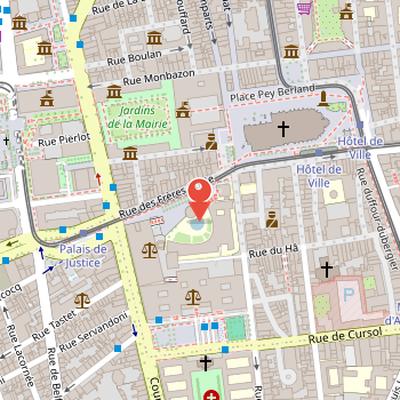
Nearby Objects
-
 Palais Rohan 160 m away
 -
 Musée des Beaux-Arts de Bordeaux 150 m away
 -
 Bordeaux Cathedral 200 m away
 -
 Hôtel de Basquiat 200 m away
 -
 Temple du Hâ 200 m away
Construction and Heritage Status
Fort du Ha in Bordeaux was built by Intro by decision of King Charles VII immediately after 1453. Of the original structure, two towers remain: the tower des Anglais and the tower des Minimes. Both towers were registered as historical monuments on February 6, 1925.
Construction and Early Military Role
Fort du H a was ordered by the King of France together with Chateau Trompette, as part of a strategy to control Bordeaux and protect it against English offensives. After Bordeaux had surrendered to Dunois in 1451 for siding with the English, the city had to bear the cost of these constructions. Jean des Vignes is considered the architect of Chateau du H a, although Mathieu de Fortune, the builder of Chateau-Neuf de Bayonne, was also proposed as responsible for its construction, with Jean des Vignes playing a financial role. The Bureau brothers, Jean and Gaspard, supervised the work, assisted by a commission of three trusted men. The first stone of Chateau du H a was laid on an unspecified date.
The fortress first housed royal troops and formed the Bordeaux garrison. Its military character is also reflected in the thick walls of the Minimes tower, though the precise measurement is not provided. In 1470, Chateau du H a became the residence of Charles de Valois, who had been made Duke of Guyenne by his brother. The castle then served as the seat of a splendid court until the monarch died there on an unspecified date. Later, during the gabelle tax revolts, Chateau du H a experienced a siege and capture. Lieutenant General of Guyenne Tristan de Monenh was killed during the garrison's intervention, and Constable Anne de Montmorency led the repression to restore order.
Fort du Haa: Military Changes and Civic Use
Fort du Haa had a long history of military alteration and administrative reuse. During the Fronde, it took part in the defense of Bordeaux against the royal troops. In 1654, it was repaired and received additional constructions. The site later became the subject of strategic planning when Vauban was commissioned to write a memorandum on the fortifications of the chateau du Haa, chateau Trompette, and fort Sainte-Croix. Following this memorandum, some transformations were carried out on the fortifications.
In 1731, a civil prison was installed at the chateau du Haa, showing a shift in the site's function beyond defense. Later, a new phase of redevelopment was considered when a royal order called for the demolition of chateau Trompette and the construction of new barracks at fort du Haa. Architect Victor Louis was entrusted with the design of these new buildings, and the plans and estimates were accepted on 25 May 1785. However, the project was not realized because of the Revolution.
The history of the site also includes repeated interventions by the monarchy. One demolition was ordered under the pretext of a duel involving the baron de Merville and an officer of marshal d'Ornano, but the works were stopped by letters patent from the king. In another episode, the Tour des Anglais was ceded to the city when the prisons were full. Eventually, the suppression and sale of fort du Haa, fort Louis, and chateau Trompette were decreed.
From State Prison to Execution Site
Fort du Ha was declared national property and converted into a state prison during the Terror. It held many detainees awaiting death sentences by the Gironde Military Commission, and even Jean-Baptiste Lacombe, president of that commission, was imprisoned there until his execution on 28 July 1794. Earlier requests from the departmental directory had led to the fort being left to the department to establish prisons. In later years, the site remained tied to capital punishment in Bordeaux. From 1918, all capital executions in the city took place in the common courtyard of Fort du Ha and the nearby courthouse. Between 1918 and 1933, six men were publicly executed there. Between 1941 and 1960, one woman, Elisabeth Lamouly, and five men were executed at the fort.
War, Detention, and Memorials
During the Occupation, Fort du Ha was used by the Germans as a political prison to detain opponents and resistants. Among those held there were Edouard Daladier, Georges Mandel, Eliane Gosse, prince Louis Napoleon Bonaparte, Renee Darriet, Louis de Jabrun, and Andree De Jongh. The prison also held resistants including Lucien Nouaux, Robert Darniche, Max Coyne, Raoul Batany, Serge Duhourquet, Paul Cazaux, Laure Gatet, Aurore Pica, Andree Tamise, and Paulette Sauboua. Some of these detainees were deported to concentration camps or executed at camp de Souge. Many Jews were detained at Fort du Ha before being transferred to camp de Drancy and then deported to extermination camps in Poland. The site also detained Leon Librach, cousin of Hersz Librach, who later became a Shoah survivor and witness in the Papon trial in 1998.
Commemoration at the site includes a commemorative plaque honoring detained resistants and resistants, as well as a gray granite monument erected in 1985 in the courtyard against the tour des minimes. This monument contains ashes collected from concentration camps.
After World War II, Fort du Ha resumed its function as a departmental prison. It imprisoned Marie Besnard during her second trial and detained the 16 de Basse-Pointe in 1951 during their murder trial. Rene Pons was guillotined in the courtyard and was the last person condemned to death there. At a later date, detainees were transferred from Fort du Ha to the new arrest house of Gradignan.
Reuse of the Fort du He2 Site
Demolition work at the historic site began at the end of 1969, making way for the new c9cole nationale de la magistrature (ENM). The new school was designed on the site by architect Guillaume Gillet, and the ENM was later inaugurated there. Within the perimeter of the historic site, two towers are registered as historical monuments. One of these, the tour des Minimes, was transformed into a conference room for the ENM, linking the former fortifications to the school's new function.
The Tribunal judiciaire at Historique
In 1990, a competition was launched for the construction of the Tribunal judiciaire in the judicial block of Historique. The winning project by architect Jacques Hondelatte was later annulled, and a second competition was held. Richard Rogers won this second competition. His tribunal building at Historique was modern and was put into service in 1998. The site of Historique is also associated with L'Ecole nationale de la magistrature around the tour des Minimes, and with the tribunal judiciaire near the tour des Anglais.