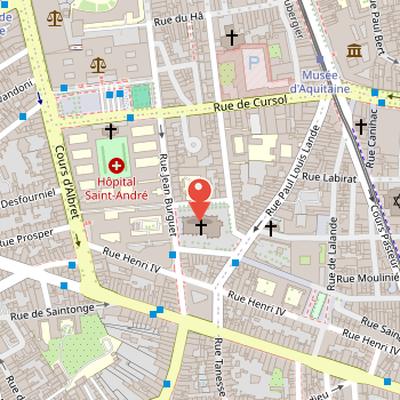
Église Sainte-Eulalie is a Catholic church in Bordeaux, in the French department of Gironde. Located at 13 place Sainte-Eulalie, opposite the emergency department of Hôpital Saint-André, it stands in the south-west part of the city. The parish area was once outside the city walls of the castrum built in the 1st century and was later included by the third enclosure built in the 3rd century.
The church has very ancient origins and is associated with a church mentioned from the 5th century, built over a 5th-century chapel. Its history includes a monastery founded by the Frankish king Dagobert, who dedicated it to Saint Pey (Saint Peter). In the 7th century, Sigebert III donated a relic of Saint Eulalie’s arm, after which the monastery church took the name Sainte-Eulalie. The site also housed a Benedictine nuns’ convent in the 7th century. The church contains the relics of Gascon saint martyrs and has been modified several times. It was classified as a historical monument in 1840 and registered as a historical monument in 2004.
Nearby Objects
-
 Bourse du Travail 120 m away
 -
 Couvent des Annonciades 140 m away
 -
 Temple du Hâ 300 m away
 -
 Synagogue 300 m away
 -
 Aquitaine Museum 350 m away
History and Religious Significance
Eglise Sainte-Eulalie de Bordeaux is a Catholic church whose origins go back to a very ancient period. It has been modified several times over time, reflecting a long and layered history. The church houses the relics of Gascon saint martyrs, which adds to its religious significance. It is also associated with several notable visitors, including Guillaume Chaminade, Therese de Lamourous, Pierre-Bienvenu Noailles, and Louis Martin, the father of Sainte Therese de l'Enfant-Jesus. Sainte Therese de l'Enfant-Jesus herself was baptized in the church in 1823. In recognition of its heritage value, the church was classified as a historical monument in 1840 and later registered as a historical monument in 2004.
Location and Urban Context
The parish of Sainte-Eulalie is located in Bordeaux, in the French department of Gironde. It lies in the south-west part of the city and is situated at 13 place Sainte-Eulalie. The parish is also located opposite the emergency department of Hpital Saint-Andre at 1 rue Jean Burguet. In historical urban terms, the parish was originally outside the city walls of the castrum built in the 1st century, before being included within the third enclosure constructed in the 3rd century.
Early History and Religious Development
Historical accounts mention a church on this site from the 5th century, and the present church is said to have been built over a 5th-century chapel. The monastery was founded by the Frankish king Dagobert between 629 and 638, and he dedicated it to Saint Pey, or Saint Peter. A later donation changed its identity: Sigebert III, Dagobert's son, gave a relic of Saint Eulalie's arm, after which the monastery church took the name Sainte-Eulalie. In the 7th century, the site included a convent of Benedictine nuns, and it is mentioned in the annals of the Saint-Benoist order for the year 658. The monastery was burned by Sarrasin forces in 732 during the Battle of Bordeaux. Around 811, Charlemagne built a chapel to house the relics of seven saints: Saint Clair, Saint Geronce, Saint Sever, Saint Babyle, Saint Policarpe, Saint Jean, and Saint Justin. These relics were hidden again during the Norman arrival in 844.
Medieval Growth and Relics
Rebuilt in the 12th century to receive pilgrims on the route to Saint Jacques de Compostelle, the church of Sainte-Eulalie was consecrated by Archbishop Guillaume, called le Templier, between 1173 and 1187, in the presence of King Henri II Plantagenet. The building was enlarged in the 13th century with the addition of two lateral naves, then further shaped in the 14th century by the construction of a Gothic choir. At the beginning of that century, it was also integrated into the city walls, and its western vault was completed in 1398. In the 15th century, the eastern part was rebuilt, a polygonal apse was added, and two chapels were created to the north-east and south-east.
The church also developed a strong connection with relics and devotional practices. It included the Saint-Clair chapel, which held Saint Roch's staff and the relics of Saint Clair. The staff of Saint Roch, dating from the 15th century, was venerated by the city's lepers, for whom the church provided a separate entrance called the Porte des lepreux. In the 16th century, the bell tower was destroyed by lightning. A chapel for the reliquaries of seven martyrs was created in 1639, after Cardinal de Sourdis authenticated the relics of the seven saints in 1610. He also established the Corps-Saints procession between Sainte-Eulalie and Saint-Andre cathedral, a ceremony that continued until 1880 and is represented in a stained glass window by Joseph Villiet.
Later additions include a Louis XV rococo-style grille made in 1751 by the blacksmith Blaise Charlut. The church also preserves a monumental lectern from the destroyed Carmelite convent, decorated with scenes from the life of the prophet Elijah.
Reliquaries and the History of the Relics
The chasses-reliquaires of Sainte-Eulalie were commissioned by Cardinal de Sourdis and later regilded in 1826, with the work mentioning Michaut, doreur. They were restored again between 2014 and 2018. Their history is closely linked to the relics preserved in the church, including the head of Saint-Clair, identified as human bone. A silver reliquary containing this head appeared in paintings of Sainte-Eulalie church, then disappeared, although the head itself remained. About twenty sealed parchment authentiques are associated with the relics. Their verification was documented in reports signed by Mgr d'Aviau, archbishop of Bordeaux, and Cardinal Donnet, and a new verification report was prepared in 2018 by a commission chaired by Didier Monget. In the 19th century, lawyer Pierre Sansas repeated a rumor in 1863 that the relics had been dispersed in 1793, but this was denied in a publication in 1865. Certificates from 1855 also recorded fragment donations to sanctuaries in Bordeaux, Agen, Auch, and Lectoure.
Rebirth and Early 19th-Century Transformations
During the French Revolution, the church was used as an art warehouse for objects brought from other Bordeaux churches. The northern cemetery adjacent to the church also disappeared. In the early 19th century, the building was revived by priests, parishioners, and figures such as Mademoiselle de Lamourous, pere Chaminade, and pere Noailles. This period was also marked by a reported miracle in which the image of Christ blessing appeared on the consecrated host. The face of Jesus was described as luminous and very beautiful, and although Milady Peychaud said she heard the miracle without seeing it, the testimonies were considered precise and concordant. Archbishop Charles Francois d'Aviau launched an investigation by theologians and doctors, and published positive results a few days later. At the same time, the church was extensively remodeled: the western gothic portal was demolished, the western facade was entirely rebuilt, and the church was enlarged.
Clergy History at Sainte-Eulalie
The history of Sainte-Eulalie includes the service of several clergy members over different periods. Jean-Louis Tauran served as vicar at the church in the early 1970s. Later, father Pierre Legrand was cur of Sainte Eulalie from the 1990s until his retirement in the early 2010s. After his death on 16 February 2018, he was buried at Sainte-Eulalie.