Rue Lanterne is a historic public street in Lyon, France, oriented north-south. It begins at rue d’Algérie, extending from place Tobie-Robatel, and ends at one of the facades of rue Longue. The street was already known in Lyon in 1356, and when its name first appeared, only the central part was called rue Lanterne. At that time, the street was closed to the north by a gate and later opened halfway through the century. Public works were carried out there in 1790, but unlike other avenues in the area, rue Lanterne was not restructured by prefect Claude-Marius Vaïsse. Its history also includes references to a bas-relief of a lion holding a lantern, a pavement order in 1507, and several named houses and businesses. The street hosted inns, shops, and later a discotheque, and was home to many goldsmiths, painters, surgeons, and for a time Alphonse Daudet.
Nearby Objects
-
 Palais Saint-Pierre 150 m away
 -
 Palais Saint-Pierre 150 m away
 -
 Place des Terreaux 150 m away
 -
 Fontaine Bartholdi 200 m away
 -
 Rue Sainte-Catherine 200 m away
Route and Urban Setting
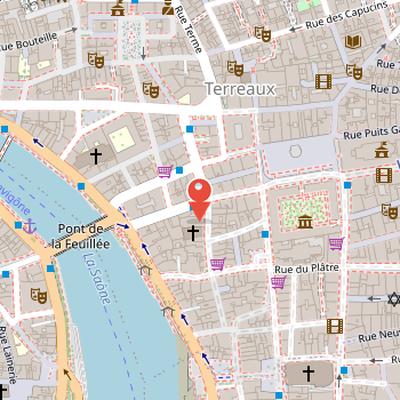
Rue Lanterne is a very old public street in Lyon, France. It follows a north-south orientation. The street begins at rue d'Algerie, extending from place Tobie-Robatel, and ends at one of the facades of rue Longue. Its course and endpoints place it within the historic street network of the city.
Historical Layers of Rue Lanterne
Rue Lanterne was already known in Lyon in 1356, and when its name first appeared it referred only to the central part of the street. At that time, the street was closed to the north by a gate and was opened halfway through the century. Pavement was ordered in 1507, and public works were carried out in 1790. Unlike other avenues in the area, rue Lanterne was not restructured by prefect Claude-Marius Vaise.
The street also preserved several traces of its changing urban identity. In 1846, the part between place de la Platiere and rue Longue, incorporated into rue Lanterne, borrowed the name rue de l'Enfant-qui-pisse. A statue of a urinating child reportedly poured wine during certain festivals, and a bas-relief of a lion holding a lantern in its claws was placed on a house corner. Other decorative or commemorative elements included a bust of a Roman emperor at number 11, a medallion with a lamb suspended by a chain above the door at number 24, and a tombstone found in 1867.
Rue Lanterne also had varied commercial and social uses. A butcher's shop on the street was destroyed by fire in 1612 and again in 1734. In the seventeenth century, the Grand Chevalier inn and the Hotel de l'Ecu de France were located there, while the twentieth century saw the discotheque Au Fort de Brissac. The street was also home to many goldsmiths, painters, and surgeons, including Alphonse Daudet for a time. Houses carried names such as L'Urne aux Roses at number 15 and A la Toison d'Or at number 24.
History of rue Lanterne and the Lanterne tower
La Lanterne was a fire in a tower that lit a medieval entrance to Lyon. In the seventeenth century, the fosses de la Lanterne were located in what is now place des Terreaux, bordered by a northern city wall that included the Saint Pierre abbey near rue Constantine. The very damaged wall required significant repairs led by Aynard de Chaponnay in 1417. The related guard post stored munitions without strong precautions. The tower of the lantern was later destroyed by fire, and it was destroyed again during the implementation of the plan using the fosses des Terreaux. The tower also served as an execution site during the Revolution in 1790. The newer northern part was included in an abattoir called la boucherie des Terreaux, which opened onto the former place de la Boucherie-des-Terreaux between rue Constantine and rue d'Alsace. During World War II, pastor Roland de Pury was arrested at the Terreaux Protestant temple before imprisonment at prison Montluc for resistance activities.
Architecture and Passageways on Rue Lanterne
Rue Lanterne includes buildings dating from the 19th century at the beginning of the street. Its architectural fabric also features several houses from different eras after rue Constantine, including sculpted doors. At number 4, there is a closed straight traboule composed of bourgeois buildings from the 19th century. Another passage, at number 29, is a closed curved traboule that begins with a high stone floor and a large door with an open transom and a traditional hammer; it crosses three buildings and ends at number 20 rue Paul Chenavard. The large gate of the galerie des Terreaux includes a traboule that is opened only during major events. At number 8, the architecture is related to romanticism, with diversity and richness in decorative programs and a variety of sources of inspiration.