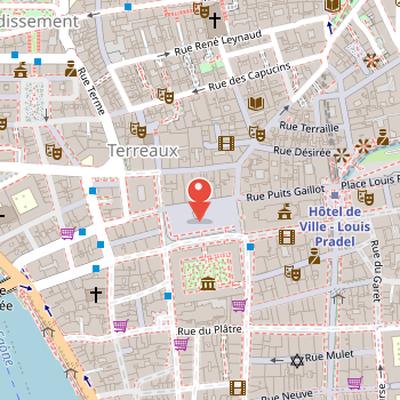
Place des Terreaux is a square in Lyon, France, located in the north of the Presqu'île between the Rhône and the Saône rivers, at the foot of the Croix-Rousse hill. It is bordered by the Hôtel de Ville on the east side and by the Musée des Beaux-Arts on the south side. The Fontaine Bartholdi is located at the center north of the square.
The site has a long history connected to Lyon’s defensive works. In 1206, conflicts between Lyonnais merchants' associations and Archbishop Renaud II de Forez led the bourgeois to build a wall and a tower to control access across the Pont du Change. Defensive works were later resumed, including a wall about 500 meters long between the rivers, with gates, towers, patrol paths, and sentry boxes. A ditch known as Terralia nova or fossés de la Lanterne could be filled with water during a siege. The walls fell into ruin in the 16th century, and demolition began in 1538. The land of today's Place des Terreaux was filled in 1578, and the old ditch disappeared permanently in 1617.
Nearby Objects
-
 Fontaine Bartholdi 20 m away
 -
 Palais Saint-Pierre 60 m away
 -
 Palais Saint-Pierre 70 m away
 -
 Rue Sainte-Catherine 80 m away
 -
 Rue Lanterne 150 m away
Location and Surroundings
Place des Terreaux is a square in Lyon, France, situated in the north of the Presquile between the Rhone and the Saone rivers. It lies at the foot of the Croix-Rousse hill. The square is bordered by the Hotel de Ville on the east side and by the Musee des Beaux-Arts on the south side. At the center north of the square stands the Fontaine Bartholdi, making it a prominent feature of the site.
Early Defensive Works
In 1206, the Lyonnais merchants' associations clashed with Archbishop Renaud II de Forez over violations of tax agreements. In response, the Lyonnais bourgeois decided to build a wall at the foot of the Saint-Sebastien hill and a tower on the Saone in order to control the Pont du Change. The conflict continued in 1208, when Renaud II de Forez used arms before peace was restored through the intervention of Pope Innocent III. Renaud de Forez and his successors later resumed the defensive works begun by the bourgeois to protect Lyon from an attack from Dombes.
Medieval Fortifications and Later Remains
The area of place des Terreaux was once part of a defensive system built between the Saone and Rhone rivers. Histoire describes a new wall, two meters thick and ten meters high, extending for about 500 meters. It had two gates protected by drawbridges, ten round or square towers, crenellated patrol paths, and five stone sentry boxes for soldiers to observe from the top. A 22 meter wide ditch separated this main wall from another wall, also two meters high, positioned further north. In the 13th century, a third structure was added on the slope to strengthen the defenses, and early in the 14th century another work was built at the summit of Saint-Sebastien hill, with an earthen mound and wooden towers.
The ditch, known as Terralia nova or the fosses de la Lanterne, could be filled with water during a siege. Water entered through Neyron canal basins dug next to the Rhone and drained toward the Saone below. The ditches were also used for military training: archers, and later crossbowmen, practiced there, first on the Saone side and from 1533 on the Rhone side. During the 16th century the walls fell into ruin, and demolition began in 1538. The Saone side ditch was filled in for the construction of the Lanterne butchery, and in 1555 the nuns of Saint-Pierre convent were allowed to reuse stones from the wall for monastery repairs.
Formation and Later Uses of Place des Terreaux
In 1578, the land that is now Place des Terreaux was filled in. By 1617, the old ditch had permanently disappeared as a result of the development of the city hall garden, on the site now occupied by the Opera. The land was then divided and turned into a square, with several streets providing access. In 1646, the pig market was transferred to Place Saint-Just, and the square also served as a place of public executions.
The area continued to change in the 19th century and afterward. In 1855, an opening was made between the square and rue Lanterne. Rue de Clermont was merged into rue de l'Imperatrice, now rue du President-Edouard-Herriot, which connects Place des Terreaux to Place Bellecour. A new street planned to the north, aligned with the Palais Saint-Pierre, was never built.
One building on the square had a particularly changeable history. Its hotel closed in 1905, and the ground floor was transformed into a cinema in 1913-1914. The cinema closed definitively in 1988, and a restaurant later replaced its premises. The courtyard was described as being in very poor condition, with wooden galleries and balconies on the east, south, and north sides, and the stucco decoration was made by decorator Jules Mazzini.
Fontaine Bartholdi and the Reworking of the Square
Place des Terreaux saw a sequence of changes centered on its fountains and the surrounding urban layout. A new fountain, the Fontaine de Tourny, was inaugurated at the center of the square, and it remained there until 1892, when it was moved to Place Guichard. Its relocation made room for the erection of the Fontaine Bartholdi. This new fountain was placed on the west side of the square facing city hall and was inaugurated by city officials. Bartholdi designed it as an allegory of the Garonne. The monument had earlier been commissioned in 1857 by the Bordeaux council under the name Char Triomphal de la Garonne, with the river and its four tributaries represented by a woman leading a quadriga. After the 1889 Universal Exposition, Lyon mayor Antoine Gailleton bought the monument in 1890. The square was also affected by major urban projects of the Second Empire, which enlarged the outlet of rue Saint-Pierre.
Execution Site in the 19th Century
Histoire identifies Place des Terreaux as the theoretical site of death executions in Lyon during the first half of the 19th century. It also records that Claude-Antoine Chrétien served as the official executioner until 1842. At the same time, the source notes that some executions took place in other locations, showing that the square was associated with executions without being the only site used.
Redesign and Recent Renovation
Place des Terreaux was redesigned in 1994 by Christian Drevet, Laurent Fachard, and Daniel Buren. The redesign introduced an orthogonal pattern of 68 mini-fountains with variable height water jets, set on granite slabs and accompanied by 14 black and white striped pillars. A grid of identical stripes covers the entire square, with the facade of the Saint-Pierre Palace placed rhythmically within the composition. At night, light effects combine the mini-fountains, facades, pillars, and the surrounding square.
Michel Noir classified the Terreaux as an artwork, and later legal disputes concerned the use of images of the square. Buren and Drevet sued postcard publishers for copyright infringement after partial reproductions of their work, but the Court of Cassation ruled that their work was only a simple element and not the main subject. Photographers were therefore able to commercially use photographs of the square without breaching artwork communication rights.
The Bartholdi fountain was relocated in connection with the construction of a parking garage park, which required it to be moved in line with the Saint-Pierre Palace. It was classified as a historical monument on March 15, 1995. Since 2016, it has been restored by transporting fragments to Paris, and it was reassembled at its location on May 18, 2018 during an evening ceremony.
A renovation project began on May 14, 2021 for the worn and degraded square. It included replacing the pavement from dark grey to light grey, improving lighting, adding and restoring Buren cubes and pillars, and unifying the terraces. Fifteen new illuminated round mini-fountains were created centrally, reaching up to 0.60 meters in height, while the 68 old mini-fountains, which had malfunctioned and been inactive for about ten years, were removed. The reconfiguration cost more than 6 million euros and involved consultation with Drevet and Buren. The project was completed on October 30, 2021, before the Festival of Lights. The new light coating has been criticized as dirty, and the absence of vegetation has also drawn criticism, although the mayor's office of Lyon has justified that absence by the need to accommodate Daniel Buren's wishes.
Public Events and Projections at Place des Terreaux
Place des Terreaux is used for major public events and visual displays. In 2024, the Fete des Lumieres drew nearly one million spectators to the square. During the event, luminous and sound projections are shown on the facades of the Hotel de ville and the Musee des Beaux-Arts. In 2018, during the square renovation, these projections were replaced by lighting on the freshly restored Bartholdi fountain for safety reasons. In 2025, anti-police slogans were projected on the Musee des Beaux-Arts facade, and this act was claimed by Les Soulevements de la Terre. The square also hosts the Beaujolais nouveaux tasting ceremony organized by department winemakers for one evening at the end of November.