Rue Sainte-Catherine is a street in Lyon with a complex history marked by several successive names and changes in urban form. A rue and a place Sainte-Catherine are recorded in 1680, named after an orphan care establishment located on the site. Over the centuries, the area also bore names such as marché du Fillet, place du Fil, place Neuve-des-Carmes, and rue du Forès. The current street absorbed the former place Sainte-Catherine, while the petite rue Sainte-Catherine was renamed rue Jean-François-Terme on the same date that the present rue Sainte-Catherine received its definitive name.
The street also has a wartime history. During the Second World War, the Union générale des israélites de France maintained a social works office at number 12 rue Sainte-Catherine, where aid was organized for the Jewish community, including support, false papers, and crossings to Switzerland.
In the late 20th century, rue Sainte-Catherine became known for nightlife. The center of this activity moved there progressively during the 1980s, and the street became emblematic of the pentes de La Croix-Rousse, with many bars and pubs and a festive atmosphere shaped by its cultural and social diversity.
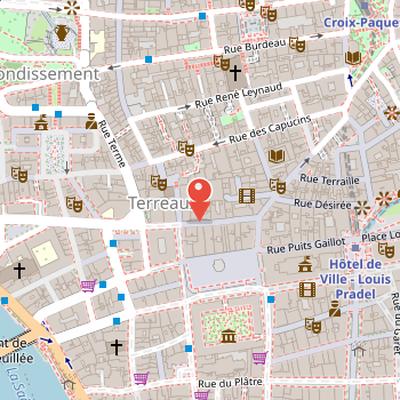
Nearby Objects
-
 Fontaine Bartholdi 70 m away
 -
 Place des Terreaux 80 m away
 -
 Rue des Capucins 110 m away
 -
 Palais Saint-Pierre 140 m away
 -
 Palais Saint-Pierre 150 m away
Names and historical layers of rue Sainte-Catherine
The history of rue Sainte-Catherine is marked by several earlier names and forms that changed over the centuries. According to the historical record, a rue and a place Sainte-Catherine already existed in 1680, named after an orphan care establishment located on the place. Other names also appeared over time, including marche du Fillet, place du Fil, place Neuve-des-Carmes, and rue du Fores. A different rue Sainte-Catherine was recorded in 1831 in what is now rue Charles-Francois-Lebrun. The historical sources also distinguish between a petite rue Sainte-Catherine and a grande rue Sainte-Catherine. The petite rue Sainte-Catherine was later renamed rue Jean-Francois-Terme, and the current rue Sainte-Catherine received its definitive name on the same date. In addition, place Sainte-Catherine was absorbed by the rue Sainte-Catherine, showing how the street incorporated surrounding space into its final form. The area is also linked to a statue of Catherine d'Alexandrie, sculpted in 1866 by Joseph-Hugues Fabisch at the corner of rues d'Algerie and Sainte-Marie-des-Terreaux. This statue replaced an earlier work and recalls the hospital connected to the hôpital de la Charite de Lyon.
Wartime aid at rue Sainte-Catherine
According to Histoire, the Union generale des israelites de France had a social works office at number 12 rue Sainte-Catherine during the Second World War. Despite strict control by the authorities, the association developed a valuable network of aid for the Jewish community. Many Jews in Lyon visited rue Sainte-Catherine in search of medical support or material assistance. The association also provided false papers and organized crossings to Switzerland, making the street a significant point of wartime support and assistance.
Nightlife and Memory on Rue Sainte-Catherine
Histoire describes rue Sainte-Catherine as a street whose image was shaped by nightlife, social mixing, and a difficult past. In the bas des pentes quarter, sometimes called quartier Sainte-Catherine, the area became known for prostitution, various traffics, clandestine bars, and delinquent gangs. The Gang des Lyonnais used the street as one of its bases, especially the bar Le Chambery, whose owner was shot dead on site in 1977. At the same time, the nightlife center initially lay on rue Rene Leynaud before gradually moving to rue Sainte-Catherine during the 1980s.
The street later became emblematic of the pentes de La Croix-Rousse and gathered a concentration of bars and pubs, including lAbreuvoir, le Shamrock, le Perroquet Bourre, lAlbion, and le Douala. LAlbion, founded in 1982, was the first Irish pub in Lyon. Rue Sainte-Catherine is also surrounded by kebabs and night grocery stores. Histoire links this concentration of venues to the streets central location in Lyon, which attracts people from La Croix-Rousse, presquile, Saint-Jean, Saint-Paul, and the 1st arrondissement. Access is reinforced by the pont La Feuillee, which connects Saint-Jean and Saint-Paul over the Saone, by the pont Morand, which connects the 1st arrondissement, by the Hotel de Ville metro stop between lines A and C, and by many buses serving the quartier Sainte-Catherine until late at night.
The street is especially active at night and is called la Rue de la Soif by Lyonnais. A prefectural order of February 14, 2013, changed bar closing times in the quartier Sainte-Catherine, requiring all bars to close at 1 a.m. instead of 3 a.m. Histoire notes effects including bar closures, dealer raids, and the transformation of bars such as the Shamrock into more respectable pubs. It also states that smoking bans and higher drink prices contributed to these changes, and that rue Sainte-Catherine no longer resembles its lively state before the mid-1990s.
The street also carries commemorative traces, including a plaque for Marie-Louise Rochebillards 1899 creation of a womens union at 13 rue Sainte-Catherine, a statue of Sainte Catherine of Alexandria by Joseph-Hugues Fabisch, and a commemorative plaque of the rue Sainte-Catherine raid.
Related Context and Connections
The associated topics for rue Sainte-Catherine place it within several wider contexts in Lyon. It is linked to the Voie in the 1st arrondissement of Lyon and to the Voie de Lyon, which refers to a woman's name. It is also associated with the Pentes de la Croix-Rousse, indicating a connection with that part of the city. In addition, the street is connected to the history of Jews in Lyon and to sites linked to the Shoah in France, pointing to its relevance in historical and memorial discussions.