Palais Saint-Pierre is the modern name of the abbaye de Saint-Pierre-les-Nonnains de Lyon, also known as the abbaye des Dames de Saint-Pierre. It is an ancient Catholic religious building in Lyon that received Benedictine nuns starting in the 5th century. The abbey was rebuilt in the 17th century and closed during the French Revolution. It now houses the Musée des Beaux-Arts de Lyon.
The history of the abbey’s foundation is uncertain, and the available sources do not provide a clear date. Medieval and later accounts associate its origins with different periods and figures, including references to bishops and monastic communities, while historians have questioned the reliability of some of these claims. During the Carolingian era, the abbey was described as the wealthiest religious establishment in Lyon. In the French Middle Ages, it was known as Saint-Pierre-les-Nonnains and in official medieval texts as Monasterium sancti Petri puellarum.
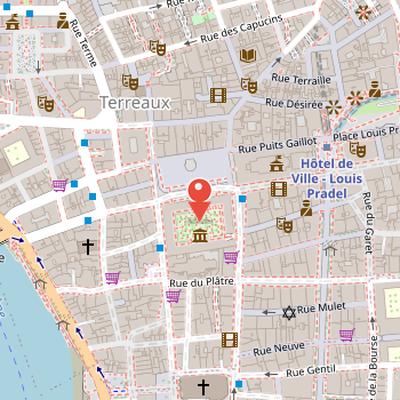
Nearby Objects
-
 Palais Saint-Pierre 10 m away
 -
 Place des Terreaux 70 m away
 -
 Fontaine Bartholdi 90 m away
 -
 Rue Sainte-Catherine 150 m away
 -
 Rue Lanterne 150 m away
From Abbey to Museum
The Palais Saint-Pierre is the abbaye de Saint-Pierre-les-Nonnains de Lyon, also known as the abbaye des Dames de Saint-Pierre. It is an ancient Catholic religious building that received Benedictine nuns starting in the 5th century. The complex was rebuilt in the 17th century, reflecting an important later phase in its history. It was closed during the French Revolution, marking the end of its religious use. Today, the building houses the musee des Beaux-Arts de Lyon, giving the former abbey a new public and cultural role.
Early History and Church Fabric
The foundation date of the abbey is unknown, and Histoire reports that research on its origins is difficult because the oldest documents do not provide reliable authority. One traditional account, preserved in the testament of Bishop Ennemond of Lyon, claims that Aldebert endowed the monastery of Saint-Pierre with lands in 208 and that the monastery was already governed by abbesses in the 4th century. However, historian Alfred Coville identified this testament as a medieval forgery. Other proposed origins place the first construction in the Merovingian period under Bishop Sacerdos of Lyon, while Pierre Picot attributes the constitution of the monastic community to Bishop Ennemond in the 7th century. Joachim Wollasch considered this date hypothetical, and Picot preferred a later adoption date in the time of Benedict of Aniane. Wollasch linked this adoption to the regional abbey of Remiremont under Louis the Pious.
A letter from Bishop Leidrade to Charlemagne, which is preserved, states that Leidrade rebuilt a monastery of virgins dedicated to Saint Peter under Charlemagne. During the Carolingian era, the abbey was the wealthiest religious establishment in Lyon, and the letter written by Leidrade between 809 and 813 says that it housed thirty-two nuns. The abbey was directly subject to the papacy and became increasingly independent from the clergy of Lyon. In the French Middle Ages it was called Saint-Pierre-les-Nonnains, while medieval official texts refer to it as Monasterium sancti Petri puellarum and Ecclesia que dicitur sancti Petri puellarum.
The abbey has included two churches since its foundation. Its conventual church is Saint-Pierre, which was rebuilt in Roman style in the 11th century and kept that style until the abbey reconstruction in the 17th century. A smaller church stands next to it, called Saint-Saturnin or Saint-Sornin.
Religious Authority and Reform at Histoire
Histoire was an aristocratic abbey governed by nuns drawn from high nobility. In the 12th century, novices were required to prove four generations of paternal nobility before being admitted to the convent. The nuns formed an assembly called the chapter, which elected the abbess for life. The abbess reported her election only to the pope and was not subject to the authority of the Archbishop of Lyon. The church of Saint-Saturnin was the parish church, and its revenues were collected by the nuns.
In 1503, during a visit to Lyon by King Louis XII and Queen Anne of Brittany, complaints were made about the conduct of the nuns. They were ordered to return to a cloistered life and follow the rule of Saint Benedict. The nuns resisted the reform and appealed to the pope to protect their rights.
Reconstruction and Later Public Uses
For the reconstruction of Palais Saint-Pierre, Histoire chose the architect Francois Royers de la Valfreniere, whose grand work was the rebuilding of the palace. He designed the monumental facade elevation on Place des Terreaux and two lateral facades. The first stone of the new palace was laid on November 1, 1657 by a poor little man. Valfreniere was already old during the project and died in 1667. The resulting building was an imposing Roman-style structure stretching along Place des Terreaux, and it was described as the most beautiful baroque achievement in Lyon, with an Italian extent and monumentality.
At the death of Anne de Chaulnes in 1672, two wings still had to be built and the interior decoration had not yet begun. Her sister-in-law, Antoinette de Chaulnes, succeeded her as head of the abbey in 1675 and completed the project. A sumptuous interior decoration was carried out between 1676 and 1687, although it is now almost entirely lost. Only the grand staircase and the refectory, with exuberant baroque decor, survive from this campaign. The original lighting of the staircase, provided by five windows, has recently been restored. The refectory decoration involved sculptors Simon Guillaume and Nicolas Bidault, while Marc Chabry created the coats of arms, including those of the sisters of Chaulnes. Painter Louis Cretey, recently returned from Italy, painted two monumental canvases and three compositions in the vault oculi.
The reconstruction works cost a considerable sum for the time, and shops were arranged on the ground floor and rented to merchants to provide income. In the 18th century the abbey remained prosperous, and in 1755 it was considered one of the five richest in France. The French Revolution ended the abbey after more than a thousand years of existence. In 1790 there were 31 nuns in the monastery, and they were expelled in 1792 after decrees suppressing religious congregations. The first museum room opened to the public in 1803 on the first floor of the southern wing in the former abbey warming room. Later, in 1835, the Faculty of Sciences occupied part of the former abbey, and the Faculty of Letters joined it in 1838. After the inauguration of the Palais de la Bourse in 1860, the Bourse and the Chamber of Commerce left the old abbey.
Architecture and Historical Transformations
Palais Saint-Pierre is protected in several ways as a historic monument: the building as a whole, apart from the classified parts, is inscribed as a monument historique, while the facades and roofs are classified. The porch, two doors, and the facade are also listed as monuments historiques. According to the available facts, the site was reportedly built by Saint Annemond or Ennemmond and contained reliquaries, then rebuilt in the 11th century. In that period, the church was reduced to the area up to the present steps before the choir, with a single nave ending in a five-sided apse. Its transept arms were formed by the chapels of Sainte Marguerite to the north and Saint Benoit to the south, and Romanesque windows remain visible in the interior passage and in the porch on rue Paul-Chenavard. Lateral chapels were added in the 15th century. Part of the church was destroyed in 1562 during the Wars of Religion by Protestants under the baron des Adrets. In 1742, architect Antoine Degerando enlarged the choir and built the bell tower. The church later became a parish church in 1807, was deconsecrated in 1907 because of the law separating churches and the state, and was then assigned to the Musee des Beaux-Arts, where some sculpture collections were displayed. A second church dedicated to Saint Saturnin, commonly called Saint-Sorlin, stood south of Saint-Pierre and was used by the parish especially for baptisms and marriages until it was sold and demolished in 1793.
Baroque Refectory and Cloister Garden
The Baroque refectory at Palais Saint-Pierre was directed in 1684 under Thomas Blanchet, who also conceived its iconography and that of the grand staircase. It is presented as an important testimony to Baroque decor in Lyon and at the royal abbey of Dames de Saint-Pierre. The refectory survived the revolutionary destructions of the museum's interior decor and was later renovated for use as a space for group receptions.
The refectory preserves a carefully organized decorative program. Two monumental paintings face each other on opposite walls, with themes related to meals and thus matching the original function of the room. The walls are decorated with The Multiplication of the Loaves and The Last Supper, while the ceiling oculi contain three lunettes showing The Assumption, The Ascension, and The Prophet Elijah by Louis Cretey. The sculptural ensemble includes 14 sculptures created by Nicolas Bidault and Simon Guillaume, with Simon Guillaume's works based on designs by Thomas Blanchet. Additional decorative elements include armorial bearings, escutcheons, and coats of arms made by Marc Chabry, as well as the armorial bearings of abbesses Anne and Antoinette de Chaulnes on the west fronton of the entrance door and the coat of arms of the King of France on the second vault keystone.
The cloister was extensively modified by Rene Dardel and Abraham Hirsch. Under the arcades, wall paintings reproduce the names of famous people from Lyon and medallions on frontons. In the garden, a circular basin fountain is made from an antique sarcophagus topped by an Apollo statue. The garden also displays statues of 19th-century artists including Auguste Rodin, Leon-Alexandre Delhomme, and Bourdelle. Its lawn beds are semi-circular and rectangular, with trees and flower beds designed by Abraham Hirsch. The garden follows the original 19th-century plan and is open for free visits from 8:30 AM to 6:30 PM all year.
Archival Documentation and Study
Most of the documentation concerning the abbey is preserved in the Archives departementales du Rhone. René Lacour, chief curator, classified the archives and published a digital directory in 1968 under reference 27 H. Later, Joseph Picot used these materials for a doctoral thesis and published a book in 1970 on the abbey Saint-Pierre from its foundation until the mid-century. His research also drew on archives from Rhone, Isere, Ain, the Archives municipales de Lyon, and the municipal libraries of Lyon and Puy.