The Museum of Fine Arts of Lyon is a municipal museum located on place des Terreaux in Lyon, France, in the former abbaye de Saint-Pierre-les-Nonnains. More commonly known as palais Saint-Pierre, it was formally established during the French Revolution, officially founded in 1801, and opened in 1803. In the 19th century, it shared its premises with the École des beaux-arts de Lyon.
The museum’s collections include numerous archaeological and historical pieces, as well as artworks displayed in rooms dedicated to Lyon artists. It acquired notable works such as La Lapidation de saint Étienne by Rembrandt and later expanded its holdings under the Third Republic. Under Édouard Aynard, it was among the first museums to embrace avant-garde art, and it exhibited works including Nave Nave Mahana by Paul Gauguin. It also organized ambitious modern art exhibitions under René Jullian.
The museum has since specialized its collections through transfers to musée Gadagne and Musée gallo-romain de Fourvière, recovered premises after the departure of the École des Beaux-Arts and the Académie de Lyon, and underwent major renovation of its exhibition rooms at the end of the 20th century. Today, it presents about 20,000 works from a collection of 70,000, arranged in 35 rooms in chronological order, with major sections devoted to Venetian Renaissance painting, 17th-century painting, 19th-century French painting, early 20th-century painting, sculpture, and antiquity objects.
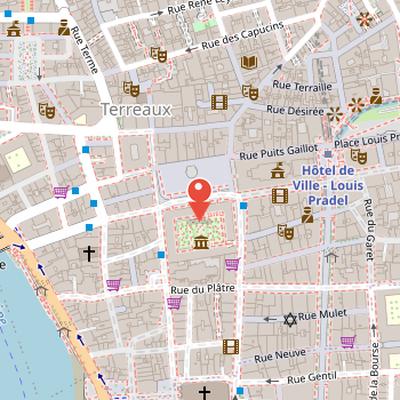
Nearby Objects
-
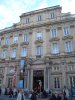 Palais Saint-Pierre 10 m away
 -
 Place des Terreaux 60 m away
 -
 Fontaine Bartholdi 80 m away
 -
 Rue Sainte-Catherine 140 m away
 -
 Rue Lanterne 150 m away
History and Collections of the Museum
The Museum of Fine Arts of Lyon is a municipal museum located on the place des Terreaux in Lyon, France, in the abbaye de Saint-Pierre-les-Nonnains, and is more commonly known as palais Saint-Pierre. It was formally established during the French Revolution, officially founded in 1801, and opened in 1803. In the 19th century, it shared its premises with the Ecole des beaux-arts de Lyon, and it also had a flower salon intended for designers of the local silk industry, as well as rooms dedicated to paintings by Lyon artists.
The museum's collections developed over time to include numerous archaeological and historical pieces, and they also gained prestigious artworks such as La Lapidation de saint Etienne by Rembrandt. Under the Third Republic, the museum expanded and adopted a more ambitious contemporary acquisition policy. Under Edouard Aynard, it was one of the first museums to embrace avant-garde art, and it exhibited works including Nave Nave Mahana by Paul Gauguin. Later, under Rene Jullian, it organized ambitious modern art exhibitions. At the end of the 20th century, it specialized further by transferring some collections to musee Gadagne and Musee gallo-romain de Fourviere, while contemporary art collections were transferred to the Musee d'Art contemporain. It also underwent a major renovation of its exhibition rooms during this period.
Today, the museum presents about 20,000 works from a collection of 70,000 artworks. These are displayed in 35 rooms arranged in chronological order. Its holdings include rich sections in Venetian Renaissance painting, 17th-century painting, 19th-century French painting, and early 20th-century painting. The sculpture department presents 7,000 sculptures in three locations: ancient sculptures on the first floor, contemporary sculptures in the chapel, and some sculptures in the garden. The museum also holds a large collection of Antiquity objects from Egypt, the Ancient Near East, Greece, and Etruscan art, along with a rich collection of medieval objects and Islamic, Asian, Art Nouveau, and Art Deco artifacts. Its medal cabinet contains a rich numismatic collection, and its graphic arts cabinet includes drawings and engravings from all periods.
Formation of the Museum Collections
According to Histoire, the Museum of Fine Arts of Lyon emerged from revolutionary efforts to gather art seized from the clergy and nobility so that it could be used to educate the public. In 1792, Philippe-Auguste Hennequin and Joseph Janin compiled a list of preserved artworks for the district directory, and François Artaud became the first conservator of a museum inspired by the projects of Alexandre Lenoir and the Louvre. Authorities planned the museum in the former abbey of the Dames de Saint-Pierre in Lyon.
The museum was also tied to an industrial objective. Its official purpose included reviving Lyon's silk industry through drawing art, a goal that gained urgency after the siege damage of 1793 affected the silk trade. Etienne Mayeuvre de Champvieux later requested silk design models from the government for Lyon's factories. The collections expanded through several government shipments in 1803, 1805, and 1811, which brought nearly 3000 artworks to Lyon. These additions included works by Pérugin, Veronese, Le Tintoret, Guerchin, Rubens, Jordaens, Champaigne, and Jouvenet.
Histoire ranks the museum among the top provincial museums in France. Most of its artworks came from revolutionary seizures and plundering by French armies in Italy and Northern Europe. The museum also contained a painting gallery inaugurated by Comte d'Artois and a cabinet of antiquities. After the fall of the First Empire, eight foreign-seized paintings were returned.
Curators, Collections, and Acquisition Policy
François Artaud is named as the first true curator of the new museum in 1806, and he remained head of the institution until 1830. He resigned that year because he refused to swear allegiance to the July Monarchy. As an archaeologist, Artaud gave the museum its initial collection of antiques. He gathered inscriptions, bronzes, and mosaics under the cloister arcades, presenting them as evidence of Lyon's Roman prestige. Among these early holdings were the table claudienne and the mosaic of the Circus Games, now conserved at the Gallo-Roman Museum of Fourviere. Artaud also initiated the acquisition of the Kor e athennienne between 1808 and 1810, at a time when public interest in Lyonnais painters had long declined. Shortly before 1815, he created the Salon des Fleurs, which presented works by Jan van Dael and Jan van Huysum.
The museum's collecting policy later relied on ambitious goals set by Aynard and advisers, together with several important financial foundations. Jean-Baptiste Giraud gathered most of the museum's Islamic art collection and created and organized the art objects department. The antiquities department was then expanded with Greek and Etruscan vases and bronzes. The most spectacular acquisitions, however, were made in modern painting. In 1901, the museum purchased Renoir's Guitariste from the Durand-Ruel gallery. It became the first museum outside Paris to form an impressionist painting collection. Its holdings also include Edgar Degas's Le Cafe-concert aux ambassadeurs and Paul Gauguin's Nave Nave Mahana, which was the artist's first painting in a French museum in 1913. The museum also favored works by Pierre Bonnard, Edouard Vuillard, and Leonard Foujita over avant-garde movements, and Foujita is represented by Autoportrait au chat.
Expansion of the Collection in the Late 20th and Early 21st Centuries
In the 1950s, director Rene Jullian sought to address major gaps in the museum's collections despite municipal hostility. A significant milestone came in 1952, when the museum acquired Jean Dubuffet's Paysage blond, the first Dubuffet painting to enter a French museum. Later, in the 1980s, the museum faced problems of space, decay, and inadequate visitor facilities, which created a need for renovation and expansion.
The museum also benefited from important donations, especially from Jacqueline Delubac, a Lyon native and actress who assembled a notable modern art collection and inherited Impressionist paintings from Myran Eknayan. Her gifts added works by Braque, Rouault, Leger, Picasso, Miro, Dubuffet, Bacon, Manet, Degas, Renoir, Monet, Corot, Bonnard, and Vuillard. The museum also established a pioneering patronage structure, with Lyon companies contributing to the endowment fund.
Acquisitions continued in the 21st century despite budget constraints. In 2011, the museum acquired three works by Pierre Soulages during the economic crisis. It added two paintings by Jean-Honore Fragonard and one by Jean-Auguste-Dominique Ingres in 2013, followed by a work by Corneille de Lyon in 2015. In 2016, it acquired Nicolas Poussin's La Mort de Chione, painted in Lyon in 1622. The museum also launched a public subscription to acquire Ingres's L'Aretin et l'envoye de Charles Quint, renewed the operation in 2015, and secured the Corneille de Lyon painting with support from Cercle Poussin, Fondation Bullukian, and many individuals.
These efforts contributed to the museum's strong standing. In 2017, Le Journal des arts ranked it first among metropolitan museums, just ahead of the Musee des Beaux-Arts de Rouen.
Palais Saint-Pierre: Architecture and Interior Spaces
The Museum of Fine Arts of Lyon is housed in the Palais Saint-Pierre, which is inscribed as a historical monument, with its facades and roofs separately classified as historical monuments. The municipal garden is located in the former cloister of the Benedictine abbey, in the city center on the presqu'ile. It underwent major architectural modifications in the 20th century and contains murals under the arcades with the names of famous Lyonnais, along with medallions on the pediments. The garden also includes a circular basin fountain made from an antique sarcophagus topped by a statue of Apollo, as well as statues of 19th-century artists from the museum collections, including works by Auguste Rodin and Leon-Alexandre Delhomme.
Inside the building, the Baroque refectory was created in the 17th century under the direction of Thomas Blanchet and has since been renovated. It serves as a reception area for groups and is presented as an example of Baroque art in Lyon and of the wealth of the royal abbey of the Dames de Saint-Pierre in the 17th century. The refectory survived the revolutionary destruction of interior decoration despite its religious theme. Its decoration includes two monumental paintings on the theme of a meal, The Multiplication of the Loaves and The Last Supper by Louis Cretey, as well as three other paintings by the same artist in the ceiling oculi. Sculptural decorations were made by Nicolas Bidaut and Simon Guillaume, and coats of arms by Marc Chabry appear in several places, including the ceiling. The refectory was restored from April to June 2010.
The grand staircase and balustrade were built around 1680, and the salle de la lanterne is located above the dome of the staircase. The center of the staircase has a masonry cylinder with a rocky base, leading to a neo-classical lantern with stucco scrolls, probably built around 1813 to 1814 by the architect Gay.
Painting Collections and Display
The Museum of Fine Arts of Lyon offers a panorama of European painting from the 15th century to the second half of the 20th century. Its collections comprise a total of 3,500 paintings, of which around 700 are shown to the public, while the rest are kept in storage. The paintings are organized chronologically and by major schools, creating a chronological path through the evolution of Western painting until the 1980s. They are displayed in thirty-five rooms on the second floor of the building, where natural zenithal lighting is used for the painting rooms.
The collections present different European painting schools separately, except for non-Italian primitives. They include some primitives and 15th-century art, as well as significant groups of Venetian Renaissance paintings. There are also paintings from France, Italy, Flanders, and the Netherlands from the 17th century. The richest groups are French paintings from the 17th and 18th centuries, and the collections place particular emphasis on ancient French paintings, especially from the 17th century. Several major works also come from the Jacqueline Delubac bequest of 1997. Works created after 1980 are stored and exhibited at the Museum of Contemporary Art.
Painting Collections and the Lyon School
The collections include a broad survey of painting from the 17th century onward, with works by Simon Vouet, including his Self-portrait, and by Nicolas Poussin, including The Flight into Egypt and The Death of Chione, both acquired in 2008 and 2016. They also hold Philippe de Champaigne's The Last Supper, paintings by Lyonnais artists Jacques Stella, Thomas Blanchet, and Louis Cretey, and works by Eustache Le Sueur, Charles Le Brun, Jean Jouvenet, and Hyacinthe Rigaud. Among 18th-century works are François Boucher's The Light of the World from 1750, two landscapes by Jean-Honore Fragonard, L'Abreuvoir and Le Rocher, from around 1765 and acquired in 2013, as well as paintings by Jean-Baptiste Greuze, Hubert Robert, and Claude Joseph Vernet.
The collections then represent major currents of 19th-century French painting, from Neoclassicism to Post-Impressionism, while reserving a particular place for the Lyon school within French painting. Works include Ingres's L'Aretin et l'envoye de Charles Quint, painted in 1848 and acquired in 2012, La Monomane de l'envie by Gericault, and paintings by Delacroix and Courbet. They also include Corot and Daumier, several works by Manet, and others by Boudin, Morisot, Monet, Sisley, Pissarro, and Degas, including Danseuses sur la scene from around 1889. The collection also contains Nave Nave Mahana by Gauguin from 1896, noted as the first Gauguin painting acquired by a French museum, and works by Van Gogh, Cezanne, Renoir, and symbolists such as Moreau, Fantin-Latour, and Redon.
The Lyon school is represented by works by Antoine Berjon, Pierre Revoil, Hippolyte Flandrin, Paul Chenavard, Louis Janmot, Victor Orsel, Pierre Puvis de Chavannes, and Alexandre Seon. Within this group, Paul Chenavard's monumental Palingenesie sociale is featured, a whole room is dedicated to Louis Janmot's Poeme de l'ame cycle, and Pierre Puvis de Chavannes is present through paintings including the staircase decoration in the museum.
Italian and Spanish Old Masters in the Collections
The collections present a coherent group of ancient Italian painting ranging from the Trecento to the 18th century. Among the Renaissance works are Perugino's monumental retable L'Ascension du Christ, painted between 1496 and 1500, and Lorenzo Costa's La Nativite. The holdings also include works by Correggio, Veronese, Tintoret, and Federico Barocci. Veronese is represented by two works, including Bethsabee au bain, while Tintoret is represented by two works, including Danae.
The 17th-century Italian section is particularly important, with paintings by Guido Reni, Pierre de Cortone, Le Dominiquin, Le Guerchin, Salvator Rosa, Luca Giordano, and Alessandro Magnasco. Notable examples include Pierre de Cortone's Cesar remet Cleopatre sur le trone d'Egypte and Le Guerchin's La Circoncision. The 18th-century Italian works are fewer, but include paintings by Canaletto, Giovanni Paolo Panini, Francesco Guardi, and Giandomenico Tiepolo.
The collections also include some beautiful works from Spanish ancient painting, covering the period from the Middle Ages to the Golden Age.
The Miquel Alcanyis Polyptych
The museum's collections include the polyptych Scenes from the Life of Saint Michael, also known as Scenes from the Legend of Saint Michael, by Miquel Alcanyis, a painter active in Valencia between 1421 and 1442. The work is attributed to an artist associated with International Gothic in Spain, a European movement that emerged at the end of the 14th century. The authorship of the polyptych was clarified in 1952 after the discovery of a note from the commissioner. Acquired in 1917, the museum currently keeps the two side panels of the polyptych. The collection also includes an oil on wood version of Scenes from the Life of Saint Michael by the same artist.
Spanish Painting in the Collections
The collections include a significant group of Spanish paintings spanning the 15th to the 19th century. Among the earliest works are two oil on wood paintings acquired in 1862 from the convent of Santa Clara in Palencia: La mort de la vierge and Le couronnement de la vierge, dated approximately 1500 to 1507. These works were first subject to uncertainty in attribution, with initial doubts about Flemish or French origins, but they are now attributed to an artist from the Rioja region and linked to the Hispano-Flemish School of Castile, active in Palencia and Burgos.
The collections also hold notable examples from the Spanish Golden Age of the 17th century. They include works by Antonio de Pereda, among them L immaculee Conception, dated around 1634 and received from the State in 1811. This is identified as the first Immaculate Conception painted by Pereda and as evidence of his technique and talent; the artist later joined the court of the King. Another work by Pereda, Le martyre de Saint-Barthelemy, dates from 1626 to 1632. The museum also holds four works by Jusepe de Ribera, including Le repentir de Saint-Pierre, acquired in 1873.
Further Spanish works include Espolio by El Greco, dated around 1578 and bequeathed by Alfred de Poisat in 1884, and Saint Francois d Assise by Francisco de Zurbaran, from around 1645, which arrived in 1807 from the Sainte-Elisabeth convent in Lyon. The later collection includes La conversion de Saint-Paul by Juan de Valdes Leal, acquired in 1987, La Presentation du nouveau-ne by Eugenio Lucas Velazquez, dated around 1854 and obtained in 1907, and Une Cour de toril by Mariano Fortuny i Marsal, dated 1866 and acquired in 1922.
Northern European Painting in the Collections
The collections suggest that Lyon was a privileged stopover on the route to Italy for Northern artists. They report that many Dutch, Flemish, and German artists stayed in the city, and they preserve paintings from the German, Flemish, and Dutch schools of the 15th century. Among the artists represented are Lucas Cranach the Elder, Gerard David, Joos van Cleve, Quentin Metsys, and Corneille de Lyon.
The collections also include Quentin Metsys's Vierge a l'enfant entouree d'anges, dated around 1509, and they give an important place to Corneille de Lyon, a portraitist born in La Haye and active in Lyon in the 16th century. The acquisition in 2015 of Homme au beret noir tenant une paire de gants by Corneille de Lyon further strengthened this ensemble.
The museum's holdings show that Flemish painters predominated in Lyon during the 17th century, including references to dynasties such as the Corneille de La Haye, the Vandermere, and the Stellaert family. Dutch painters became more present in the 18th century. More broadly, the collections note that German painting is particularly significant for a French museum outside the Louvre. They include works from the Rhineland school and notable German artists, as well as examples of German artists who imitated Dutch, Italian, and French schools, followed eclectic academic rules, or pursued pronounced realism in genre and animal painting.
Northern European Painting in the Collections
The collections include a substantial group of Northern European paintings, with anonymous works such as Le baiser de Juda, dated around 1460, Le Christ couronne d epines from the same period, and La mort de la vierge from the second half of the 15th century. They also feature important portraiture, presented as a valued Northern European technique, through works such as Lucas Cranach the Elder's Portrait of a Saxon noblewoman of 1534, acquired in 1892, Bartholomaeus Bruyn the Elder's Portrait of a man circa 1535, and Anton Raphael Mengs's Portrait of Cardinal Alberico Archinto circa 1757.
A major part of the collection is devoted to 17th century painting, described as the golden age of Flemish and Dutch painting. Large compositions are mainly represented through historical painting genres, and the museum displays works by Jan Brueghel the Elder, including four paintings illustrating the theme of the Elements. These works, dated between 1610 and 1625, entered the collections in 1911 by state donation. Other notable works include Rembrandt's The Stoning of Saint Stephen, created around 1625 and identified as the first painting by Rembrandt in the collections, and two large paintings by Rubens, including The Adoration of the Magi, around 1617 to 1618, received in 1905, and Saint Dominic and Saint Francis Preserving the World from the Wrath of Christ, around 1618 to 1620, received in 1811 by state donation.
The collections are also strongly represented by Dutch artists. Anton Van Dyck's Two Heads Study, around 1621, entered through the 1811 state donation for provincial museums, while Jacob Jordaens is represented by several works, including Mercury and Argus around 1620, obtained by Lyon in 1843, and The Adoration of the Shepherds around 1644, acquired in 1811 by state donation. Other examples include Frans Snyders's large-format Kitchen Table with Game, Fish and Vegetables, around 1630, and Gerrit Adriaensz Berckheyde's The Great Market in Haarlem near Saint Bavo Church, purchased in 1890. David Teniers the Younger is present through Guardhouse with the Deliverance of Saint Peter around 1630, acquired in 1820, and Backgammon Players, bequeathed in 1926.
The museum also shows a varied and rather complete set of Dutch artistic production of the 17th century, including genre painting, still life, portrait, and landscape. This range is visible in works such as an authentic Rembrandt, La lapidation de saint Etienne, created around 1625 and acquired in a public sale in 1844, major works of the Dutch school inspired by Rembrandt or from Rembrandt's school, Jacob van Ruisdael's Paysage avec cascade from around 1660, and Jan van Noordt's Portrait de Garcon en pied of 1665, purchased in 1897. The collections also reflect the development of demand for portraits expressing rank, prestige, and wealth, as seen in images such as the boy from Lyon in elaborate garments representing an edile or regent.
State shipments from 1803 to 1811, intended for silk manufacturers' designers in Lyon, focused on Northern artworks and prioritized works by major Dutch colorists and flower paintings. This emphasis is visible in significant flower paintings such as Cornelis van Spaendonck's Vase de Roses of 1806, Vase de fleurs et bouquet of 1827, Jan Weenix's Bouquet depose sur un banc de pierre of 1694, and Jacob van Walscapelle's Bouquet de fleurs et de fruits suspendu dans une niche, circa 1660. The collections further encompass works by Gerard ter Borch, including Portrait d homme circa 1665, acquired in 1877, and Dame lisant une lettre devant un messager circa 1660, acquired in 1820, as well as works by Jan van Goyen and Salomon van Ruysdael. Later holdings include Van Gogh's Paysanne au chale vert from 1885, acquired in 1937, showing the continuing breadth of the collection across later centuries.
Modern Painting in the Collections
The collections include many major paintings acquired through Jacqueline Delubac's important donation. They display artworks illustrating most major pictorial movements of the century, giving the museum a broad overview of modern painting. Among the artists represented are Edouard Vuillard, Pierre Bonnard, Georges Rouault, Maurice Denis, Henri Matisse, Andre Derain, Maurice de Vlaminck, Raoul Dufy, Albert Marquet, Kees van Dongen, Georges Braque, Pablo Picasso, Fernand Leger, Alexej von Jawlensky, Joan Miro, Giorgio De Chirico, Max Ernst, Maurice Utrillo, Amedeo Modigliani, Marc Chagall, Nicolas de Stael, Francis Bacon, Pierre Soulages, and Jean Dubuffet. Specific works mentioned include Bonnard's Fleurs sur une cheminee au Cannet, Matisse's Katia a la chemise jaune, Braque's Violon from 1911, Picasso's Femme assise sur la plage from 1937, Miro's Figure from 1934, Modigliani's Nu assis from 1917, Bacon's Etude pour une corrida from 1969, Soulages' Peinture, and Dubuffet's Paysage blond from 1952. The collections also well represent the School of Paris of the mid-20th century, with artists such as Jean Bertholle and Jean Le Moal, and include works by Alfred Manessier, Gustave Singier, Georges Romathier, Michel Moskovtchenko, and Guillemette Morand.
Selected Works in the Collection
The Museum of Fine Arts of Lyon holds a collection that includes works spanning several centuries, from the late 15th century to the early 20th century. Among its older holdings are Lorenzo Costa's La Nativite around 1490, Quentin Metsys's Vierge a l'Enfant entouree d'anges around 1509, Le Tintoret's Danae around 1570, and Veronese's Bethsabee au bain around 1575. The collection also includes Nicolas Poussin's La Mort de Chione around 1622-1623, Rembrandt's La Lapidation de saint Etienne from 1625, Simon Vouet's La Crucifixion around 1636-1637, and Poussin's La Fuite en Egypte from 1657. A later group of works includes Antoine Berjon's Fruits et fleurs dans une corbeille d'osier from 1810. The 19th and early 20th centuries are represented by Claude Monet's Mer agitee a Etretat from 1883, Edgar Degas's Danseuses sur scene around 1889, Paul Cezanne's Baigneurs around 1892, Monet's Le Printemps from 1882, and Monet's Charing Cross Bridge, la Tamise from 1903. Together, these holdings show the range of the museum's collections across painting traditions and periods.
Sculpture Collections and Their Development
The Museum of Fine Arts of Lyon conserves sculptures in stone, marble, bronze, plaster, and wood, covering a period from the Middle Ages to the 20th century. The collections place particular emphasis on the Middle Ages and the Renaissance, as well as the 19th century and the early 20th century. Old sculptures are displayed on the first floor of the museum, while more recent works are shown in the chapel. Bronzes and some 19th-century marbles are presented in the garden.
The collections grew mainly through state contributions and purchases of works by Lyonnais sculptors such as Joseph Chinard and Jean-Joseph Carries until the Second Empire. In 1839, the museum opened a modern marble room that notably presented portraits of famous Lyonnais. During the 1880s, important medieval and Renaissance sculptures were acquired through the actions of Edouard Aynard and Jean-Baptiste Giraud. Later acquisitions included the Jongleur Roman du Berry and the Sienese group of the Annunciation in the late 19th century. The museum continued an ambitious acquisition policy until the Second World War, then made eclectic purchases in the 20th century without preference for particular styles or artists. From the 1980s, this policy was strengthened further, enriched by works from the Jacqueline Delubac legacy.
The medieval collection is especially significant, with works from all regional schools and some foreign ones. It begins with Romanesque sculpture, including Le Jongleur, created in Berry at the end of the 12th century. Other highlights include The Angel and The Virgin of the Annunciation, life-size polychrome Tuscan works from the mid-13th century, and Flemish works. Renaissance art is represented by works such as Saint John the Baptist by Mino da Fiesole and the Bust of a Woman in Medallion by an anonymous French sculptor, alongside numerous 15th-century Italian school sculptures. The 17th century is less represented, but notable names include Antoine Coysevox, Guillaume Coustou, and Jean-Baptiste II Lemoyne.
Sculpture Collections
The sculpture collections of the Museum of Fine Arts of Lyon bring together works from a wide chronological range, from the early 16th century to the 20th century. Among the earliest pieces is an Atelier d'Andrea della Robbia Vierge a l'Enfant, a glazed terracotta dated around 1500. The collections also include a terracotta by the Flemish sculptor Artus Quellinus, alongside works by major French sculptors such as Guillaume Coustou, Etienne Maurice Falconet, Augustin Pajou, Clodion, Jean-Antoine Houdon, David d'Angers, Louis-Ernest Barrias, Antoine Etex, James Pradier, Jean-Baptiste Carpeaux, Auguste Bartholdi, Jean Carries, Joseph-Hugues Fabisch, Medardo Rosso, Francois Pompon, and Auguste Renoir. A notable Lyonnais presence is represented by Joseph Chinard, whose works in the collections include Perseus and Andromeda, Juliette Recamier, and an important ensemble.
The museum is especially distinguished by its holdings of Auguste Rodin, which form the largest collection of his works outside Paris. These include marbles, bronzes, and plasters acquired directly from the sculptor, who had friendly relations with Lyon amateurs. Among the Rodin marbles is The Temptation of Saint Anthony, and the collections also display L'Age d'airain and L'Ombre, the latter cast in a unique state. Other 19th- and early 20th-century highlights include Francisque Duret's Chactas en meditation sur the tombe d'Atala, Jean-Francois Legendre-Heral's Giotto enfant dessinant une tete de belier, Jean-Andre Delorme's Le Joueur de flute, Leon Cugnot's Faune ivre, Leon-Alexandre Delhomme's Democrite meditissant sur le siege de l'ame, Antoine Bourdelle's Carpeaux au travail and Herakles tue les oiseaux du lac Stymphale, and Jean-Baptiste Larrive's Jeune athlete.
The collections also contain several marble groups and later works that extend this sequence into the modern period. These include Castalie by Eugene Guillaume, Gilliatt et la pieuvre by Emile Carlier, Agar by Francois Sicard, Clodion's PsychE? no sorry, Clémence Sophie de Sermezys? Wait no. The collections also present Clémence Sophie de Sermézy's PsychE abandonee, Albert Bartholome's Monument aux Morts, and Aristide Maillol's La Montagne. Further modern and contemporary representation is provided by sculptures by Aristide Maillol, Ossip Zadkine, Amedeo Modigliani, Pablo Picasso, Henri Laurens, Jeanne Bardey, and Arman. Together, these holdings show the breadth of the museum's sculpture collections and their importance within the institution's artistic profile.
Ancient Egyptian Collections
The Department of Antiquities at the Museum of Fine Arts of Lyon is centered on ancient Egyptian art, which forms its main theme. These collections occupy nine of the department's thirteen rooms and are arranged along a thematic and chronological route. They preserve nearly 2,600 Egyptian pieces and reflect the historical importance of Egyptology in Lyon.
The holdings were shaped by several important additions over time. In 1895, nearly four hundred objects were provided by the Musee du Louvre. The collections were expanded in 1936 with objects from Deir el-Medineh, the village of the artisans of the Pharaoh, and later received the doors of the temple of Medamoud in 1939 from Alexandre Varille, after being offered by the Institut francais d'archeologie orientale. In 1954, the family of Victor Loret donated more than one thousand objects to the museum, further strengthening the collection.
The displays include a wide range of material, from canopic jars, jewelry elements, and textiles from the Antinoe necropolis to monuments from the 18th dynasty. A notable showcase of sarcophagi includes the coffin of Isetenkheb. The collections also contain the doors of Luxor and Karnak from the temple of Medamoud, as well as many objects illustrating daily life in ancient Egypt.
Egyptian and Near Eastern Collections
The Museum of Fine Arts of Lyon includes a wide range of objects from ancient Egypt and the Near East, with material spanning several periods. Among the Egyptian works are a limestone fragment of a stele to Nes-Henou from the Thinite period of the 2nd dynasty, a model of a wooden boat from Assiout dated to the Middle Kingdom, and a bust of a pharaoh from the same period. The collections also contain green Egyptian faience amulets representing Sekhmet and a decan, as well as a funerary bas-relief fragment likely from Deir el-Bahari from the New Kingdom.
Later Egyptian material includes a statuette of Horus as a child from the Late Period, the coffin of Isetenkheb from the 26th dynasty made of painted linened wood, and the head of a king from Lower Egypt dated to 378-341 BCE. The collections also feature the sandstone gate of Ptolemy IV from the temple of Medamoud, and a bas-relief of Caesarion from the temple of Cleopatra and Caesarion in Coptos. In addition, there are fragments of a Coptic funerary shroud called the Sabine Shawl.
Beyond Egypt, the museum displays three major Mesopotamian and Middle Eastern civilizations through cylinder seals, clay tablets, and bas-reliefs. Together, these holdings show the museum's concentration on ancient funerary, religious, and royal imagery across several early civilizations.
Ancient Collections and Greek Rooms
The Museum of Fine Arts of Lyon presents a wide range of ancient objects across several dedicated spaces. Its collections include bronzes from Lorestan, Cypriot ceramics and statuettes, and objects from Syria, among them an anthropoid marble sarcophagus and bas-reliefs. A marble statue of cora known as cora de Lyon from the Acropolis of Athens is given an entire room, showing the importance of this single work within the display.
A second room is devoted to Greek civilization artifacts. This space gathers Attic vases with black-figure or red-figure decoration, as well as bronzes and terracotta figurines from Tanagra. The collections also dedicate a small room to Magna Graecia artifacts, including many ceramics and bronze helmets from Greek colonies in southern Italy.
The museum also displays Etruscan civilization objects from the 7th century BC and later pieces from the 6th century BC, such as bucchero vases, Attic vases, and bronzes. Among these are a triple statuette of Geryon with three heads, a statuette of a warrior with a hoplite helmet, a large incense burner with a figure of a young kouros athlete, and statuettes made by lost-wax casting with beeswax. Other Greek-period pieces include Apollon daedalic made of bronze, possibly from southern Italy, a pyxis with sphinx and sirens from Corinth dated circa 590-580 BCE, a black-figure lekythos with Artemis and Apollo dated circa 500 BCE, a bronze mirror supported by Aphrodite from the first half of the 5th century BCE, an Attic white-ground lekythos depicting a visit to the tomb dated circa 425-400 BCE, and a hydria with red-figure decoration depicting the Mysteries of Eleusis.
Later ancient collections include Roman sculptures in marble, such as a Venus torso and a child with a rooster, along with small bronze figurines of gods and goddesses including Mercury, Venus, and Mars. The museum also preserves an ancient silver decadrachm of Syracuse, struck around 400 BC, and an Augustus as coin depicting the altar of the sanctuary of the Three Gauls on the reverse; this coin was struck in Lyon at the Lugdunum mint. Additional Roman and late antique works include a Roman funerary urn in the shape of a temple, a vase shaped as a Nubian head made of Roman bronze, a marble bust of Julia Domna, a marble female head, and a sarcophagus front panel depicting Christ and the Apostles, an Early Christian work from Genzano dated to the 5th century CE. The former Gallo-Roman collections were transferred in 1975 to the Gallo-Roman Museum of Fourviere and renamed Lugdunum in 2017.
Decorative Arts Collections
The museum's art objects collections cover a wide historical range, with objects dating from the Middle Ages to the 19th century, and extend to Europe and other regions. They include many techniques, such as ivory carving, goldsmithing, enameling, glassmaking, carpentry, and cabinetmaking. The collections began in 1810 with acquisitions from the marquis de Migieu's collection, and they grew significantly in 1850 with the large donation from Jacques-Antoine Lambert, which included numerous art objects.
A proper art objects department was established in 1878 with the appointment of a curator, marking a major step in the institutional organization of the collections. From that year, the museum reorganized the art objects halls and expanded exhibition spaces. Around the same period, it formed an Islamic art section and collections of champleve enamels and Renaissance plaques. The collections continued to expand through donations and deposits in the late 19th century.
In 1913, the museum opened a modern creation section devoted to modern decorative arts focused on fire arts. Its holdings later included Art Deco furniture and works by Lyon ironworker Charles Piguet, and after 1945 it introduced Art Nouveau through Hector Guimard's bedroom set and Emile Galle's objects. In 1917, the acquisition of painter Raphael Collin's collection created an East Asian stoneware section. The department now preserves an exceptional collection of Chinese, Korean, and Japanese ceramics, among the most important in France. Today, the art objects department occupies part of the first floor, and its exhibition is arranged chronologically across fourteen centuries of decorative arts history from the Middle Ages.
Tapestries in the Collections
The collections include a group of medieval tapestries depicting heroes of Troy, along with a series of seven works that form a continuous decoration inspired by the Iliad. Among them is a tapestry showing Hecuba discovering the body of her son Polydorus, who was killed by the king of Thrace, as well as La Vengeance d'Hecube, which depicts Hecuba blinding her son's murderer in a palace setting. The tapestries are notable for their original execution, with faces and flesh rendered in painted silk satin embroidery, and for their decorative, stylized backgrounds. Some works also bear a Chinese inscription found during restoration, suggesting an East Asian workshop origin, while others carry coats of arms linked to a governor of Macao in the early 17th century.
Decorative Arts and Salon Interiors
The collections document the circulation of Chinese porcelain through Portuguese and Dutch merchants, placing imported ceramics within a broader history of exchange and demand. They also include faience produced by the Veuve Perrin manufactory in Marseille from the 1750s, created to compete with porcelain. These works are shown with decoration made using the low-temperature petit feu firing technique, and they are noted for a rich palette and varied shapes and ornament.
A French salon from La Norenchal, a house in Lyon once owned by Pierre Monlong and now destroyed, presents a different aspect of domestic decorative culture. The room is decorated with neoclassical frescoes inspired by the ruins of Herculanum and Pompeii. A central fireplace organizes the space, while alternating Greek-style bands and laurel garlands structure the decoration. The ensemble is unified through trompe-l'oeil techniques. Archival evidence attributes the decoration to Juste-Nathan Boucher, son and collaborator of François Boucher, and states that he supplied the general design to Pierre Monlong for execution by local artisans.
The collections also include 19th-century art objects, especially from the Empire period, such as a first-quarter-19th-century gueridon combining painting under glass and on canvas. A color piece by Fleury Francois Richard, a Lyon School artist and student of Jacques-Louis David, is also presented, and the museum holds numerous works by this artist.
Another major section focuses on the late 19th and early 20th centuries, identified as the golden age of glass art and pate de verre. The museum relates this development to the 1900 Universal Exhibition and the 1925 Decorative Arts Exhibition as major Art Nouveau and Art Deco events. Art Nouveau is represented in glasswork by Emile Galle and Albert Dammouse, while Art Deco appears in works by Rene Lalique, Paul Beyer, Gabriel Argy-Rousseau, and Maurice Marinot. The section emphasizes ceramics, glass, and cabinetmaking, and notes that the late 19th century saw a revival of ceramics within the applied arts renaissance. This revival is described as a reaction against the fusion of fine arts and industry from the Second Empire. Artists such as Ernest Chaplet, Jean Carries, and Auguste Delaherche are presented as proponents of craftsmanship, and Japanese art, especially Japanese stoneware seen at the 1878 Universal Exhibition, is identified as a major influence.
Emile Galle receives particular attention as a major figure in French Art Nouveau, both as a cabinetmaker and as founder of the Nancy School. The collections include cabinetmaking works such as Bahut-etagere and La Berce des pres from 1902, as well as glass and ceramic works including Vase a motifs de chardons around 1900. His practice is described as combining botanical knowledge with workshop refinement, producing layered glass engraved to reveal colors beneath and forms with thistle motifs in relief.
Auguste Morisot in the Collections
The collections document Auguste Morisot as a comprehensive artist of the early 20th century whose work covered both fine arts and applied arts. They note that he trained at the Lyon School of Fine Arts and apprenticed under the master glassmaker Paul Nicod. Among the works preserved are stained glass pieces made for his apartment, including Jour et Nuit and La cuisine. The collections also display stained glass featuring his wife Pauline and his daughter Marcelle, shown as both a child and an adolescent. These works reveal his use of varied techniques and different types of glass to create accentuation and contrast effects. They also show a stylistic evolution from Art Nouveau influences toward a purer Art Deco style.
Decorative Arts and Modern Design
The Museum of Fine Arts of Lyon includes a decorative arts section shaped by the initiative of Leon Rosenthal, who led the musee des Beaux-Arts de Lyon in 1924 and created a section for arts decoratifs modernos. The collections are displayed in three vitrines named Arts decoratifs, Ceramique du, and Ceramique et Verre du, and bring together works by artists and designers including Louis Bouquet, Marcel Gimond, Leon Albert Jallot, Andre Metthey, Rene Lalique, Maurice Marinot, Jean Nicolas Gerard, Albert Gleizes, Robert Wlerick, Michel Zadounaïsky, Charles Piguet, Jacques-Emile Ruhlmann, Claudius Linossier, Francisque Chaleyssin, Anne Dangar, Christian Krass, Emile Malespine, Marius Magnin, Lucien Magnin, Claude Dalbanne, and Jean Aslanides.
Among the most notable objects is the Art Nouveau bedroom furniture suite by Hector Guimard, presented as the only furniture ensemble in the collections. Guimard is identified as a Lyon-born architect known for designing Paris metro entrances, and the suite came from the hotel he designed in Paris after his 1909 marriage. The collections also include a table by Sue and Mare acquired from the 1925 Exposition internationale des Arts decoratifs et industriels modernes in Paris, a vitrine bibliotheque by Leon Albert Jallot that was shown in the grand salon of the French embassy, a colored glass flask by Maurice Marinot, and an ensemble of glassware by Rene Lalique. A meuble vide poche purchased directly from Jacques-Emile Ruhlmann is also included; it has a rectangular chest with two doors and three drawers in front, is mounted on four fuseau legs characteristic of his work, and is decorated with ivory inlays shaped as joints and denticules, along with ivory drawer buttons with silk fringes.
The decorative arts holdings also feature forged iron gates in Art Deco style by Charles Piguet, included at the musee des Beaux-Arts in 1928, as well as the 'a l'oiseleur' gate created in 1919 and the Celestins gate in 2004. During the 1990s renovation at the musee des Beaux-Arts, the medaillier was moved to its current room.
The Medaillier Collections
The medaillier at the Museum of Fine Arts of Lyon contained a vast numismatic collection. Its richest section was devoted to Antiquity, especially the Roman Empire, and it included nearly complete series of imperial Roman coins. The collections conserved nearly 1200 Roman coins, among them rare works such as an Augustus sesterce from the Lyon altar of the Three Gauls and objects from the Ruffieu treasure. They also held more than 1000 Greek coins and almost 500 Gaulish coins, including the Syracuse decadrachm of Evainete and the Vercingetorix stater.
The medaillier also preserved significant medieval material, with about 600 royal and 400 feudal coins, as well as Merovingian and Carolingian coins, tokens, medals, and weights. Beyond coinage, the collections included numerous medals and jewelry reflecting the history of art in Lyon. Renaissance medals were also represented, including one of the earliest in the world by Jean Palaiologue from 1438 to 1439 and a medal of Louis XII and Anne of Brittany made in Lyon in 1499.
Graphic Arts Collections
The Museum of Fine Arts of Lyon preserves one of its most significant holdings in the graphic arts department, which was created at the beginning of the 20th century. The collections include drawings, prints, watercolors, pastels, and other works executed on paper. Together, they conserve nearly 450,000 works, including 350,000 drawings and a print collection of 100,000 works. The drawing collection spans a wide range of artists and periods, from Filippino Lippi, Parmigianino, and Fra Bartolomeo to Nicolas Poussin, Claude Lorrain, Charles Le Brun, and Francois Boucher. It also includes works by Ingres, Theodore Gericault, Eugene Delacroix, Camille Corot, Honore Daumier, Gustave Courbet, Odilon Redon, Puvis de Chavannes, Auguste Rodin, Edgar Degas, Henri Matisse, Raoul Dufy, and Fernand Leger. Among its notable pieces is a remarkable study by Albrecht Durer. These holdings show the breadth of the museum's graphic arts resources and their place within its wider collections.
Visitor Attendance
The Musee des Beaux-Arts was the most visited museum in Lyon and the Rhone-Alpes region until 2015. Its annual attendance had been around 200,000 since the early 2000s, then approached 350,000 at the end of the decade. In 2009 national statistics, the museum ranked 8th in annual attendance.
Collection Policy and Museum Organization
One goal of the museum's acquisition policy is to complete its collection of 19th century Lyonnais works. In 2017, acquisitions and donations included works by Pierre Revoil, Claudius Lavergne, and Jean-Baptiste Frenet. Other gifts mentioned were a wash drawing by Claude Bonnefond, donated by Olivier Scherberich; Saint Francois by Alexandre Seon, given by Michel and Anne Bosse-Platiere; and, from anonymous donors, a wash drawing by Michel Dumas and a stone study by Louis Janmot. These acquisitions show the continuing effort to strengthen the museum's holdings through both purchase and donation.
The museum employs over one hundred people in various fields. Sylvie Ramond is the director and chief curator of the museum's heritage, assisted by an assistant director and a general secretary. The collections are overseen by five curators and a medal collection manager, with Genevieve Galliano, Salima Hellal, Stephane Paccoud, Francois Planet, and Ludmila Virassamynaiken listed as part of the curatorial team. Documentation services include a librarian and a documentalist, while the diffusion service includes an editorial manager and an assistant responsible for the image service.
Technical and public-facing work is organized across several teams. The technical team includes a workshop led by a workshop manager, with an electrician and multiple carpenters, and it also handles exhibition scenography design. Artworks are monitored and controlled by a works manager assisted by an assistant during museum or transport times. Visitors are welcomed by reception staff, reservation staff, and surveillance agents, while a team of mediators led by a cultural service manager helps initiate and guide visitors. Additional roles cover secretarial and management assistance, security and building management, patronage research, space rental, event organization, and communication. The museum also regularly hires external service providers for restoration, exhibition scenography, and artwork transport, and partnerships with public institutions or associations help implement cultural actions for different audiences.
Temporary Exhibitions and Curatorial Policy
The Museum of Fine Arts of Lyon began organizing temporary exhibitions regularly in the 20th century, often with a catalogue edition. From the late 1930s, this exhibition program became more regular, alternating retrospectives with exhibitions promoting regional painting. After Rene Jullian's departure in 1963, the museum's exhibition policy became less fixed and relied more on seizing opportunities, while still aiming to present the Lyon art scene even though international contemporary art was absent from the exhibitions.
A new direction began in 2004 under director Sylvie Ramond, when the museum started to reorient its policy in order to redevelop both collections and exhibitions. Under her leadership, exhibitions combined current research with themes open to the general public, and they increased visitation despite sometimes dealing with complex subjects. This period included the 2013 exhibition Joseph Cornell et les surrealistes a New York. The museum also used exhibitions to present large collections such as La collection Grenville L. Winthrop, Le Royaume d'Ougarit, and Le Genie de l'Orient, as well as lesser explored fields like Le temps de la peinture and Repartir a zero. Beyond the museum, selected works were also shown at distant events such as the 2010 Shanghai Expo and Saisons France-Afrique du Sud.
Museum Publication History
A publication associated with the Museum of Fine Arts of Lyon was created in Lyon in 1952 as Bulletin des musees lyonnais, at the initiative of Rene Jullian. In 1960, it changed its title to Bulletin des musees et monuments lyonnais. The publication later became annual and was renamed Cahiers du Musee des Beaux-Arts de Lyon in 2003. These changes show a continued institutional publication history linked to the museum and to Lyon's museums and monuments.
Subterranean Access and Ancient Objects
Access to the Museum of Fine Arts of Lyon is provided through the subterranean Terreaux parking facility, which was built in 1995 beneath the museum. The access tunnel contains ancient objects because of its location, giving the entrance area a distinctive archaeological presence. This arrangement links the museum's underground infrastructure with the presence of older material in the access space, making the approach to the building notable in its own right.