Fontaine Bartholdi is located at Place des Terreaux in the center of Lyon, France. Created by sculptor Frédéric Auguste Bartholdi, it was inaugurated in 1892 under the original name Char triomphal de la Garonne. Its official name is Les fleuves et les sources allant à l’océan. The work is a fountain and sculpture with two basins and a statue supported by an iron framework made by the Moisant workshops.
The fountain was moved in 1992 during the redevelopment of Place des Terreaux following the construction of an underground parking lot. The renovation by Christian Drevet and Daniel Buren included a new location chosen to suggest water flowing from the slopes of the Croix-Rousse toward the Rhône and Saône rivers. The fountain now stands north of the square, facing the Musée des Beaux-Arts.
The sculpture later underwent restoration because its metal structure was completely rusted, its lead statue deformed and cracked, and its water system no longer worked properly. The work was dismantled, restored, and reassembled in 2017, with the fountain and water reinstated on December 19, 2017.
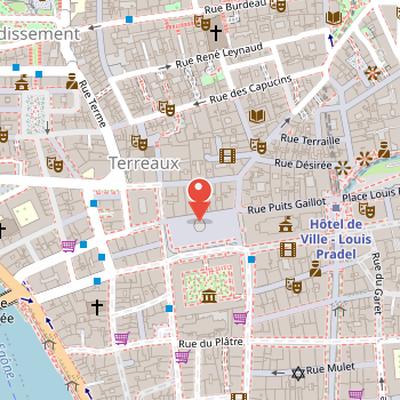
Nearby Objects
-
 Place des Terreaux 20 m away
 -
 Rue Sainte-Catherine 70 m away
 -
 Palais Saint-Pierre 80 m away
 -
 Palais Saint-Pierre 90 m away
 -
 Rue des Capucins 150 m away
Location and Naming
The Fontaine Bartholdi is located at Place des Terreaux in the center of Lyon, France. It was created by the sculptor Frederic Auguste Bartholdi and inaugurated in 1892 under the original name Char triomphal de la Garonne. Its official name is Les fleuves et les sources allant a l'ocean.
Commissioning, Relocation, and Restoration
The city of Bordeaux decided to commission a fountain for the place des Quinconces, and a competition was launched for the project. The winner was the 23-year-old sculptor Frederic Bartholdi, who presented a monumental work for the competition. In 1992, the municipality later decided to redevelop the space after the construction of an underground parking lot under the place des Terreaux. During the renovation carried out by Christian Drevet and Daniel Buren, the Bartholdi fountain was moved for architectural reasons. Its new location was chosen to create the impression that water flows from the slopes of the Croix-Rousse toward the Rhone and Saone rivers. It is now situated north of the place des Terreaux, facing the Musee des Beaux-Arts, which contains a model of the Statue of Liberty.
The fountain had deteriorated significantly: its metal structure was completely rusted, and the lead statue was deformed and cracked. Histoire notes that the statue had been damaged both by time and by crowds during festive commemorations at place des Terreaux. The water system also did not work properly, especially at the nostrils of the central horses. Restoration was undertaken to preserve the work and improve the clarity and vibrancy of the sculpture. After the internal structure was reinforced, each part of the statue was carefully dismantled. The dismantling took place in May and June for transport to the art restoration workshop of the Coubertin foundation in southwest Ile de France. The restoration was planned for eight months, followed by three months for reassembly. It was completed at the end of 2017, with the installation of Amphitrite's head on November 15, and the fountain was inaugurated with the water reinstated on December 19, 2017.
Design and Symbolism
The Fontaine Bartholdi consists of two basins and a statue, with the full group weighing a total amount. The statue is supported by an iron framework made by the Moisant workshops, which were competitors of Gustave Eiffel. The composition was initially commissioned by Bordeaux and was first named Char triomphal de la Garonne. Its iconography is strongly symbolic: Amphitrite represents France, while rivers are shown through horses. In the central scene, the Greek sea goddess Amphitrite, accompanied by a child, directs a quadriga pulled by four sea horses. These elements combine sculpture, engineering, and allegory in a single public work.
Design and Water Features
The Bartholdi fountain was created by Oeuvre innovante in a style combining classical and baroque elements. It was conceived both as a technical innovation and as an artistic reference, with an emphasis on realism and dynamism in its structure. The fountain also made extensive use of water games, which helped define its appearance and movement.
Several design elements reinforce this effect. Four horses are shown as if emerging from the water, while five interlaced water jets feed a shell at the center of the composition. The water overflow was designed to color the metal, and the horses' nostrils were made to exhale sprayed water. These features gave the fountain a strong animated character.
The fountain was initially supplied by the city's water network. In 1907, it was adapted to a closed circuit using an electric motor and centrifugal pump, and a water-saving technique was implemented.