The Bibliothèque nationale de France is a French public cultural institution and one of the most important libraries in France and the world. Located in Paris in the XIII arrondissement, it holds physical collections estimated at more than forty million items. It is also known for Gallica, its digital library, which consists mostly of digitized documents in image form and is evolving with the Europeana project, which provides books in text format via OCR.
According to the provided history, the institution originated from the royal library constituted by Charles V at the Louvre. Its collections and administration developed under Charles VIII, were transferred to Blois and Fontainebleau, and returned to Paris in 1568. The library received a significant impulse under Louis XIV and opened to the public in 1692. Its collection later moved to rue Richelieu in 1720, and the institution changed status with France’s regime changes starting in 1789. It was transferred to buildings constructed by Henri Labrouste in 1868 and moved definitively to the new Tolbiac site in the 1990s. Over time, its history included successive expansions of collections, new buildings, cataloguing methods, and cultural activities.
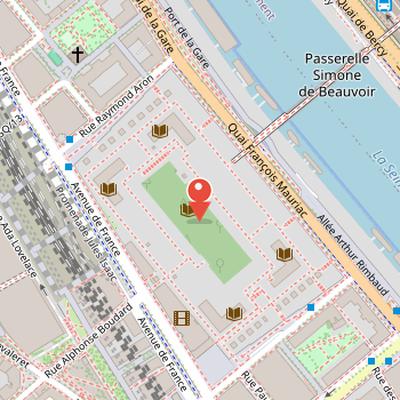
Nearby Objects
-
 Passerelle Simone-de-Beauvoir 250 m away
 -
 Parc de Bercy 550 m away
 -
Cinémathèque française 600 m away
-
 Accor Arena 650 m away
 -
 Pitié-Salpêtrière Hospital 900 m away
Location and Collections
The Bibliotheque nationale de France is a French public cultural institution located in Paris in the 13th arrondissement. It is considered one of the most important libraries in France and in the world, with physical collections estimated at more than forty million items. The institution is also known for its digital library, Gallica, which consists mostly of digitized documents in image form. Gallica is evolving through the Europeana project, which provides books in text format via OCR.
From Royal Collection to National Institution
The Bibliotheque nationale de France originated from the royal library established by Charles V at the Louvre. Under Charles VIII, the royal library gained stable management and patrimony, and it was later transferred to Blois and Fontainebleau before returning to Paris in 1568. Its development received a significant impulse during the reign of Louis XIV, and it opened to the public in 1692. In 1720, the collection was transferred to rue Richelieu.
From 1789 onward, regime changes in France were reflected in the institution's changing status, as it became first the National Library and then the Imperial Library. In 1868, the library was transferred to buildings constructed by Henri Labrouste. The institution moved definitively to the new Tolbiac site in the 1990s, marking the latest stage in a long history of transfers and administrative changes.
Collections, Expansion, and the Tolbiac Site
The history of the Bibliotheque nationale de France is presented as a succession of collection expansions, technical changes, and institutional transformations. Its status evolved from a sovereign's library to a state service and eventually to an autonomous public institution. Over the centuries, the library acquired diverse documents and adopted new technical methods, including increasingly complex catalogues for manuscripts, printed works, cards, and computerized catalogues from 1987 onward.
Collection growth came from several sources. Legal deposit was the main source, covering different types of documents. The library also benefited from numerous legacies, single donations, advanced collections, and publication exchanges, especially foreign publications. Acquisitions added new works and rare document auctions, while purchases varied in importance depending on the period and the credits granted to the library. At times, it also benefited from confiscation proceeds during the French Revolution, and it received entire funds mainly from abbeys, colleges, and suppressed universities in Paris. Donations also came from neighboring countries. Storia notes that Minoide Mynas contributed to the increase and description of Greek manuscripts in the 19th century.
The library's development also involved repeated relocations and expansions, with new buildings and the annexation of preexisting structures. Storage of collections took place underground at the Richelieu site and overground at the Tolbiac site. From 1988, the Bibliotheque nationale entered a phase of important changes. On July 14, Francois Mitterrand announced the construction of a major modern library covering all fields of knowledge. The chosen location was the Tolbiac district in the 13th arrondissement of Paris, in the ZAC Rive-Gauche area, and the architectural project of Dominique Perrault was adopted. The new Bibliotheque nationale de France opened to the public on December 20, 1996, and the majority of collections were transferred from rue Richelieu. The first researchers arrived in October 1998.
Alongside its collecting role, the library diversified its activities by organizing exhibitions and other cultural events such as conferences. It also developed cooperation initiatives with other libraries, first within the French network and then internationally.
Public Mission and Access
The Bibliotheque nationale de France is managed as a public institution under the Ministry of Culture by decree 94-3 of January 3, 1994. Its mission is to build collections, especially through legal deposit, ensure their preservation, and promote public access. It also produces a reference catalog and cooperates with similar institutions in France and abroad, while taking part in research programs through the library.
Access to the Bibliotheque nationale de France is organized in different ways at the Tolbiac site. The Haut-de-jardin section is open to persons over sixteen years of age with either an entry fee or an annual subscription. The Rez-de-jardin section and reading rooms are restricted to accredited researchers who pay for a fortnightly or annual card. Some categories, especially students, are exempt from fees or receive reduced rates.
The institution has a major role in legal deposit, with assistance from regional deposit centers, the Institut national de l'audiovisuel, and the Centre national de la cinematographie. It is the main holder of documents collected through legal deposit, which make up most of the heritage, while legal deposit of comics is assigned to the Cite internationale de la bande dessinee et de l'image in Angouleme.
Beyond collecting and preserving materials, the Bibliotheque nationale de France maintains an active cultural and scholarly program. It continues a tradition of exhibitions centered on its heritage, often supplemented by external contributions, and hosts scientific events such as conferences and congresses in its new public premises. It also organizes occasional screenings and concerts. As a publisher, it issues mainly collection catalogs, exhibition catalogs, and unpublished documents, including in partnership with private publishers. Two periodicals are also published: Chroniques de la Bibliotheque nationale de France, which informs readers about the life of the institution, and Revue de la Bibliotheque nationale de France, which publishes articles on the history of the library and its collections.
Its cooperation extends to other French libraries, including privileged relations with libraries known as poli associe of the Bibliotheque nationale de France. It provides bibliographic information to various libraries and manages the collective catalog of France, including BN-Opale Plus, SUDOC, and special collections of municipal libraries. The institution also has a professional training role through internships, professional days, and the dissemination of bibliographic standards. Internationally, it maintains relations with libraries and institutions abroad, participates in the Biblioteca europea and the initiative for a biblioteca elettronica europea, supports libraries in other countries, especially in francophone Africa and South America, and takes part in IFLA and its cataloging standards working groups. It also coordinates the PAC program for the conservation of ancient and fragile documents.
Internal Organization
The Bibliotheque nationale de France is administered by a board of directors made up of representatives from administrative ministries, members of scientific research, staff representatives, and two user representatives. The board is assisted by a scientific council in a consultative role. The institution is led by a president, appointed by decree for a three-year term that may be renewed once; the president directs the structure with the help of a director general and several additional director generals. Gilles Pecout is the current president.
The library services are divided into three directions and four delegations. The Collections Direction (DCO) is responsible for collections and public services and is organized into documentary departments. The Services and Networks Direction (DSR) handles transversal functions that affect all documentary departments and related activities across the library. The Administration and Personnel Direction (DAP) groups the services needed for the daily operation of the whole institution, including human resources, finances, and material resources.
Several specialized departments support the BNFs wider operations. The National Bibliographic Agency establishes the French national bibliography, enriches the catalog, and maintains the controlled vocabulary RAMEAU. The Digital Library Department develops a digital library from BNF or partner institution documents, mainly for Gallica. The Conservation Department oversees preservation and restoration, and manages technical services in Bussy-Saint-Georges and Sable-sur-Sarthe. Other units manage cooperation with French libraries, legal deposit, reproduction services, and information systems. Delegations report directly to the director general.
The Richelieu Site
The headquarters of the Bibliotheque nationale de France is located on rue Richelieu in the 2nd arrondissement of Paris, within the Richelieu quadrilateral complex bordered by rues des Petits-Champs, Vivienne, Louvois, and Richelieu. The site includes the Musee des monnaies, medailles et antiques, as well as a place for temporary exhibitions. The original buildings were constructed for Mazarin by the architects Pierre Le Muet and Francois Mansart, and two galleries from this period are now used as exhibition galleries.
The complex underwent numerous renovations beginning in 1720 under Robert de Cotte and Abate Bignon. It remained with few changes between the mid-18th century and the mid-19th century, before major works began in 1854 under Henri Labrouste. Labrouste designed the current facade of the Cour d'honneur and the large Salle Labrouste. Later work at the Cour d'honneur continued under Jean-Louis Pascal, who designed the Oval Room in 1916; however, this room was not inaugurated until 1936.
Because of limited space, the Bibliotheque nationale de France expanded beyond the Richelieu quadrilateral. It occupied part of Galerie Vivienne for legal deposit services, but left these premises after the opening of the Mitterrand site. It also continues to use a purely administrative building at 61 rue Richelieu and a building on rue Louvois built in 1964 for the Music Department. The Richelieu and Louvois complex mainly contains reading rooms, storage, and offices, and includes three exhibition spaces: Galerie Mazarine for thematic exhibitions, Galerie Mansart as a photography gallery, and the crypt for smaller exhibitions.
After the transfer of prints to Tolbiac, the Richelieu site was modernized through improved document indication using computerization of the Richelieu department archives, the transfer of cataloging from BN-Opaline to BN-Opale Plus, and the use of new standards for electronic manuscript description. The project also involved extensive renovation and rearrangement of spaces, redistribution of spaces and collections, the transfer of the Arts of the Performing Department to the current Museum of Coins, Medals and Antiquities department, and the reorganization of that museum department. The renovated Labrouste room was converted into the reading room of the Institut national d'histoire de l'art, while the Oval Room was designated as a consultation space introducing various specialized departments and made widely accessible, like the Haut de jardin.
The Tolbiac Site of the Bibliotheque nationale de France
The Francois Mitterrand Library of the Bibliotheque nationale de France is located in Tolbiac on a 7.5 hectare site. Its architecture is organized around four large corner towers, symbolizing four open books. Each tower has a name: Tour des temps, Tour des lois, Tour des nombres, and Tour des lettres. The towers are made up of 7 floors of buildings protected by movable wooden shutters and 11 floors of storage, and each one is also protected by a fixed insulating wooden screen.
The building includes a garden at the center at Rez-de-jardin level, designed as a forest within the building and creating a cloistered atmosphere. Two levels lie under the garden, with the lowest level occupied by an internal road for vehicles. The total built floor area outside the work is 120000 square meters. Concrete structures and technological systems are left visible to emphasize rationalist lines, while iron and glass are used to provide transparency and connect the building with the surrounding city, as requested by Mitterrand.
Entrances at the base of the towers lead to reading rooms arranged around the garden. Corridors with INOX metal mesh walls and escalators are presented as a journey toward knowledge. The library includes a public part with streets and squares paved in ippe wood, as well as a reserved reader area. The Tolbiac site also contains two exhibition spaces, called sala grande and sala piccola, a permanent exhibition at the entrance presenting the general structure, and a large and a small auditorium for meetings, conferences, readings, or concerts. The globes of Vincenzo Coronelli are exhibited in the west entrance. The site was inaugurated on March 30, 1995, and opened to the public in December 1996. Its architecture continues the French tradition of Etienne-Louis Boullee and Claude-Nicolas Ledoux.
Tolbiac Collections and Specialized Departments
The Tolbiac site brings together both open access and heritage collections. The open access collections are located in the Haut-de-jardin and Rez-de-jardin and contain about volumes. Heritage collections are held across various Tolbiac departments, except the bibliographic research department (DRB). Among the departments linked to the Printed and Periodicals sections, four preserve patrimonial funds dating from the 16th to the 21st century. These patrimonial collections include approximately books and periodical titles, as well as living French and foreign periodical titles. The printed collections also include microforms, with microfilms and microfiches.
The Audiovisual department, which inherits the Phonotheque nationale, holds patrimonial funds on special media, including sound documents, videograms, digitized still images, and multimedia documents. The rare books reserve is described as the most prestigious department and contains about rare volumes. Its holdings include incunabula, precious format works, documents on technical evolution, low edition documents, books from famous people, and the Enfer of the library. Around texts have been digitized and consulted, and part of this material is visible on Gallica without rights issues.
Beyond Tolbiac, the Bibliotheque de l'Arsenal has been integrated since 1934 as a specialized literature and minor history department. It holds volumes of books and periodicals, along with manuscripts, prints, papers, and musical scores. The library-museum of the Opera is located inside the Opera Garnier and forms part of the music department. It originates from the musical library and archives of the Opera national de Paris created in 1669, and it preserves important funds including scores, models, and costumes. Its collections also include many documents on music and dance, among them the Archives internationales de la danse, as well as books, periodicals, photographs, prints, programs, decoration models, and costumes.
Sites, storage, and conservation facilities
The Bibliotheque nationale de France operates several specialized sites connected to archives, storage, and document conservation. In Avignon, it owns the Maison Jean Vilar as part of the performing arts department. This site holds the personal archives of filmmaker Jean Vilar and the archives of the Festival d'Avignon, making it an important repository for performance history.
The institution also owns a building in Bussy-Saint-Georges, which it shares with the Centre technique du livre de l'enseignement superieur. This site is used for special restoration work, research for document conservation, and storage of extra copies from legal deposit. Its activities may soon be abandoned. Another headquarters is located in Sable-sur-Sarthe at the Joel Le Theule center, which is dedicated to the restoration of fragile documents.
Earlier facilities in Versailles also formed part of this network. The first building there was constructed between 1932 and 1934, followed by a second building in 1954 for storing periodicals and duplicate collections. A reading room was later added after the buildings had initially been used only for storage. These Versailles buildings ceased to be used in 1998.
The Bibliotheque nationale de France also created a restoration and newspaper microfilm transfer center in Provins, but this center was closed in 2002. Together, these sites show the institution's long-term role in preservation, storage, and archival stewardship across several locations in France.
Catalogs and Access Systems
At the Bibliotheque nationale de France, Cataloghi developed and enriched several types of catalogs, with BN-Opale Plus becoming the most used computerized catalog. Originally called BN-Opale, it was created for collections from legal deposit and acquisitions after 1987. Over time, it was expanded with retroconverted data from the general catalog of prints and supplements, then renamed BN-Opale Plus after data from documents at the Tolbiac open access site were added. The catalog was further enriched with audiovisual department data, including multimedia, and it continues to receive prints from specialist departments at other locations.
Cataloghi also created BN-Opaline as another computerized catalog. This system was initially distributed via Telnet and later through a web interface. It was based on multiple databases with specific fields and was used for specialized collections at other locations such as Richelieu. It also included extra-BNF document information, especially for other musical fonds. Cataloghi plans to suppress BN-Opaline after transferring its data to BN-Opale Plus.
In addition to computerized systems, Cataloghi maintains interest in printed and card catalogs. Printed catalogs are used in specialist departments including manuscripts, prints, coins, and medals, and new printed catalogs are published periodically. Older catalogs have been digitized and made available online. Card catalogs remain at Arsenal, Opera, and Richelieu for retroconversion into BN-Opale Plus, while Tolbiac keeps limited card catalogs in rooms Y, W, and X, with some digital forms also available on the Internet.
Public Use and User Profile
The Bibliotheque nationale de France employs about people in total, although only a few are on permanent contracts. Two thirds of its personnel have the status of public administration officials, and half of these depend on the library sector of the Ministry of National Education. Among non-official staff, the workforce is divided evenly between contract employees and hourly wage employees. Most hourly wage employees are students, and their working time is often below half-time. There are also large disparities between the number of actual employees and the total number of job positions. These figures do not include people working for private companies under concession or delegation, such as security and cafeteria staff, nor the permanently detached fire brigade section.
The institution's public is largely made up of students. In the Haut-de-jardin, students are estimated to represent 84 percent of users, with the space used mainly by students with a licence degree. High school students account for about 6 percent there. In the research spaces, almost 60 percent of accredited readers say they come to study, while a little over 30 percent visit for professional reasons. Many of these professional visitors are likely teacher-researchers. Doctoral students mainly meet in research rooms, and master students are spread across different levels. Teachers and researchers form the second largest group after students. The library has more difficulty attracting the general cultured public, as only 10 percent of research space visitors come for personal reasons.
The accredited research public is overwhelmingly French, at more than 85 percent, with the most numerous foreign visitors coming from the United States and Italy. The public is evenly split between men and women in both the research spaces and the Haut-de-jardin. Seasonal changes in activity mainly reflect changes in the composition of the public.
Attendance Patterns at Haut-de-jardin and Rez-de-jardin
At Personale e pubblico, the Haut-de-jardin follows a university library calendar, with the highest activity during the academic year and around exam periods. Attendance is very low in July and August, and the authorities have experimentally introduced free occasional access during these low-attendance periods. The Haut-de-jardin also shows weekly variation, with weekends and Tuesday being the busiest days. Tuesday is especially active because of the closing of the Bibliotheque publique d'information.
By contrast, the Rez-de-jardin is busiest in summer, when some researchers can visit Paris. It can become saturated during summer periods, while attendance in the research space is more regular outside these peak months.
Budget and Funding
In 2004, the budget of the Bibliotheque nationale de France amounted to 145 million Euros. The largest share came from State grants, which totaled 116 million Euros and were primarily allocated by the Ministry of Culture. Additional resources included entrance fees, which did not exceed 2 million Euros per year. On the spending side, operating expenses reached 104 million Euros, while investment expenses amounted to 58 million Euros. Within operating costs, 41 million Euros were assigned to personnel costs. Only employees with credit contracts were paid from the operating budget, while other employees were paid directly by the State. Investment spending included 18 million Euros for structures and 15 million Euros for collection enrichment. Document acquisitions were counted as investments because of preservation requirements.
Criticism and Public Debate
The Bibliotheque nationale de France has frequently been the subject of criticism, and these concerns initially received extensive media coverage. Some forms of criticism continue to this day, and they are usually grouped into three main categories: disputes over working conditions, conflicts involving readers, and questions about institutional priorities.
Trade unions have challenged the institution, and social conflicts have been reported, including one that followed the opening of the Rez-de-jardin area. A long strike took place after the first days of this opening. Staff complaints have focused mainly on working conditions. Storage staff have cited noise and frequent work under artificial lighting, while employees have also said they are required to deal with user related dysfunctions. Another recurring criticism concerns the use of precarious employment, especially hourly paid workers.
Readers have also raised objections, particularly at the Francois-Mitterrand site. Access has been described as difficult because of slippery slopes in humid weather, although anti-slip paths have partly reduced this problem. Conveyor belts for descent were removed. Other reader complaints concern noise in the reading rooms, unacceptable delays in document delivery, low temperatures in the reading rooms even in summer, and computer stations that are poorly oriented because the screens are hard to see in sunlight.
Representatives of readers have called for longer opening hours, including Monday morning opening of Rez-de-jardin and weekly nighttime openings, while the reading rooms currently close at 8 PM. There has also been occasional criticism of cafeteria prices. In addition, reader representatives have said that more resources are directed to Gallica or exhibitions than to readers on site.
Criticism and Public Debate
The Bibliotheque nationale de France, especially its Grande bibliotheque, has been the subject of numerous criticisms, most of them focused on the Francois-Mitterrand location. Some of these critiques were political in nature and were linked to the wider policy of large projects associated with F. Mitterrand. The project choice was also criticized as a political decision made quickly by a single man, without sufficient practical considerations. Dominique Perrault's architectural concept drew detractors as well, particularly because it proposed storing documents in towers.
The institution was also marked by a series of incidents that attracted media attention, sometimes in exaggerated form, leading to ridicule and indignation. These included alarm system malfunctions that caused flooding in the magazine sector in 1997, theft reports following the implication of a librarian in 2004, and the discovery of asbestos in collections in 2005. On March 10, 2006, Michel Garel was sentenced to two years of suspended jail, a five-year ban from public office, and damages and interest; he appealed the decision.
Despite this criticism, protection and institutional efforts, including major financial investment, contributed to significant catalog enrichment and strong institutional visibility, notably through the use of Gallica.
Bibliography on the Bibliotheque nationale de France
The bibliography on the Bibliotheque nationale de France brings together several works focused on the institution, its collections, and its public role. Among the listed publications are Bibliotheque nationale de France, Au Seuil du vingt-et-unieme siecle, published by the Bibliotheque nationale de France in Parigi in 1998, and Bibliotheque nationale de France: l'esprit du lieu by Bruno Blasselle, published by Scala in Parigi in 2001. Other entries include La Bibliotheque nationale de France, memoire de l'avenir by Bruno Blasselle and Jacqueline Melet-Sanson, published by Gallimard in Parigi in 1990, and La Bibliotheque nationale de France: collections, services, publics by Daniel Renoult and Jacqueline Melet-Sanson, published by Ed. du Cercle de la librairie in Parigi in 2001. The list also cites La Veritable Histoire de la grande bibliotheque by Francois Stasse, published by Seuil in Parigi in 2002, together with specialised studies on manuscripts, such as Inventario dei manoscritti italiani delle biblioteche di Francia and La collection de manuscrits persans de la Bibliotheque nationale de France et son histoire. Additional references include Carlo Paganelli in ARCAplus, and two volumes on treasures of the library published in Parigi in 1996 and 1986.