Accor Arena is a versatile modular venue on boulevard de Bercy in Paris, on the right bank of the Seine at the level of Pont de Bercy. It is bordered by the Ministry of Economy and Finance to the northwest and Parc de Bercy to the southeast, and faces the Bibliothèque François-Mitterrand across the river. The venue has been sponsored under the name Accor Arena and has hosted numerous sports events since its inauguration in 1984.
The arena is known for its adaptable configuration, with seating arrangements that can vary from seated to standing formats and up to a 360° layout with the stage at the center. Its modular space is suited to nearly all sports, including aquatic ones, as well as all types of shows. Regular events include the Masters de Paris-Bercy in tennis and the Grand Chelem de Paris in judo. The main hall also serves as a concert venue for singers and musicians of many styles, and major national and international artists perform there. The venue will host basketball and artistic gymnastics competitions for the 2024 Summer Olympics. The former Palais omnisports de Paris-Bercy also features a skating rink named patinoire Sonja-Henie.
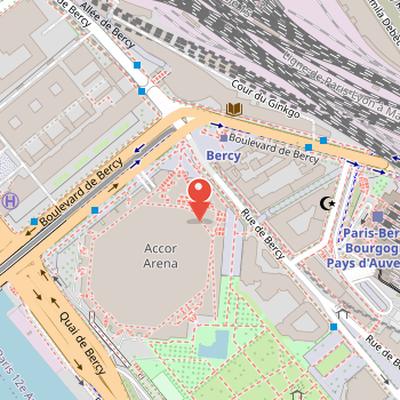
Nearby Objects
-
Cinémathèque française 350 m away
-
 Passerelle Simone-de-Beauvoir 450 m away
 -
 Parc de Bercy 500 m away
 -
 Bibliothèque nationale de France 650 m away
 -
 Pitié-Salpêtrière Hospital 1100 m away
Accor Arena in Bercy
The Accor Arena is a versatile and modular arena located boulevard de Bercy in the Bercy district of Paris. It is currently sponsored under the name Accor Arena and has been a venue for numerous sports events since its inauguration in 1984. Regular events held there include the Masters de Paris-Bercy in tennis and the Grand Chelem de Paris in judo. The arena also hosts concerts by major national and international artists. It is scheduled to host basketball and artistic gymnastics competitions for the 2024 Summer Olympics.
The arena is situated on the right bank of the Seine River at the level of Pont de Bercy. It is bordered by the Ministry of Economy and Finance to the northwest and Parc de Bercy to the southeast. Across the river, it faces the Bibliotheque Francois-Mitterrand on the left bank of the Seine.
Flexible Arena and Concert Venue
The palais omnisports de Paris-Bercy is designed as a modular venue adapted to nearly all sports, including aquatic ones, as well as to all types of shows. Its main hall can accommodate spectators in several seating arrangements, including seated, standing and seated-standing formats, and it can also be configured for a 360 degree layout with the stage at the center. In concert mode, the hall can be arranged with an end-stage or with an American central stage, with the number of seats changing according to whether the central pit is opened. The venue includes a skating rink called the patinoire Sonja-Henie. The main hall also functions as a concert hall for singers and musicians of all styles, and many artists include the venue as a Paris tour date. The hall is operated by the Societe anonyme d exploitation du Palais omnisports de Paris-Bercy, or SAE POPB, which also manages the Bataclan. SAE POPB is a mixed economy company owned 52 percent by the Paris City Hall and 48 percent by the American group Anschutz Entertainment Group. The Accor group pays only for attaching its name to the venue.
Architectural Design and Interior Function
The POPB was designed with a pyramidal exterior and sloping grass covered walls. Inside, the main hall was planned for perfect visibility, made possible by the absence of supporting pillars in the stands. The structure uses four recessed supporting shafts to hold an irregular geometry metal framework by Jean Prouve. This framework includes a monorail network with four five ton overhead conveyor cranes. The design also allowed unrestricted technical applications for sound, lighting, and special effects in both sports and performances.
From Bercy Warehouses to Arena
The site of the present Accor Arena has a long urban history. In the 18th century, the land belonged to the fief of la Rapee and included a hotel built by a commissaire general aux troupes near the river rue de Bercy. The area also contained a terrain with a pond and the Montreuil stream, which flowed from rue de Bercy to its mouth. By the end of the 19th century, the hotel had disappeared and wine warehouses were established on the site.
The location was near the barriere d octroi de la Rapee and lay on the territory of the commune of Bercy from 1790 to 1859, outside Paris for taxation purposes. In the first half of the 19th century, the Montreuil stream was channeled between the warehouses and covered around 1850. The warehouses remained active until the 1960s, after which they declined.
In the 1970s, Paris planned the Paris-Bercy district as a major urban development project, including the Palais omnisports. The city launched an architectural competition for the Palais des sports in February 1983 within the future Parc de Bercy. Candidate teams submitted projects on May 10, 1983, and the team Andrault-Parat, Prouve, Guvan was selected on May 20, 1983. Design study began in May 1983, foundation work started in February 1984, and construction ran from May 1984 to November 1986.
The venue later changed name through sponsorship and municipal decisions. In January 2015, the Accor group obtained the right to rename POPB to AccorHotels Arena under a ten year sponsorship contract, and Paris city council approved a further name change in October 2019. The venue was officially renamed Accor Arena, listed as Accor Arena POPB, in early 2020.
Sports Events and Public Use
The Palais Omnisports de Paris-Bercy was inaugurated with a cycling event, the Six Jours de Paris. Football was the second sport to be held there, with the first indoor football tournament of Paris Saint-Germain. The venue also introduced a new cycling discipline, bicross, now known as BMX, in Bercy, and the Bicross Indoor International of Paris-Bercy was organized by editions Lariviere, bringing together American stars and leading French cyclists. This event remained successful until its final edition. After a hiatus, the UCI BMX World Championships later returned to Bercy Arena. The Palais Omnisports has hosted regular and exceptional sporting events in many different disciplines, including artistic gymnastics, trampoline, and basketball finals during the Paris Olympic Games. During the Paralympic Games, it hosted wheelchair basketball and was referred to as Bercy Arena.
Early Concerts and Long-Running Artists
The first concert at Bercy was given by the German hard rock band Scorpions, with Mama's Boys as the opening act. Early international performances included Queen on Tuesday, September 18, 1984, and ZZ Top on Monday, September 29, 1986. Paul McCartney performed at Bercy on October 14, 1993. The venue also marked several firsts for French artists: Julien Clerc was the first French male singer to perform on the Palais Omnisports stage the year after 1993, while Jeanne Mas was the first French female singer to perform at Bercy in 1986 and gave four concerts there. Jeanne Mas was also the first French female artist to present four concerts at the venue that same year.
Bercy later became closely associated with long-running and record-setting appearances. Jacques Higelin had the longest run at Bercy, performing from September 22 to October 22, 1983. Dire Straits played ten nights during the On Every Street Tour. Michel Sardou performed at Bercy between 1989 and 2012 with multiple shows, and his 1989 concert series included a final tableau with Robert Hossein lasting over twelve minutes and featuring Un jour la liberte. In 1998, Sardou's concert installed the first central stage. Johnny Hallyday held the male attendance record, with performances at Bercy from 1987 to 2016, while Dorothee held the female attendance record with concerts between 1990 and 1996 totaling 88 shows, including twelve performances in 1990, twelve in 1992, six in 1993, ten in 1994, and sixteen in 1996. Dorothee returned for a single show on October 12, 2010, and was featured again in October 2015 in a special evening hosted by Alessandra Sublet celebrating 30 years of Bercy.
Major Performances and Event History
Accor Arena, known in the facts as Bercy, has hosted a wide range of major concerts and public events. Mylene Farmer gave the first concerts at Bercy on 7 and an unspecified date, and later performed thirteen consecutive times there in 2006, with the run lasting from one unspecified date to another. The record for the most performances at Bercy is held by Dorothee, who gave sixteen shows in 1996. Mylene Farmer also performed ten times at Bercy in 2013, and her total number of performances there is listed as an unspecified figure. Her spectacle was described as untransportable because of its gigantic stage setting, and Bercy was the only venue used for her Avant que lombre... A Bercy residency.
International pop acts have also marked the venue history. Madonna performed at Bercy during the Blond Ambition Tour on 3, 4, and an unspecified date, and later returned for the Girlie Show in 1993, as well as for the Drowned World Tour, Re-Invention Tour, Confessions Tour, Sticky and Sweet Tour, Rebel Heart Tour, and Celebration Tour in unspecified years. Michael Jackson performed at Bercy during The Immortal World Tour from one unspecified date to another, and is identified as the first deceased artist represented at the venue.
The arena has also been important for rap and African music. NTM was the first rap group to fill a capacity venue in France with five concerts on 18, 19, 20, 22 and an unspecified date. Koffi Olomide was the first African singer at Bercy on an unspecified date, and Werrason became the unspecified artist African to perform and fill Bercy, alongside Alpha Blondy, Papa Wemba, and Youssou N Dour. Kassav' was the first French group to play two consecutive nights at Bercy with an unspecified number of attendees. Indochine is listed as the French group with the most shows at Bercy, appearing in 2003, 2004, 2007, 2010, twice in 2006, six times in 2018, and twelve times in the 2025/2026 tours, for a total of 24 performances since 2003 by 2026. In 2016, the British group Muse filled the Arena six times with a central stage configuration, gathering an average unspecified number of attendees each night and a total unspecified attendance. Beyond concerts, Paris-Bercy has also hosted operas, dance, ice shows, equestrian shows, martial arts festivals, La Nuit du zapping, political meetings, and conferences.
Name change and public controversy
The renaming of the Palais Omnisports de Bercy to AccorHotels Arena was criticized by some public service conservation groups, who argued that it represented a commercialization of sports and cultural heritage. In connection with the new name, AccorHotels Arena worked with its advertising agency on a promotional campaign, and AccorHotels launched a poster campaign in the Paris metro. Some of the statements on these posters were considered sexist by some internet users and by Christophe Najdovski. A petition then denounced the use of sexist statements, as well as the normalization of violence and the reinforcement of misogyny. The posters were later removed from the Paris metro at the request of the Paris city hall.
Projet Arena II at Porte de la Chapelle
Projet Arena II was planned to be built next to the current arena for wrestling and basketball events for the 2024 Summer Olympics in Paris. After controversy over green space reduction, Paris city hall announced that the project would be built at Porte de la Chapelle. The venue is also known as Arena Porte de la Chapelle or Adidas Arena and has a seating capacity of 8000. It was inaugurated during a Betclic Elite match between Paris Basket and Saint-Quentin.
Phantom Under the Accor Arena
Phantom is located under the Accor Arena and occupies an area of 1000 square meters with a capacity of 1500 places. It was created by Paris Society, which belongs to the Accor group. The venue is dedicated to nocturnal musical programming between 23 h and 6 h, and it is used for aftershows linked to events held in the main hall of the Accor Arena. Phantom is the result of rehabilitating the Marcel-Cerdan hall, an annex of the former omnisports palace. Before this transformation, the Marcel-Cerdan hall served as a storage room.