Passerelle Simone-de-Beauvoir is a pedestrian bridge over the Seine River in eastern Paris, connecting the 12th and 13th arrondissements. In planning, it was initially to be called Passerelle Bercy-Tolbiac, after the nearby city districts. Since its inauguration on 13 July 2006, it has borne the name of the French writer Simone de Beauvoir. It was the first bridge in Paris to be given a woman’s name.
The bridge is the thirty-seventh Seine bridge in Paris and the city’s fifth pedestrian bridge. It measures 304 metres in length and 12 metres in width. Its main opening spans 190 metres without support on river piers and crosses the Seine and its port areas. The structure combines a tension band bridge with a shallow arch, and its middle section resembles 19th-century lenticular girders. Truss-supported extensions link the main opening with the high areas of the BnF and Parc de Bercy. The bridge also includes transparent-walled elevators on both river sides, oak flooring with non-slip strips, and a railing made of netting and wide aluminum handrails with integrated lighting.
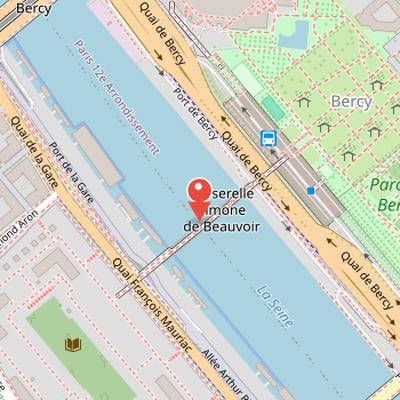
Nearby Objects
-
 Bibliothèque nationale de France 250 m away
 -
 Parc de Bercy 350 m away
 -
Cinémathèque française 400 m away
-
 Accor Arena 450 m away
 -
 Pitié-Salpêtrière Hospital 950 m away
Location and Role
The Passerelle Simone-de-Beauvoir is a pedestrian bridge over the Seine River in the east of Paris. It connects the 12th and 13th Arrondissements of Paris, serving as a crossing between these two parts of the city.
Naming and Dedication
The bridge was initially planned under the name Passerelle Bercy-Tolbiac, reflecting the names of the surrounding city districts. At its inauguration on July 13, 2006, it was named after the French writer Simone de Beauvoir. This made it the first bridge in Paris to receive a woman's name.
Design and Structure
The Passerelle Simone-de-Beauvoir is the thirty-seventh bridge over the Seine in Paris and the fifth pedestrian bridge. It is 304 m long and 12 m wide, and it crosses the Seine and its port areas with a 190 m span without support on river piers. Truss-supported extensions connect the main opening with the high areas of the BnF and Parc de Bercy.
The main opening combines a tension band bridge with a shallow arch. In its middle section, this structure resembles 19th-century lenticular girders. The tension band bridge and the arch are accessible along their entire lengths, and it is possible to change between them at their intersections.
The bridge provides connections between high areas, street levels, and different street elevations. Transparent-walled elevators are installed next to the bridge on both river sides, linking the high areas with street level and the lower port area.
Structure and Construction
The Passerelle Simone-de-Beauvoir features arch girders resting on slanted steel pillars, with steel tension bands guided vertically down the pillars and anchored in deep chambers. Its flooring consists of oak boards with non-slip strips, and the railing is made of a net with wide aluminum handrails that include integrated lighting. The steel structure was manufactured by Eiffel Construction Metallique in Lauterbourg, Alsace, using steel sourced from the Dillinger Hutte in Saarland. The steel weighed 1600 tons, and the 106 m lenticular girder was transported by ship along the Rhine, the English Channel, and the Seine before being installed at the construction site in January 2006. After completion, the bridge underwent load testing with 550 tons of water tanks, and about 100 architecture students walked and jumped on it during the tests.