Pitié-Salpêtrière Hospital is an Assistance publique - Hôpitaux de Paris hospital located at 47–83, boulevard de l’Hôpital in Paris. It was formed by the fusion of hôpital de la Pitié and hôpital de la Salpêtrière, and it remained physically at the same place after ceasing to exist administratively in 2011. Since 2011, it belonged to GH de la Pitié-Salpêtrière - Charles-Foix, and it is part of the AP-HP Sorbonne Université hospital-university group. In 2013, it was the largest hospital in Europe, with more than 90 buildings spread across 33 hectares.
The history of the site began in 1634, when a saltpeter factory for munitions production was established there by sieur Rebattier on land acquired from abbaye Saint-Victor. The factory was later sold and eventually became the basis for hospital construction. Work began in the 1650s and resumed in 1669, and the institution became the first and largest establishment of l’Hôpital général de Paris for imprisoning beggars. Over time, it also housed prisoners and other groups, reflecting the changing functions associated with the site.
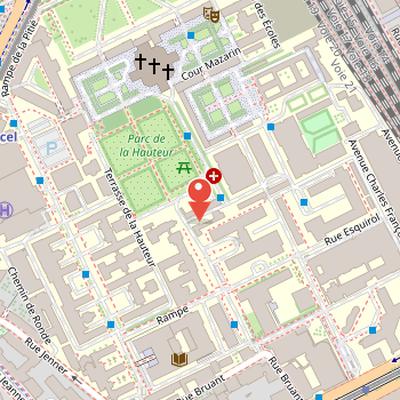
Nearby Objects
-

-
 Jardin des Plantes 850 m away
 -
 Muséum national d'histoire naturelle 850 m away
 -
 Bibliothèque nationale de France 900 m away
 -
 Place d'Italie 900 m away
Site and Hospital Formations
The Pitie-Salpetriere Hospital is located at 47-83 boulevard de l'Hopital in Paris and is an Assistance publique - Hopitaux de Paris hospital. It was formed by the fusion of Hopital de la Pitie and Hopital de la Salpetriere. The Hopital de la Pitie was reconstructed in 1911. Since 2011, the hospital has belonged to the GH de la Pitie-Salpetriere - Charles-Foix and is part of the AP-HP Sorbonne Universite hospital-university group. Although the Hopital de la Pitie-Salpetriere ceased to exist administratively in 2011, it remained physically located at the same place.
In 2013, it was the largest hospital in Europe, with more than 90 buildings spread across 33 hectares.
From Saltpeter Factory to Major Hospital Prison
The site began in 1634 as a saltpeter factory for munitions production, established by sieur Rebattier on land acquired from the abbaye Saint-Victor. It stood opposite the petit Arsenal du faubourg Saint-Antoine, an area already marked by earlier explosions in 1538 and 1563. The factory was sold in 1639 to sieur du Fay, who later resold it to the king.
In 1656, architect Liberal Bruand was commissioned to build a hospital on the site using the factory buildings. Construction began in 1658 under Antoine Duval, but stopped because of a lack of funds. Work resumed in 1669 under Louis Le Vau's orders. The institution became the first and largest establishment of l'Hopital general de Paris for imprisoning beggars.
Over time, it also served other controlled populations. Between 1663 and 1673, it housed 240 of the 327 young women from Paris sent to Quebec, known as Les Filles du Roi. In 1684, a maison de force prison was added for common law offenders and publicly scandalous prostitutes awaiting departure for the Americas. The prison was located on the lieu-dit des Deux-Moulins in the commune d'Ivry, later the village des Deux-Moulins.
Administration of the institution was closely linked to female leadership, and the superior was usually a woman connected to parlement janseniste circles. This role made her the leading figure of l'Hopital general. The site also became politically contentious in 1749 after the appointment of a woman close to the archbishop of Paris. By the eve of 1789, the institution housed ten thousand people and more than three hundred prisoners, and its prison was later a site of bloodshed during the September massacres of the Revolution.
From Hospice to Hospital
Before the letters patent of the 1780s, Medicinalisation de la Salpetriere had no medical function and sent patients to Hotel-Dieu. The new letters patent prohibited Hotel-Dieu from admitting certain patients, and architect Payen then built an infirmary at the general hospital site, completed in 1787. This building had about 300 beds and was aligned with the south axis of the chapel. From 1781 to 1801, Charles Francois Viel worked to transform the institution from hospice to hospital care. By 1801, it had become a hospice for elderly women with a population reduced to 300. It also developed into an asylum for the insane, where doctors Pinel and Esquirol applied theories of moral treatment, including the removal of chains and the creation of specialized divisions.
In the late 19th century, the site acquired a different cultural and scientific role. From 1882 to 1892, the Salpetriere School, led by Jean-Martin Charcot, was a major center of hypnosis in France, and together with the Nancy School it represented one of the two great hypnosis schools during the golden age in France. At the end of the century, Medicinalisation de la Salpetriere also hosted annual balls, including the bal des folles during Mid-Lent and a ball for epileptic children. These events drew numerous prominent attendees and were reported by the Parisian press.
Formation of the Modern Hospital
After the old Pitie hospital was demolished in 1896, a new hospital was installed in 1911 next to the Medicalisation de la Salpetriere site. The former Pitie hospital site is now occupied by the Grand Mosque of Paris. In 1920, the Pitie and Medicalisation de la Salpetriere hospitals merged, forming the institution known today as the Pitie-Salpetriere hospital. Since 2012, it has been part of the Pitie-Salpetriere - Charles-Foix hospital group.
The Medicalisation de la Salpetriere site received double historic monument protection on May 11, 1996. The classification included the entrance pavilion and several named buildings: Hemey, Jacquart, Lassey, and Mazarin. The registration protected the floors of multiple courtyards and the rue des Archers. The site also hosts the Brain and Spinal Cord Institute, since its creation in 2010, as well as the headquarters of the Sorbonne University Faculty of Medicine.
Main Entrance and Central Pavilion
The hospital's description notes a main entrance on boulevard de l'Hopital. It also includes a central pavilion named Pavillon central, which is identified as a detailed structural element of the site. These features help define the hospital's overall layout and architectural organization.
Chapelle Saint-Louis and the Hospital Layout
The chapelle Saint-Louis was built between 1670 and 1677 by Liberal Bruand under Louis. It is located at the center of the hospital buildings and forms a Greek cross with arms 70 m long. At the crossing stands a rotunda supporting a dome 65 m high. The interior consists of four naves, with the altar placed at the center of the rotunda and visible from all four naves. This arrangement allowed groups to attend services separately without coming into close proximity. Additional chapels are placed around the rotunda at the angles of the cross. The chapel also contains an organ, and it is documented in both south and northeast views. In the wider hospital grounds, the Parc de la Hauteur includes sculptures by Roger Vene, acquired for the 400 years hospital commemoration in 2013.
Medical Leadership at Pitie-Salpetriere
Pitie-Salpetriere Hospital was associated with several notable medical figures. One physician, a surgeon and gynecologist, founded and directed the cardiac surgery department there from 1972 to 1990; the Lisfranc joint of the midfoot is named after him. Another physician served as head of the psychiatry department at Pitie-Salpetriere and founded the psychotherapy chair at the hospital. These roles reflect the hospital's importance as a site for specialized medical work and departmental leadership.