The Cinémathèque française is a French private organization under the association law of 1901. Founded on January 8, 1936, with the moral and financial support of Paul-Auguste Harlé, it was directed at its creation by Henri Langlois. Its mission included conserving, restoring, showing films, and teaching cinematic knowledge. The institution also collected cinema-related objects such as cameras, posters, publications, costumes, and film sets. Today, it holds more than 50,000 films and thousands of related documents and objects, making it one of the largest global databases on the seventh art. The Cinémathèque is equipped to project 16 mm, 35 mm, and 70 mm film formats, as well as digital formats. Its funding comes from a subsidy from the Centre national du cinéma et de l'image animée, sponsorship revenue, and its own resources, including subscriptions, ticket sales, bookstore activity, and commercial rentals.
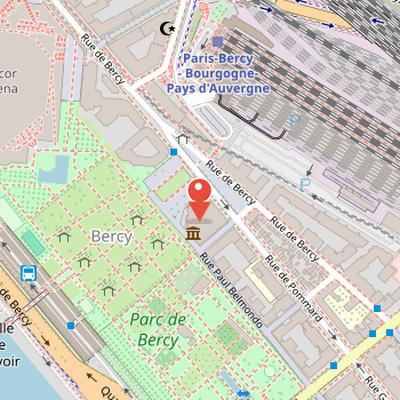
Nearby Objects
-
 Parc de Bercy 200 m away
 -
 Accor Arena 350 m away
 -
 Passerelle Simone-de-Beauvoir 400 m away
 -
 Bibliothèque nationale de France 600 m away
 -
 Church of the Holy Spirit 1100 m away
Collection and Functions
The Cinematheque Francaise is a French private organization operating under the association law of 1901. It holds more than 50,000 films, along with thousands of cinema-related documents and objects, making it one of the largest global databases on the seventh art. The institution is equipped to project film formats in 16 mm, 35 mm, and 70 mm, as well as digital formats. Its funding comes from a subsidy from the Centre national du cinema et de l'image animee, together with sponsorship revenue and its own resources, including subscriptions, ticket sales, bookstore income, and commercial rentals.
Founding, Screens, and Museum Spaces
The Cinematheque francaise was created on January 8, 1936, with moral and financial support from Paul-Auguste Harle, and Henri Langlois directed it from the beginning. Its mission was to conserve, restore, show films, and teach cinematic knowledge, while also collecting cinema-related objects such as cameras, posters, publications, costumes, and film sets. In 1937, Langlois became friends with Lotte H. Eisner, a film historian who had fled Nazi persecution; after World War II, she served as chief curator until her retirement in 1978.
The institution developed through a series of screening spaces and museum settings. A sixty-seat screening room and Langlois's first cinema museum opened at 7 avenue de Messine on October 31, 1948. This room became a meeting place for François Truffaut, Jean-Luc Godard, Jacques Rivette, Eric Rohmer, Jean Douchet, and Suzanne Schiffman. The Cinematheque then moved to 29 rue d'Ulm on October 14, 1959, in a room known as Salle Jules-Ferry, where Parisian cinephiles could discover global cinematic heritage. Langlois also projected films there, including American films usually shown at the Nickel Odeon of Bertrand Tavernier.
The Cinematheque settled in the Salle du Palais de Chaillot on October 28, 1969, with funding from Culture Minister Andre Malraux. Its history also included a major dispute in May 1968, when Malraux demanded management changes and expelled Langlois. French filmmakers formed a defense committee, and support came from figures including Abel Gance, Francois Truffaut, Alain Resnais, Charlie Chaplin, and Stanley Kubrick. Following protests, Langlois was reinstated as head of the Cinematheque on July 20, 1968. The first major cinema museum was inaugurated at Place du Trocadero on June 23, 1972.
Moves, Fires, and New Screening Spaces
The history of the Cinematheque francaise includes several moves shaped by fires, institutional changes, and new plans for its facilities. A fire at a warehouse in Le Pontel, Villiers-Saint-Frederic, near Rambouillet in Yvelines, destroyed thousands of film reels. However, copies and negatives of most of the destroyed films existed in other deposits, which limited the heritage damage. The episode also underlined the need for greater resources for the proper preservation of the collection. In the same year, a screening room of the Cinematheque francaise was inaugurated at the Centre Pompidou.
In 1981, filmmaker Costa-Gavras became president of the institution. From 1983 to 1988, Jack Lang initiated a plan to install a major cinematic institution in the Palais de Tokyo near the Trocadero, and the Cinematheque francaise was temporarily relocated there. The Femis was installed in the Palais de Tokyo in 1986. Jean Saint-Geours became president in 1990.
During this period, the Cinematheque francaise presented retrospectives devoted to the complete works of Ingmar Bergman, Ernst Lubitsch, Fritz Lang, and Robert Bresson, as well as thematic programs such as westerns. From 1993 to 1994, it partially occupied the Republique cinema at 18 rue du Faubourg du Temple in the 10th arrondissement, where films by Jesus Franco and Luigi Cozzi were shown in double programming within the permanent cycle called Cinema bis.
A fire on March 1, 1997 destroyed the roof of Palais de Chaillot. The museum of cinema's works were evacuated overnight and remained intact, but the Cinematheque francaise had to leave Palais de Chaillot, and the screening room there stayed closed for more than a year. The Salle des Grands Boulevards screening room was inaugurated on October 3, 1998, and it explored new cinematic territories with margin films such as cineastes underground. After Catherine Trautmann announced on February 12, 2007 the abandonment of the Palais de Tokyo redevelopment project, the decision was made to install the Maison du cinema in the former American Center at 51 rue de Bercy, built in 1994 by Frank Gehry, next to Parc de Bercy in the 12th arrondissement.
Leadership Changes and the Move to Bercy
The recent history of the Cinematheque francaise was marked by several changes in leadership and institutional structure. Jean-Charles Tacchella was elected president in 2007, and Claude Berri later succeeded him as president. During Berri's illness, Costa-Gavras presided over the institution from an unspecified date. Serge Toubiana presented his report, "Toute la memoire du monde," and became general director of the Cinematheque, holding the post until he was succeeded by Frederic Bonnaud.
A major institutional change took place in 2008. On June 24 of that year, Jean-Jacques Aillagon announced that the Cinematheque francaise and the Bibliotheque du film would cohabitate and merge in the building at 51 rue de Bercy under the name Cinematheque francaise. The organisation had already merged with BiFi on an unspecified date. The move was accompanied by the closure of the palace cinemas of Chaillot and the Grands Boulevards, followed by the opening of the new site of the Cinematheque francaise to the public at 51 rue de Bercy.
Governance and Institutional Reform
The Court of Auditors published a management report on the Cinematheque Francaise covering its governance since 2016. The report described the institution as an association living in a closed world with reduced public oversight, and it suggested either transforming it into a foundation or strengthening its affiliation with the CNC. In response, the Cinematheque reformed its statutes to integrate State governance. As part of this reform, the CNC obtained one vote on the 19-member board of directors. The institution also adopted a new code of ethics and a strict parity mandate in its bureau. Despite these changes, it retained its status as a 1901 law association.
Marseille Antenna at La Plateforme
Histoire states that the Cinematheque Francaise announced an antenna opening in Marseille at the La Plateforme campus. The Marseille project includes a 128-seat screening room programmed to show eight films per week. It also dedicates 400 square meters to an exhibition that is renewed annually. In addition, image education activities are offered in Marseille for students from kindergarten to high school.
Public Debates and Controversies
The Histoire records several moments in which the Cinematheque Francaise was linked to public debate and controversy. Roman Polanski was present for the opening of his retrospective, and a debate with director Sharunas Bartas provoked heated exchanges. The absence of a debate during the screening of Le Dernier tango a Paris led to intense controversy and cancellation in 2017. Costa-Gavras also said he regretted not contextualizing Bernardo Bertolucci's film before the parliamentary commission on sexual violence in 2023.
Cultural References
The Cinematheque Francaise appears in several cultural works. In Baisers voles, it is associated with a scene at the closed gates of the Palais de Chaillot. It is also mentioned in Une vie en liberte by Michel Mourlet, which recounts meetings and conflicts with Henri Langlois. In Bruno Bertin's comic Les Maitres de la magie et de l'illusion I : Melies, the Cinematheque francaise is shown with the Georges Melies collection.