Parc de Bercy is an urban park in Paris located on the site of the former wine warehouses of Bercy. Histoire vinicole notes that the park preserves elements of the former site, including visible rails in the central Parterres, remnants of the internal warehouse network linked to Paris-Bercy freight station, a wine cellar used for bottling, the gatekeepers' house, and the tax house in the Jardin romantique. The garden also retained the orthogonal street layout and some paved roads of the old site.
Within Les trois jardins, designed between 1993 and 1997 by Bernard Huet, Marylène Ferrand, Jean-Pierre Feugas, Bernard Leroy, Ian Le Caisne, and Philippe Raguin, an elevated terrace on the Seine side acts as a noise barrier against Quai de Bercy traffic and contains municipal sports rooms. The park also includes a rampart path reached by a cascade staircase, with views over the trees and the left bank. It is connected to the Bibliothèque nationale de France, François Mitterrand site by the Simone-de-Beauvoir footbridge. The site is served by metro lines 6 and 14 at Bercy station, line 14 at Cour Saint-Émilion, and is next to Bercy-Seine bus station.
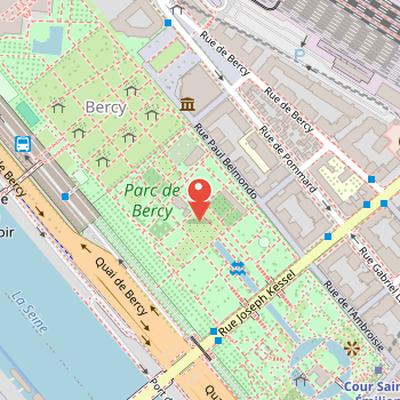
Nearby Objects
-
Cinémathèque française 200 m away
-
 Passerelle Simone-de-Beauvoir 350 m away
 -
 Accor Arena 500 m away
 -
 Bibliothèque nationale de France 550 m away
 -
 Church of the Holy Spirit 1100 m away
Access and Transport Links
Parc de Bercy is well connected by public transport. It is served by metro lines 6 and 14 at Bercy station, and by metro line 14 at Cour Saint-Emilion station. The park is also located next to the Bercy-Seine bus station, which handles about 2 million travelers each year and is the busiest bus station in France. These links place the park within a major transport area and make it easily accessible from several points.
Les Trois Jardins in Parc de Bercy
Les trois jardins in Parc de Bercy were designed between 1993 and 1997 by architects Bernard Huet, Marylene Ferrand, Jean-Pierre Feugas, and Bernard Leroy, together with landscapers Ian Le Caisne and Philippe Raguin. The ensemble includes an elevated terrace on the Seine side, which acts as a noise barrier against traffic from Quai de Bercy and contains municipal sports rooms. Beneath this terrace, at the former cellar site, is the Bercy-Seine bus station.
A rampart path runs through the site and is reached by a cascade staircase. This route offers views over the park trees and the left bank. Les trois jardins also provide access to the Bibliotheque nationale de France, Francois Mitterrand site through the Simone-de-Beauvoir footbridge designed by Dietmar Feichtinger.
The gardens are also known for their public art. They host twenty-one sculptures titled Les Enfants du Monde by Rachid Khimoune, created in 2001. These works represent 21 children from 21 countries and are understood as symbols of respect for children's rights at the entrance to the 21st century.
The site is bordered on the northeast by buildings from the former ZAC de Bercy and is near the Yitzhak-Rabin garden, part of the Parterres in Parc de Bercy. It is also close to 51 rue de Bercy, built in 1994 by architect Frank Gehry for the American Center. Since 2005, the site has housed the Cinematheque francaise. The park alley known as allee des 116-victimes-du-vol-AH-5017-du-24-juillet-2014 was also included by municipal decree.
Wine Warehouse Traces in Parc de Bercy
Parc de Bercy stands on the site of the former wine warehouses of Bercy. Its layout preserves several traces of that earlier use, including the orthogonal street pattern and some paved roads from the old site. These roads were formerly used to transport wine from the banks of the Seine. In the central area known as the Parterres, rails remain visible; they belonged to the internal warehouse network linked to the Paris-Bercy freight station and supported major wine transport. Other surviving elements include a wine cellar used for bottling, the gatekeepers' house, and the perceptrons' tax house in the Jardin romantique. The wine market site was located at the edge of the octroi barrier established in the 19th century. Since the 1970s, the garden has been separated from the Seine banks by automobile traffic on the quays. To recall this history, grapevines of chardonnay and sauvignon blanc were planted in the park.
Musee des Arts Forains in Parc de Bercy
At the eastern end of Parc de Bercy is the Musee des Arts Forains. The museum presents a reconstruction of a funfair dating from 1850 to 1950, with a focus on diverse and decorative richness. Its presence adds a cultural dimension to the park through this historical recreation.