The Musée archéologique de Strasbourg is the archaeological museum of the city of Strasbourg and one of the most important archaeology museums in France in the field of Antiquités nationales, second only to the National Archaeology Museum of Saint-Germain-en-Laye near Paris. Installed in the vast basements of the Palais Rohan, it presents several millennia of ancient history of Alsace and its inhabitants, with a timeline extending from the Paleolithic to the year 800. Its layout is organized around four major chronological sections: Prehistory, Protohistory, the Gallo-Roman era, and the Merovingian era.
The museum’s collections developed from an end-of-18th-century legacy by Jean-Daniel Schoepflin to Strasbourg. They were first placed in the choir of the former Dominican church, then housed with the city’s library and archives in the current Temple-Neuf. After the bombardment of Strasbourg in August 1870, the collections were almost entirely lost, but research later revived through the efforts of enthusiasts and Alsatian and German academics. The museum was installed in the Palais Rohan basements in 1896 and reorganized after 1946, when the collections were transferred to the city of Strasbourg.
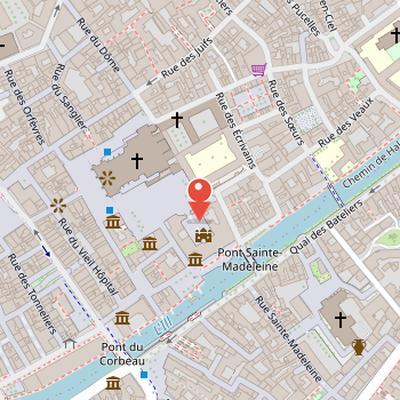
Nearby Objects
-
 Musée des Beaux-Arts de Strasbourg 10 m away
 -
 Palais Rohan 20 m away
 -
 Musée de l'Œuvre Notre-Dame 70 m away
 -
 Jubé of Strasbourg Cathedral 100 m away
 -
 Strasbourg astronomical clock 110 m away
Collections and Chronological Scope
The Musee archeologique de Strasbourg is the archaeological museum of the city of Strasbourg and is considered one of the most important archaeology museums in France in the field of Antiquites nationales, second only to the National Archaeology Museum of Saint-Germain-en-Laye near Paris. It is installed in the vast basements of the Palais Rohan. The museum presents several millennia of the ancient history of Alsace and its inhabitants, from Paleolithic origins to the early Middle Ages. Its timeline extends from the Paleolithic period to the year 800. The layout is organized around four major chronological sections: Prehistory, Protohistory, the Gallo-Roman era, and the Merovingian era.
From the Former Dominican Church to a Modern Archaeological Museum
The history of the archaeological collections in Strasbourg began at the end of the 18th century, when Jean-Daniel Schoepflin left a collection legacy to the city. The Gallo-Roman sculptures and inscriptions were first placed in the choir of the former Dominican church, where they remained for nearly one century. For a period, the collections were also housed with Strasbourg's city library and archives in the current Temple-Neuf.
From 1855 onward, the collections were supplemented by the Society for the Conservation of Historical Monuments of Alsace, which gathered archaeological objects and documents throughout the 19th century and early 20th century. During the 19th century and the first half of the 20th century, this society functioned as a regional archaeological service. The collections were almost entirely lost during the bombardment of Strasbourg in August 1870, but research later revived through the efforts of enthusiasts and Alsatian and German academics.
In 1896, the collections were installed in the basements of the Palais Rohan. Between 1909 and 1939, archaeologist Robert Forrer and F.A. Schaeffer led the institution and significantly expanded its research and publication activities. The collections now form a coherent representation of Alsace history from Prehistory to the Middle Ages. After being transferred to the city of Strasbourg in 1946, the institution created the current archaeological museum.
Museographic Renewal and Regional Role
The Musée archéologique de Strasbourg was recognized by the Ministry of Fine Arts and French Museums Inspection as one of thirty classed museums. Its collections had been built up over three centuries through the concentration of important regional antiquities in Strasbourg, and its scientific profile was strengthened by research in protohistory and Gallo-Roman archaeology. From 1946 to 1981, the museum was reorganized with Professor Jean-Jacques Hatt, a process that expanded its national dimension.
A major renovation took place between 1988 and 1992, with a complete rearrangement of the premises and presentation. The museographic approach respected the architectural framework of the end of the 19th century and highlighted the vaulted rooms of the Palais Rohan overlooking the terrace and main courtyard. Alsatian architects Claude Pache and Jean-Claude Goepp took part in the spatial arrangement, in close collaboration with the French Museums Directorate. Financial support was shared by the city, the State, and the Bas-Rhin council.
The new presentation favored simplicity and transparency in order to improve the readability of the works. It also introduced staged areas, including an excavation site reconstruction, an evocation of a Gallo-Roman house, and a polychrome reconstruction of a large relief from the Mithra sanctuary. This rearrangement allowed the museum to regain its role as a major regional synthesis museum and reinforced its position as a showcase of national archaeology near Germany and Switzerland.
A Regional Chronology of Alsace Prehistory
The collections illustrate several millennia of the history of Alsace, from the earliest traces of human occupation to the dawn of the Middle Ages. Their scope goes beyond the strict history of Strasbourg and its immediate surroundings to present a regional dimension. The permanent exhibition follows a chronological route divided into four large sections, with each period organized around major civilization facts, principal sites, and thematic approaches. Numerous objects and trilingual documentary panels support this presentation.
The prehistoric material attests to human presence in Alsace from the Lower Paleolithic. It shows that the region is in eastern France the one where the oldest human-used tools have been discovered. A central reference is the loess site of Achenheim-Hangenbieten, presented as key for the European Quaternary. Its stratigraphic sequence provides extensive information on climate, vegetation, and fauna during the major glaciations. The collections also document the first humans living alongside mammoths, elephants, and rhinoceroses during the last Wuerm glaciation, and describe a hunting camp site discovered in 1974, where animal carcasses and stone tools were found together.
Other key sites include Mutzig-Felsbourg, discovered in 1993, which broadened knowledge of the Middle Paleolithic in Alsace. Around 8000 BCE, a climate similar to the present one was established, and environmental changes altered the lifestyle of late Epipaleolithic and Mesolithic hunters. The collections then trace the arrival of new populations around 5500 BCE from Danube regions, bringing agriculture and livestock economies. Neolithic first farmers built villages with large earth and wood houses, made pottery and polished stone tools, and also worked wood, bone, plant fibers, and textiles. Habitat remains and cemeteries are represented from sites such as Reichstett, Rosheim, Bischoffsheim, Colmar, Ensisheim, Sierentz, Rouffach, and Niedernai. Together, these finds illustrate an agro-pastoral civilization developing in Alsace between 5300 and 2200 BCE.
Bronze and Iron Age Collections
The collections trace a long sequence of change in the region, beginning with the first objects in copper and bronze, which appeared around 2000 BC. They present this as the opening of a new era marked by the growing importance of metal. The Middle Bronze Age is represented through the tumulus civilization centered on the Haguenau forest and spreading across eastern France. Burial mounds in the Foret Sainte reveal metal ornaments, weapons, tools, and fine ceramics, while the Final Bronze Age shows new funerary rites in which cremation became predominant and metal use developed significantly.
The collections then move into the Celtic or Iron Age, which began around 750 BC. This civilization is described as culturally unified despite being divided into multiple regional groups. Its settlements were concentrated in fortified hill sites called oppida, which served both as seats of Hallstatt princes' authority and as refuges in times of insecurity. The collections also connect Celtic aristocratic wealth to control of Mediterranean trade routes. These routes linked Northern Europe to the Mediterranean through Alpine passes and the Rhone, Saone, and Rhine valleys, placing Alsace prominently on the main north-south axis. The traded goods included salt, amber, lignite, coral, wine, bronze vessels, and Greek and Etruscan ceramics.
Burial sites from this period reflect this wealth through precious metal and bronze furnishings, often accompanied by funeral chariots. Two notable examples are identified from Hatten and Ohnenheim in Alsace. The collections also present the Second Iron Age, or La Tene civilization, from 450 to 50 BC. In Alsace, La Tene discoveries reveal agricultural units of varying sizes. The period came to an end with the Gallic Wars and the Roman conquest in 58 BC.
Roman Strasbourg and the VIII Legion Augusta
The museum collections present Alsace as part of the Roman Empire for more than five centuries. During this period, Strasbourg-Argentorate became both the seat of military authority and the administrative center of the region, while also serving as the main supply base for Roman camps on the Danube frontier. A central theme is the VIII Legion Augusta, described as the Alsatian legion. It arrived in the region around 80 AD and remained stationed there until the end of the Empire. Its presence influenced provincial life in several ways. The legion constructed the legionary camp, supported agricultural development and land registration, and built an underground aqueduct at Kuttolsheim to secure water supply. It also created numerous roads across the region, helping to connect settlements and military sites. By attracting artisans and merchants, the legion contributed to regional economic development. Around the camp and along the main exit routes, civilian suburbs known as canabae developed, showing how military installation and urban life were closely linked.
Daily Life, Belief, and Burial in Roman and Merovingian Alsace
The collections associated with the museum present a broad view of life in Strasbourg and Alsace from the Roman period through the Merovingian era. For the vicus of Koenigshoffen, they emphasize artisanal facilities and necropolis zones, while numerous excavated small objects show daily life through ceramics, glassware, oil lamps, tools, weapons, jewelry, and toys. Funerary steles add iconography that depicts Gallo-Roman daily activities, and necropolis excavations, together with votive sculptures from Strasbourg and Alsace, illuminate funerary rites and beliefs.
The collections also document a religious landscape marked by coexistence and overlap. Celtic-origin deities are shown as living alongside Roman gods, with Mercury described as especially omnipresent and associated with Jupiter, Mars, Minerva, Juno, Apollo, Bacchus, and Hercules. Roman deities also coexisted with Gaulish figures such as Epona, Esus, Taranis, Sucellus, the Father Rhine, and Gaulish mother goddesses. The cult of Mithras, a solar god whose worship spread across the Empire from the 1st century AD, is presented as having strongly competed with early Christianity in the Late Empire.
For the Merovingian period, the collections show the extension of Alamans and Francs domination in Alsace after 451, the integration of Alsace into the kingdom of Austrasia in 532, and its status as a duchy administered by Frankish officials in 635, with Duke Etichon identified as the third duke of Alsace. Archaeological excavations also reveal continuous and dense occupation of the plain. The most recognized sites are necropolises with stone slab graves and wooden coffin burials, often arranged in parallel rows with an East-West orientation.
Despite repeated Church prohibitions until the 7th century, funerary furniture remains abundant. The collections include ceramics, glassware, weapons, jewelry, and other objects buried with the deceased, as well as a wide range of armaments such as spatha, scramasax, damascened long swords, shields, francisques, and framees. They also show the high-quality military equipment preferred by Merovingian princes, along with decorated and vermeil honorary phalerae from Ittenheim used on parade harnesses. Jewelry such as fibulae, earrings, necklaces, and bracelets made of gold, silver, bronze, and colorful stones reflects the material culture of a society organized in a pre-feudal model dominated by a warrior aristocracy, which gradually submitted to Church authority during Christianization and monastic expansion.
A Museum of Continuously Growing Collections
The Musee archeologique de Strasbourg is described as a museum that continually enriches its collections. It holds abundant furniture from archaeological excavations mandated by the Ministry of Culture, with items coming mainly from excavations in Strasbourg, the territory of the Urban Community, and much of Bas-Rhin. The museum acquires new objects every year through agreements signed between the City and the State, and these acquisitions are then integrated into the museum's displays either permanently in the rooms and showcases or occasionally in temporary exhibitions.
Among the notable material preserved by the museum are finds from the 2012 excavation at Place du Chateau in Strasbourg by INRAE. This group includes two important Roman wall paintings. They are understood to have decorated the walls of two adjoining rooms in a praetentura residence associated with the camp of the VIII legion, which housed six tribunes. The owner of the property may have been one of these tribunes from a high social class.
The first painting shows a red garland tied with a green knot on a red and black frame, and this motif is confirmed as a repeated pattern on the wall of the room. The second painting depicts a standing figure within a fictive architecture of columns and a pedimented edicule. The figure wears a cloak that leaves the right shoulder exposed and holds an object resembling a pedum in the right hand, while the object in the left hand may be a pilgrim's staff or a serpent. The museum also includes graffiti inviting to toast, written by two different hands and understood as a response or escalation between two inscriptions.
The Funerary Stele of Comnisca
Among the objects that continue to expand the museum's collections is the funerary stele of the soldier Comnisca, discovered at Koesnigshoffen. The limestone stele was found at the entrance to the Roman suburb of Koenigshoffen, in the sector of the legionary necropolis, during diagnostic archaeological excavations carried out by the Institut national de recherches archeologiques preventives before construction work.
The stele is dated to the first half of an unspecified period. Its carved scene shows Comnisca brandishing a lance while riding a rearing horse that tramples a defeated opponent. A weapons valet stands behind him. The inscription identifies the deceased as Comnisca, of Celtic filiation, son of Vedillus, and a member of the Ambiens tribe. It also states that he was a horseman of the Indian wing, part of the Celta squadron, and that he died at the age of 25 after seven years of military service.
The text further notes that Comnisca rests at the place marked by the funerary stele, which was erected by his heir according to his will.
Temporary Exhibitions and Research
Since the reopening of the museum in 1992, expositions temporaires have regularly designed and organized temporary exhibitions to present archaeological news and research results in Alsace. These exhibitions have addressed a wide range of themes, offering different perspectives on archaeology and its methods. The museum has also hosted or presented a series of earlier temporary exhibitions and collaborative displays. Among them were De Sumer a Babylone at the Bibliotheque municipale de Strasbourg in collaboration with the University of Strasbourg and the Departement des Antiquites orientales du musee du Louvre, shown from 21 January to 27 March 1982, and Emar, un royaume sur l'Euphrate au temps des Hittites, organized with the University of Strasbourg - Institut d'Antiquites orientales in 1984. Other exhibitions included 3500 apres J.-C. with artist R. E. Waydelich at Musee Archeologique in 1984, Hommage a G.F. Heintz - 50 ans d'activite archeologique en Alsace in 1985, Fouilles recentes on Geispolsheim and on a tumulus at Mussig in 1985 and 1986 to 1987, and Aux origines de Strasbourg for the bicentenary of Strasbourg in 1988. Together, these exhibitions show the museum's role as a venue for research, public presentation, and collaboration with academic and cultural partners.
Temporary Exhibitions at the Museum
The Musee archeologique de Strasbourg hosted a long series of temporary exhibitions in its salle d'expositions temporaires, while some projects were presented at the Galerie d'exposition des musees a l'Ancienne Douane and other partner venues in Strasbourg. The program covered a broad range of archaeological themes, often developed in collaboration with the Service regional de l'archeologie and other institutions. Early examples included Vivre au Moyen Age. 30 ans d'archeologie medievale en Alsace, presented from 14 May to 4 November 1990 at the Galerie d'exposition des musees a l'Ancienne Douane. In the following years, the museum hosted exhibitions such as Wolfisheim. Un village de l'Age du Fer, Mutzig. Les chasseurs de mammouths dans la vallee de la Bruche, Archéopub. La survie de l'Antiquite dans notre vie quotidienne, and Autour du Neolithique. 5500 - 2200.
The range of subjects expanded from prehistoric archaeology to Roman, medieval, and modern topics. Among the exhibitions were Strasbourg. 10 ans d'archeologie urbaine, Un reve d'eternite. Antiquites egyptiennes de la collection G. Schlumberger, Robert Forrer (1866-1947), archeologue, ecrivain et antiquaire, and Strasbourg. Fouilles archeologiques de la ligne B du Tram. Later exhibitions included Des signes et des mots. L'ecriture, des origines au Moyen Age, Tresors merovingiens d'Alsace. La necropole d'Erstein, Histoire(s) de squelettes. Archeologie, medecine et anthropologie en Alsace, and Strasbourg-Argentorate. Un camp legionnaire sur le Rhin. The museum also presented larger historical themes such as L'archeologie en Alsace et en Moselle au temps de l'Annexion (1940-1944) and A l'est du nouveau ! Archeologie de la Grande Guerre en Alsace et en Lorraine.
This recurring exhibition program shows the museum functioning not only as a site for archaeological collections, but also as a venue for public interpretation of research in Alsace and beyond. The exhibitions frequently linked local discoveries, regional archaeological services, and university or museum partners, reflecting an active role in presenting archaeological history to the public over several decades.
A Strong Publishing Program
The Musee archeologique de Strasbourg is presented as having an active publishing policy that reflects sustained research and public communication. Over several decades, it has produced and directed a wide range of collective publications in Strasbourg and beyond, covering major periods of Alsatian archaeology and history. These include works on the Paleolithic and Mesolithic, the Neolithic, the Bronze and Iron Ages, Roman civilization in Alsace, and the Merovingian period, as well as broader studies on the origins of Alsace and the history of archaeology in the region.
The museum's publication activity also includes thematic and site-based volumes. Titles mention prehistoric beginnings, early farmers, urban archaeology in Strasbourg, the archaeology of the medieval period, Roman bronzes from Alsace, and the history of museums in Strasbourg. Some publications were produced in collaboration with named scholars such as Jean Sainty, Christian Jeunesse, Jean-Jacques Schwien, Beatrice Arbogast, Annette Frey, Jean-Pierre Legendre, Isabelle Bardies, Jean-Marie Le Minor, Bertrand Ludes, Eric Boes, Francoise Schnitzler, Gertrud Kuhnle, and Michae l Landolt.
This publishing record extends from 1988 to 2013 and includes both collective works directed by the museum and books published under the museum's imprint. Several titles are listed with page counts, indicating substantial scholarly output. The range of subjects suggests that the museum has played an active role in documenting archaeological research in Alsace, presenting discoveries to a wider audience, and situating Strasbourg within regional and historical studies.
Archaeology and Heritage Management in Alsace
Professional archaeology in Alsace developed in response to the accelerated destruction of archaeological heritage caused by major works and intensive agricultural exploitation. This change permanently altered the framework of national archaeology in the 1970s and 1980s, when rescue archaeology was replaced by contractual archaeology between developers and excavation leaders. Within this system, Alsace occupies a prominent place because of its dynamic activity and the large number of projects carried out there.
The Service Regional de lArcheologie acts as the scientific and administrative authority overseeing annual excavations in Alsace. It is a decentralized service of the Ministry of Culture and Communication and operates within the Direction Regionale des Affaires Culturelles dAlsace. Under the law, the State remains the sole prescriber for archaeology. It reviews construction, demolition, and development permits linked to archaeology, defines excavation conditions and methodological principles, appoints the scientific director for each field operation, and authorizes and supervises archaeological surveys.
Several complementary actors work alongside the State. The Institut National de Recherches Archeologiques Preventives was created in 2001 as a public research institution, taking over missions previously carried out by the Association pour les Fouilles Archeologiques Nationales, created in 1993. Attached to the Ministry of Culture, it can conduct diagnostic surveys and preventive excavations ordered by the State and is responsible for the scientific exploitation of preventive excavations. Its financing comes from a levy paid by developers whose work threatens buried archaeological heritage, with the amount based on the nature of the prescribed operation.
Regional authorities also entered preventive archaeology in 2006 with the creation of the Pole d'archeologie interdpartemental rhenan by the General Councils of Bas-Rhin and Haut-Rhin. Located in specially equipped premises in Centre-Alsace at Selestat, it manages archaeological information and field archaeology issues through complementarity between territorial authorities and the State, while also conducting preventive archaeology operations and cultural mediation. Alsace also has the independent study office Antea-Archeologie, created in 1998 by a team of certified archaeologists and offering services to territorial authorities and developers who request them.
Research Partnerships and Field Training
Vers des sites partenaires is linked to several important field school projects near Saverne, which are managed by the Universite de Strasbourg through its Institut des Antiquites Nationales. These projects combine practical field training with research structuring within UMR 7044, a unit associated with the Universite de Strasbourg, CNRS, and the Ministere de la Culture. The network also includes an important associative structure in Alsace and maintains active partnerships with historical and archaeological societies.
Among its regular partners are the Centre de Recherches Archeologiques Medievales (CRAMS) in Saverne, the Societe d'Histoire et d'Archeologie de Brumath, and the Societe de Recherches Archeologiques de l'Alsace Bossue in Dehlingen. Collaboration with these organizations takes place through research projects, publications, and exhibitions. The results of excavations carried out by these partners also enrich the museums archaeological collections.
Associated Archaeological Exhibitions in Strasbourg
The Musee archeologique de Strasbourg is connected, through related references, to several cultural and archaeological institutions, including the Ministere de la Culture et de la Communication, the Institut national de recherches archeologiques preventives, the Pole d'archeologie interddepartemental rhenan, and the Societe pour la conservation des monuments historiques d'Alsace. It is also associated with the Musées de Strasbourg, including the Musee alsacien and the Musee archeologique in Strasbourg, in 1998. The museum appears in connection with a sequence of archaeological exhibitions held in Strasbourg, often with named specialists and specific dates. These include exhibitions on the archaeological excavations for tram line B in 2000, archaeology in Alsace and Moselle during the annexation of 1940 to 1944 in 2001, Merovingian treasures from the Erstein necropolis in 2004 to 2005, archaeology, medicine, and anthropology in Alsace skeleton history in 2005 to 2006, ArchEopub and the survival of Antiquity in advertising objects in 2006 to 2007, and ten years of archaeological excavations in Alsace in 2009 to 2010. Together, these references indicate the museum's role within a broader network of archaeological research, exhibition activity, and heritage institutions in Strasbourg.