The Musée des Beaux-Arts de Strasbourg is an art museum devoted to paintings. Its collections form a homogeneous group covering Italian, Flemish, Dutch, French, and Spanish artists, with Italian works ranging from the early primitives to painters of the 17th century. Paintings made after 1681 are displayed at the Musée des Beaux-Arts, while German and Alsatian paintings up to 1681 are shown at the Musée de l'Œuvre Notre-Dame.
The museum’s history began with the first municipal painting museum, founded by the arrêté Chaptal in 1801. That collection was destroyed during the Franco-Prussian War at the Aubette, including 43 paintings sent by the Louvre in two shipments. A new collection was formed starting in 1889 by Wilhelm von Bode, later continued after 1918 by Hans Haug. The collections were damaged again by city bombings in 1944 and by an accidental fire in 1947, which caused further losses but also allowed new acquisitions through insurance indemnification. Later donations in 1987, 1994, 2004, 2009, and 2019 further strengthened the holdings.
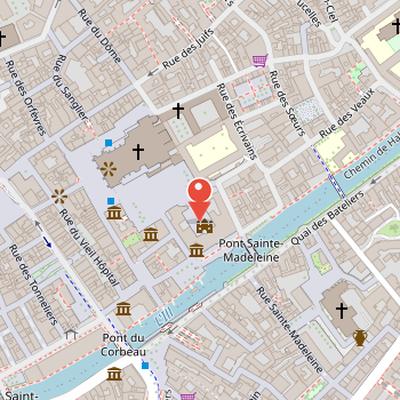
Nearby Objects
-
 Musée archéologique de Strasbourg 10 m away
 -
 Palais Rohan 20 m away
 -
 Musée de l'Œuvre Notre-Dame 60 m away
 -
 Jubé of Strasbourg Cathedral 100 m away
 -
 Strasbourg astronomical clock 120 m away
History of the Museum Collection
The Musee des Beaux-Arts de Strasbourg founded the first municipal painting museum under the Arrte Chaptal in 1801. That early collection was later destroyed during the Franco-Prussian War at the Aubette, and the entire painting collection was lost, including 43 paintings sent by the Louvre in two shipments. The first shipment arrived on 7 nivose an XI and included three paintings brought from Italy in 1797: Sainte Apolline, La Vierge and des anges by Perugin, and Saint Jean dans le desert by Guerchin. The museum also received three paintings from Belgium, including two by Jacob Jordaens, Le jugement dernier and La Vierge, l'Enfant Jesus et Saint-Joseph couronnes par les anges. Its holdings further included seven Italian paintings from royal collections by Salviati, Bassano, Correge, Carrache, Veronese, Perugin, and Dosso Dossi, as well as French and other provenance paintings by Valentin, Reni, Seghers, Savery, Ribera, Champaigne, Vouet, La Hyre, Lemoyne, De Troy, Largilliere, and Le Brun.
A new collection was constituted starting in 1889 by Wilhelm von Bode, art historian and director of the Imperial Museums of Berlin. This new collection replaced paintings by almost all principal painters lost except Perugin, and it also introduced major new artists such as Giotto, Raphael, and Botticelli. After Alsace returned to France in 1918, Hans Haug continued this work.
The collection was damaged again during city bombings on December 11, 1944, and the museum suffered a further partial loss in an accidental fire on January 23, 1947. That fire destroyed paintings by Francesco Guardi, Thomas de Keyser, Antonio Pollaiuolo, and Lucas Cranach the Elder. Insurance indemnification later made it possible to acquire other valuable paintings.
Painting Collections and Donations
The museum's collections form a relatively homogeneous group of paintings by Italian, Flemish, Dutch, French, and Spanish artists. Works are divided between the Musee de l'Oeuvre Notre-Dame, which displays German and Alsatian paintings up to 1681, and the Musee des Beaux-Arts, which presents paintings from after 1681. The collection was further strengthened through a series of donations. Italian paintings were donated by Othon Kaufmann and Francois Schlageter in 1987 and 1994. Roger and Elisabeth Eisenbeth gave Flemish and Dutch paintings in 2004, followed by Ann L. Oppenheimer, who donated Italian, Flemish, and Dutch paintings in 2009. In 2019, Jeannine Poitrey and Marie-Claire Ballabio donated Flemish, Dutch, Italian, and Tyrolean paintings.
Italian Paintings in the Collection
The Musee des Beaux-Arts de Strasbourg holds a substantial group of Italian paintings, ranging from early primitives to painters of the 17th century. The collection includes works by Giotto, Sano di Pietro, Olivuccio di Ciccarello, Carlo Crivelli, Filippino Lippi, Sandro Botticelli, Cima da Conegliano, Piero di Cosimo, Rapha l circa 1520, Lorenzo Lotto, Giovanni Cariani, Le Corr ge, Palma le Vieux, P ris Bordone, Le Tintoret and Jacopo Bassano. It also includes works by Paul V ron se circa 1584, Le Guerchin, Bernardo Strozzi, Jacopo Vignali, Francesco Cairo, Valerio Castello, Salvator Rosa circa 1670, Andrea Vaccaro, Luca Giordano, and Alessandro Magnasco from the 18th century. Among the named works are Crucifixion by Giotto, L'Enfance de saint Jean-Baptiste by Sano di Pietro, L'Adoration des bergers by Carlo Crivelli, Buste d'ange by Filippino Lippi, Vierge a l'Enfant avec deux anges by Sandro Botticelli, Le Mythe de Prom thee by Piero di Cosimo, Portrait de jeune femme by Rapha l circa 1520, L'Evanouissement de la Vierge pendant le transport du Christ by Lorenzo Lotto, Le Joueur de Luth by Giovanni Cariani, Judith et sa servante avec la t te d'Holopherne by Le Corr ge, Salvator Mundi by Palma le Vieux, C phale et Procris by Paul V ron se circa 1584, Samson et Dalila by Le Guerchin, and Paysage avec Tobie et l Ange by Salvator Rosa circa 1670. The collection also extends into the 18th century with four paintings by Giuseppe Maria Crespi, including L'Amour vainqueur circa 1695-1700, La Glorification de saint S bastien by Sebastiano Ricci, Vue de l' glise de la Salute depuis l'entr e du Grand Canal circa 1727 by Canaletto, Z phir et Flore circa 1750 by Giambattista Tiepolo, La Vierge apparaissant a saint-Laurent et a saint-Fran ois-de-Paule by Giandomenico Tiepolo, and works by Carlo Magini.
Selected Works in the Collections
The museum's collections include a wide range of paintings spanning the late medieval period to the 18th century. Among the earliest works listed are Crucifixion by Giotto di Bondone, around 1315, and L'Enfance de saint Jean-Baptiste by Sano di Pietro, from 1450. The collection also includes important works by Sandro Botticelli, Carlo Crivelli, Filippino Lippi, Piero di Cosimo, and Cima da Conegliano, as well as Judith et sa servante avec la tete d'Holopherne by Le Corrège and Le Mythe de Promethee by Piero di Cosimo. Later Renaissance and Baroque works include a Portrait de jeune femme by Raphael, Salvator Mundi by Palma le Vieux, L'Evanouissement de la Vierge pendant le transport du Christ by Lorenzo Lotto, Portrait de jeune homme by Federico Barocci, Cephale et Procris by Paul Veronese, and Samson et Dalila by Le Guerchin. The holdings also extend into the 18th century with Vue de l'eglise de la Salute depuis l'entree du Grand Canal by Canaletto and Tete de Vierge by Giovanni Battista Pittoni. The museum further holds paintings by Hans Memling, including Polyptyque de la vanite terrestre et de la redemption divine, around 1485.
Highlights of the Collection
The Musee des Beaux-Arts de Strasbourg includes a wide range of paintings spanning several periods and artistic traditions. Its collection includes works by Simon Marmion, Gerard David, Joachim Bueckelaer, Pierre Paul Rubens, Antoine van Dyck, Jacob Jordaens, Philips Lisaert IV, Gonzales Coques, Lucas van Leyden, Maarten van Heemskerck, Cornelis Cornelisz van Haarlem, Pieter de Hooch, Emanuel de Witte, Meindert Hobbema, Willem Kalf, Pieter Claesz, Albert Cuyp, Allaert van Everdingen, and Franciscus Gysbrechts. Among the works specifically named are Le Christ au Jardin des Oliviers and La Vierge a la soupe au lait by Gerard David, Portrait d'une noble Genoise by Antoine van Dyck, La Peche miraculeuse by Jacob Jordaens, L'Astronome et sa femme by Gonzales Coques, Les Fiances around 1525 by Lucas van Leyden, Le Depart pour la promenade by Pieter de Hooch, and Vanite by Franciscus Gysbrechts. These holdings indicate a collection with examples of religious subjects, portraiture, genre scenes, still life, and other forms of painting.
Notable Paintings in the Collection
The collections of the Musee des Beaux-Arts de Strasbourg include a broad group of works that range from the early 16th century to the 19th century. Among the best-known holdings is Cornelis Engelsz.'s La Garde civique de Saint-Adrien, painted in 1612 and acquired in 1895. This large painting, measuring 178 x 510 cm, was severely damaged during the bombing of Strasbourg by American aviation, and the collections were unable to protect it because of its size. After four years of restoration funded by the BNP Paribas foundation, it was displayed again.
The collection also includes several important works by Gerard David, including Le Christ au Jardin des Oliviers, created between 1510 and 1520, and La Vierge a la soupe au lait, dated to the same period and attributed to David or his workshop. Other early paintings include La Peche miraculeuse by Jacob Jordaens from around 1618 to 1620, Portrait d'une noble Genoise by Antoine van Dyck from around 1622, and L'Astronome et sa femme by Gonzales Coques from the late 1640s. Pieter de Hooch is represented by Le Depart pour la promenade, created between 1663 and 1665, while Franciscus Gysbrechts appears with Vanite from the 1670s.
The museum also holds Spanish painting, including works by Le Greco such as Portrait de la Vierge from around 1590 to 1600, and Saint Pierre et Saint Paul by Jose de Ribera from around 1616. Other notable 17th century and 18th century holdings include Musiciens et Soldats by Valentin de Boulogne, works by Philippe de Champaigne, Simon Vouet's Loth et ses filles and Le Martyre de sainte Catherine, Les cinq Sens by Jacques Linard, La Justice by Eustache Le Sueur, L'ecureuse de cuivres by Antoine Watteau, Rebecca recevant les presents d'Abraham by Francois Boucher, and Nature morte by Jean Simeon Chardin. The collection further includes works by Jean-Baptiste-Marie Pierre, Jean Barbault, Claude Joseph Vernet, Nicolas de Largillierre, and Francois-André Vincent.
For the 19th century, the collections feature paintings by Eugene Delacroix, Theodore Chassériau, Camille Corot, Theodore Rousseau, Gustave Courbet, Gustave Dore, Edgar Degas, and Paul Signac. Among the dated works are Portrait d'artiste by Francois-André Vincent, acquired in 2011, La Belle Strasbourgeoise by Nicolas de Largillierre from 1703, La Vertueuse Athénienne by Joseph-Marie Vien from 1762, Paysage avec animaux by Philippe-Jacques de Loutherbourg from 1767, and La Vallee de la Loue par temps d'orage by Gustave Courbet from around 1849. The collections also represent German and Alsatian painting between 1681 and 1871 through artists including Philippe-Jacques de Loutherbourg, Jean-Frédéric Schall, and Martin Drolling.
Notable Works in the Collections
The collections of the Musee des Beaux-Arts de Strasbourg include a work by the English painter Dante Gabriel Rossetti. The sculptural holdings feature works by Baccio Bandinelli, including Autoportrait circa 1550, as well as sculptures by Alessandro Vittoria. Among the individual pieces is a marble bust of Donna Felice Zacchia Rondanini by Alessandro Algardi, dated circa 1650. The museum also holds sculptures by Francois Girardon, a bust of Vivant-Denon by Francois Joseph Bosio circa 1810, and sculptures by Jean-Baptiste Carpeaux and Theodore-Charles Gruyere. Together, these works indicate a collection that includes examples from different artists and periods, with particular emphasis on sculpture alongside painting.