The Musée de l'Œuvre Notre-Dame is a museum in Strasbourg devoted to the arts of the Upper Rhine territories from the High Middle Ages to 1681. It is located in the historic building of the Œuvre Notre-Dame foundation near the Rohan Palace. The museum holds original sculptures from Strasbourg Cathedral, including wood and stone statues, and displays paintings, altarpieces, tapestries, Gothic architectural drawings, and stained glass from regional churches. Its collection also includes works by Konrad Witz, Hans Baldung, and Sébastien Stoskopff. A reconstructed Gothic garden with medieval plants forms part of the presentation.
The museum occupies the house called the Frauenhaus, the historic headquarters of the Œuvre Notre-Dame foundation. The building includes two symmetrical wings of different periods: a Gothic left wing dating from 1347 and a Renaissance right wing from 1579, designed by Hans Thoman Uhlberger. It also features a spiral staircase and a large entrance portal designed by the same architect. The Musée de l'Œuvre Notre-Dame was created in 1931 by merging four collections of medieval and Renaissance art of the Upper Rhine, and it reopened in near-final form in 1956 after post-war reorganization.
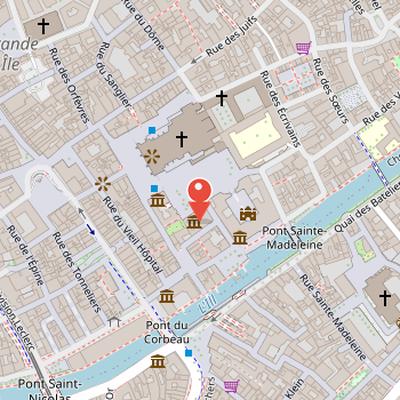
Nearby Objects
-
 Jubé of Strasbourg Cathedral 40 m away
 -
 Palais Rohan 50 m away
 -
 Musée des Beaux-Arts de Strasbourg 60 m away
 -
 Musée archéologique de Strasbourg 70 m away
 -
 Strasbourg Historical Museum 100 m away
Collections and Setting
The Musee de l'Oeuvre Notre-Dame is a museum in Strasbourg dedicated to arts from the Upper Rhine territories from the High Middle Ages until 1681. It is located in the historic building of the Oeuvre Notre-Dame foundation near the Rohan Palace. The museum holds original sculptures from Strasbourg Cathedral, including wood and stone statues, and also displays paintings, altarpieces, tapestries, gothic architectural drawings, and stained glass from regional churches. Its collection includes paintings by Konrad Witz, Hans Baldung, and Sebastien Stoskopff. The museum also features a reconstructed gothic garden with medieval plants.
The Frauenhaus at the Museumsite
The Musee de l'OEuvre Notre-Dame occupies the house called Frauenhaus, the historic headquarters of the OEuvre Notre-Dame foundation in Strasbourg. The building served as the office and residence of the receiver for the foundation, who managed construction revenues. Its Frauenhaus structure consists of two symmetrical wings of identical volume, but from different periods. The left wing is Gothic, with a stepped gable, and dates from 1347. The right wing dates from 1579 and has a Renaissance volute gable. This right wing was designed by the architect Hans Thoman Uhlberger, who also created the spiral staircase attached to the Gothic wing and the large entrance portal. During the first museum extension in 1939, two other houses were added to the rear of the building.
Formation of the Museum Collections
The Musee de l'Oeuvre Notre-Dame was created in 1931 through the merger of four collections of medieval and Renaissance art from the Upper Rhine. These included cathedral statuary, the collection of the Societe pour la conservation des monuments historiques d'Alsace, the second Musee des Beaux-Arts assembled by Wilhelm von Bode, and the Hohenlohe-Museum. The museum reopened in near-final form in 1956 after a post-war reorganization.
The history of these collections is closely tied to the Fondation de l'Oeuvre Notre-Dame, first documented in 1246. Since medieval times, the foundation preserved original architectural drawings for the cathedral, as well as sculpted elements from the building, including fragments of the jubee demolished in 1682. It also safeguarded sculptures damaged by revolutionary vandalism in 1793.
Another important source was the Societe pour la conservation des monuments historiques d'Alsace, founded in 1855. This organization conserved architectural fragments and liturgical decorations from ruined or abandoned sanctuaries in the region. The Musee des Beaux-Arts de Strasbourg also contributed material after its reorganization in 1890, when it replaced the previous museum destroyed in 1870 and included a section devoted to regional painting.
Formation and Rebuilding of the Museum
The museum's present grouping of four collections was formed in 1931, as part of a project attributed to the art historian Hans Haug, who succeeded Wilhelm von Bode. Haug is described as a pioneer of modern museography, and he designed a museum atmosphere evoking the Middle Ages and the Renaissance, modeled after the Musee de Cluny in Paris. In 1937, he reconstructed a medieval garden between the jube room and the passage that bears his name. The museum was expanded in 1939 with interior and exterior decorative elements taken from demolished Strasbourg houses, including carved wooden auricular style galleries from 1657 now placed above the Cour des Marechaux, which originated from the old marshal corporation stove demolished in 1936. After bombing caused severe damage to the building, the museum was restructured in 1946. Hans Haug's intended complete museum route was finally finished in 1956.
Architectural Drawings in the Collections
The museum's collections include the third largest architecture drawing collection in Europe, after Vienna and Ulm. They contain about thirty plans and elevations, mostly depicting Strasbourg Cathedral, as well as drawings made by master builders Erwin de Steinbach, Ulrich d'Ensingen, Jean Hult, Hans Hammer, and Bernhard Nonnenmacher. The collection also includes works deposited by the foundation of the Oeuvre Notre-Dame.
Architectural drawings have again been exhibited since 2015 in a special room with controlled climate and lighting. Because of the fragility of the material, only four drawings are displayed at any one time, with regular rotation, and the room is open for a maximum of three hours per week. The entire collection is also available in digital form in an interpretation room and on the Strasbourg museums collection portal.
The Museum Collections
The Musee de l'Oeuvre Notre-Dame presents a broad collection centered on the artistic heritage of Strasbourg and the Upper Rhine. It displays many original exterior statues removed from Strasbourg Cathedral and replaced by modern copies, including figures from the western portals such as the Tempter, the Virgins, Church and Synagogue from the south transept portal, and the Magi kings from the north arm. The collections also partially reconstruct lost cathedral monuments, including the jubee and the monumental saint sepulchre, from surviving fragments.
Beyond the cathedral, the museum shows significant late medieval Upper Rhine sculpture, among them several stone works by Nicolas Gerhaert de Leyde, including the Buste d'homme accoude. It also includes polychrome wooden sculpture, with many saint figures and sculpted groups from the 15th century, and attributes several works to Nicolas de Haguenau and other artists. The painting collection traces the evolution of painting in the Upper Rhine from the 14th century onward, with International Gothic works such as Doute de saint Joseph and Nativite de la Vierge by the Maaitre du jardinet de paradis, works by Witz and painters from Martin Schongauer's circle, Renaissance paintings by Hans Baldung Grien, and still lifes by Sebastien Stoskopff.
The museum also presents stained glass from Alsace from the 12th century to the Renaissance. Highlights include the Christ de Wissembourg panel, the Emperor in Majesty stained glass from Strasbourg Cathedral, and an Emperor stained glass from the last quarter of the 13th century showing Charlemagne clothed in red. Additional panels come from destroyed or heavily modified churches such as the Dominicans church, Saint-Pierre-le-Vieux, and Sainte-Madeleine. The museographic route also integrates antique furniture according to Hans Haug's legacy, including monumental Renaissance-style armoires from the 16th century, as well as two Strasbourg tapestries showing Saint Odile and Saint Attale from Saint-Etienne Church. A small collection of goldsmith works completes the display, including silver pieces such as conical drinking cups and a grape-shaped hanap from the 16th century, reflecting a local craft tradition that was once extensive in Strasbourg.
The Medieval Garden
The Jardin medieval was created in 1937 by Hans Haug and is inspired by the tradition of painters and engravers of the Middle Ages. Its design follows the precepts advanced by theologian Albert le Grand in De vegetalibus libri septem, historiae naturalis pars XVIII. The garden contains plants already present at the end of the Middle Ages, arranged in nine squares grouped into three beds: ornamental plants, medicinal plants, and aromatic and condiment plants.
The site also includes several historical and sculptural elements. On the south side there is a collection of funerary slabs, with a funerary slab of Lichtenberg from 1471 placed at the center. A Romanesque baptismal font stands near a contemporary work, Les Cimetières des naufragés, a slab installed in 1988 by Scottish landscape artist Ian Hamilton Finlay. The garden is further composed of groves, a linden tree, a trellis, and a small stream.