The Strasbourg astronomical clock is located in the Notre-Dame Cathedral of Strasbourg and is associated with several successive mechanisms built over time. The first clock, known as the clock of the Three Kings, was constructed between 1352 and 1354 by an unknown master. It displayed the three Wise Men before the Holy Family every hour, but it stopped functioning at the beginning of the 15th century because of wear and rust. A polychrome wooden and wrought iron automaton rooster from this early clock, made around 1350, is preserved in the clockmaking room of the Musée des arts décoratifs de Strasbourg and is described as the oldest preserved automaton in the West.
The second clock was designed in two phases between 1547 and 1574. Initially conceived by the mathematician Christian Herlin, it was completed after his death by Conrad Dasypodius, working with the Habrecht brothers, Isaac Habrecht, and the painter Tobias Stimmer. This planetary astronomical clock showed the movement of the planets on an astrolabe, included a perpetual calendar indicating movable feasts, displayed upcoming eclipses on painted panels, and featured a portrait of Copernicus. In the 19th century, Jean-Baptiste Schwilgué transformed the clock. A self-taught Alsatian who also worked as a clockmaker, mathematics professor, verifier of weights and measures, and entrepreneur, Schwilgué had long wished to repair the clock, a goal that guided much of his life.
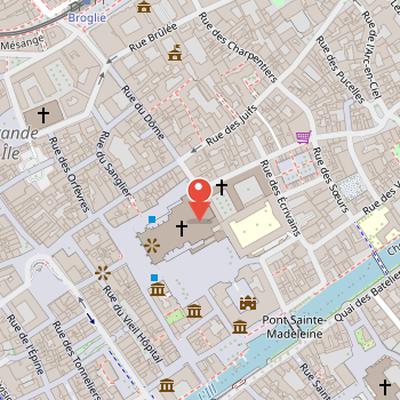
Nearby Objects
-
 Cathedral of Our Lady of Strasbourg 30 m away
 -
 Argentoratum 90 m away
 -
 Place de la Cathédrale 100 m away
 -
 Musée archéologique de Strasbourg 110 m away
 -
 Palais Rohan 110 m away
Location in Strasbourg Cathedral
The astronomical clock is located in the Notre-Dame Cathedral of Strasbourg. It forms part of the cathedral setting and is identified as the Strasbourg astronomical clock. The available information does not provide further details about its design, history, or construction, but it establishes the clock as a feature within one of the city's best known religious buildings.
The first Three Kings clock
The first clock named the Three Kings was constructed between 1352 and 1354 by an unknown master. Every hour, it displayed the three Wise Men before the Holy Family. The mechanism stopped functioning at the beginning of the 15th century because of wear and rust. A polychrome wooden and wrought iron automaton rooster associated with this first clock was made around 1350 and is now exhibited in the clockmaking room of the Musee des arts decoratifs de Strasbourg. It is described as the oldest preserved automaton in the West.
The Second Astronomical Clock
The second astronomical clock was designed in two phases between 1547 and 1574. It was initially conceived by the mathematician Christian Herlin, who died before completing the project. His disciple Conrad Dasypodius then took over the work, collaborating with the Habrecht brothers and Isaac Habrecht, as well as the painter Tobias Stimmer.
The clock was built as a planetary astronomical clock and showed the movement of the planets on an astrolabe. It also contained a perpetual calendar indicating the duration of movable feasts. In addition, upcoming eclipses were displayed on painted panels. Among its features was a portrait of Copernicus, which survived the period of Galileo's trial. The current heliocentric representation did not belong to this second clock, since it appeared only in the 19th century with the third clock.
Jean-Baptiste Schwilgue and the Clock's Transformation
Jean-Baptiste Schwilgue transformed La deuxieme horloge. An Alsatian self-taught man, he apprenticed as a clockmaker and later became a professor of mathematics, a verifier of weights and measures, and an entrepreneur. From a young age, he wished to repair La deuxieme horloge, and this goal became the guiding principle of his life. His work on the clock reflects both his technical training and his long-standing personal commitment to restoring the mechanism.
The Schwilgue clock and its ecclesiastical comput
La troisieme horloge, associated with Schwilgue, consists of new mechanisms placed in the case of the second clock dating from the 16th century. It has new dials and remains conservative in its functions compared with the old Schwilgue clock, although it also includes the procession of the Apostles, a function that did not exist before. In overall operation, it performs the same functions as the Dasypodius clock, but in a different way.
A central feature is its comput ecclesiastique, which determines the movable feasts of the coming year at the end of each year. This comput can be considered a perpetual calendar, provided that it is regularly wound and maintained. The clock follows the rule for Easter date calculation defined at the Council of Nicaea in 325: Easter is calculated as the Sunday following the 14th day of the Moon falling on or after March 21. It was also adapted to changes introduced by the Gregorian calendar in 1582, which modified the dates of the Easter full moon and the calculation rules.
The clock was the first to translate Gregorian Easter calculation mechanically in 1821, based on a prototype made in 1816. That prototype disappeared during World War II and resurfaced in 2021, when it was given to the Strasbourg Cathedral parish. The mechanism of the prototype appears enlarged at the bottom left of the current clock. The term comput ecclesiastique means the Church's calculation, and it is not a computer, even though the root comput is related to computer. A smaller model was built by Frederic Klinghammer in the 1970s, and later astronomical clocks, including those in Copenhagen, by Daniel Vachey, and in Chauvin, adopted computs inspired by this clock, though not always with Easter date determination.
Design and Mechanical Features of the Third Clock
The third clock, made by Schwilgue, was constructed while he invented tools to improve precision and maintenance. Its mechanism used flat or squared gear teeth on the second clock, and Schwilgue also used epicycloid-curved teeth to ensure minimal friction and constant force. To produce these teeth, he created tools and machines specifically for that purpose. He also integrated the precession of the equinoxes into the globe representation, although the gear mechanism precision was not measured on the globe position. In addition to the main mechanism, Schwilgue designed automata that moved at quarter hours, hours, and noon. The clock time was set to civil time minus 20 seconds, while the winter time was set to mean Strasbourg time minus 1 minute and the summer time to mean Strasbourg time plus 1 hour.
Automata and Time Displays
The third clock, designed by Schwilgue, combined elaborate automata with a wide range of time displays. At each quarter hour, an angel struck a bell, a second angel turned an hourglass, and a figure from among four paraded before Death. These four figures represented the ages of life: child, young man, adult, and old man. The clock also made twelve apostles pass before Christ each day at local noon, or 12:30 in winter time. During this procession, a rooster crowed and flapped its wings at the passage of the third, sixth, and ninth apostles. This rooster predates the apostles and does not refer to Peter's denial. Beyond these animated scenes, the clock indicated official time as well as mean time, day, month, year, zodiac sign, lunar phase, and the positions of the planets up to Saturn. It also showed the position of the Moon.
Ownership and Maintenance
The astronomical clock belongs to the State, together with the cathedral. Questions about its ownership were raised around 1910, when access became paid at noon. Ignaz Fahrner studied the issue and concluded that the Fabrique could levy a tax on it, while considering the clock to be State property rather than property of the Fabrique.
Its maintenance history shows several successive arrangements. From before 1946, the Oeuvre Notre Dame maintained the clock under contract with Schwilgue. Responsibility later shifted to the Fabrique de la cathedrale de Strasbourg because of payment issues, and since 1946 the Fabrique has paid for its maintenance. The Ungerer company maintained the clock from 1858 to 1989. Alfred Faullimmel was the official maintainer from 1989 to 2001, and since 2001 Ludovic Faullimmel has been responsible for maintenance.
Since 2006, the clock has been supervised by a committee dependent on the Fabrique de la cathedrale. In 2014, this supervisory committee had specific members, reflecting the continued administrative attention given to the clock's care and oversight.
Related Installations and Memorial Circles
Around the astronomical clock, the cathedral wall opposite the current clock includes a large circle commemorating the former largest bell of the cathedral. This circle dates from about 1700 and formerly contained the clapper of that bell, although the clapper has disappeared long ago. Between 2015 and 2018, the circle was partly covered by a temporary installation by Sylvie Lander.
The cathedral also displayed Ex Tempore, a glass tondo by Sylvie Lander, in the south transept where the first astronomical clock stood in 1352. It was inaugurated as part of the Strasbourg Glass Biennale and marked the thousand years of the Foundations of Notre-Dame de Strasbourg. Ex Tempore is a painted glass work reproducing a photograph of Conrad Dasypodius's astrolabe from 1574, taken at the Museum of Decorative Arts. It resulted from a study on depth and refers iconographically to the time shown by the clock and to the end of time, with Christ judging the living and the dead. The work was removed from the cathedral in May or shortly thereafter.